Showing posts with label Mainstream Jazz. Show all posts

Saturday, September 2, 2017

Bobby Hackett With Vic Dickenson: Live at the Roosevelt Grill


If I have to pick one trombone player whose playing embodies both the tradition and a rare timelessness that would be Victor Dickenson (1906-84).

Celebrating that artful master of melancholic humour, here is a tape worth listening to from the David W. Niven collection. Recorded live in 1970, Bobby Hackett Quintet, featuring Vic Dickenson, plays one of its regular nights at the Roosevelt Grill, located inside The Roosevelt Hotel in New York City.

The place was opened in 1924 and later became synonymous with Guy Lombardo whose orchestra performed there for nearly three decades. It was only a year before Roosevelt Grill was used as one of the locations for the copper movie The French Connection that jazz critic Whitney Balliett caught up with Hackett and Dickenson one late evening:

"My head full of cute muted trumpets and toy-soldier rhythms [of Sy Oliver band], I went over to the Roosevelt Grill for the final moments of Bobby Hackett's quintet, which will soon be dissolved when Dickenson replaces Kai Winding in the World's Greatest Jazz Band and the rare Benny Morton replaces Dickenson in Hackett's group. Hackett and Dickenson together are Jack Sprats of jazz. Hackett is cool, golden and mathematical, and Dickenson is hot, shaggy, and funny, and between them they encompass most of what is worth knowing about jazz."

Tuesday, July 22, 2014

Count Basie at the Organ


I think it was John Hammond who once complained about one of the most stylish jazz pianists of all time being too shy to play piano. Of course, he was talking about Count Basie, the master of minimal (dubbed as economical) piano in the big band era. Still, I must say, comparing to Basie's organ recordings - which is the subject of this post- his piano work can be considered superabundant. Basie and organ is a beautiful but rare pairing.

Here, I'm trying to showcase his mastery at the organ from six 1952 sessions.

Before anything, I must return to some facts: Basie learned organ from Fats Waller and had a short career as the silent film accompanist. His first known recording at the organ dates back to 1939, when he accompanied Jimmy Rushing on Nobody Knows.

"Basie economized Fats' style," argues Geoff Alexander, "[he] had a sparse and 'jumping' feel to his playing, and I think influenced later organ players such as Wild Bill Davis, Milt Buckner, and Jackie Davis as much with the sound of his band as his playing."

From the early 1950s, when due to financial issues, the size of Basie orchestra drastically shrank, the small group became a favorite format. For these small group recordings, thanks to Norman Granz, Basie revisited organ almost a decade before it turned into a best-selling instrument. (In that regard think of Jimmy Smith, Jack McDuff and many others who came to prominence in the 60s.)


In 1952, Basie took the organ seat on various occasions, some under his own name as leader, and with Oscar Peterson appointed as the piano man, and at least one session under Illinois Jacquet's name, when Basie was simply minding his own (glorious) business on the organ.

These sessions, at some point released by Verve as Basie at the Organ, are examples of Basie's "cool rage", if one borrows from the Jacquet's tune that Basie plays on the side B of the LP. By "cool rage" I mean, tense but flowing; conveying a wide range of emotions but always remaining in absolute control of itself.

The eleven tracks reissued on the VLP 9074 can be heard here:

Thursday, September 12, 2013

Bud and Buddy: Two Beautiful


If you are a regular visitor, you've probably noticed that recently the sound archives of David W. Niven (no relation to the charming actor, nevertheless a charming collector) and the writings of Whitney Balliett have been the focus of this blog. I hope you're enjoying this feast as much as I do.

This week's edition presents a recording from my favorite format in jazz, "A Meets B", in this case, two ténor extraordinaire meeting gently, passionately and unforgettably: Bud Freeman and Buddy Tate.

This is a live date recorded at the New Orleans Jazzclub, Holland, on March 31, 1976. Released by RIFF and also Circle on vinyl.

The local rhythm section is consisted of pianist Chris Smildiger, bassist Koos van der Sluis and drummer Ted Easton.

Thursday, September 5, 2013

Cootie, Rex and Hawk: Together


The year is 1957, and the session, one of the most enduring in jazz history. If you like cinema, an analogy can be made between this session and a film called RoGoPag, directed by Roberto Rossellini, Jean-Luc Godard and Piere Paolo Passolini. The session is simply called Together, alluding to the mere excitement of putting together the cream of Mainstream musicians under one roof and they blow with such versatility and ease. The Rosellini of the session is Coleman Hawkins, it's Godard, Cootie Williams, and Rex Stewart being its PPP.

For the list of other musicians supporting the Three Musketeers scroll down the page to see a scan of the liner notes, penned by no one but Monsieur André Hodeir (The LP came out in France.)

The audio file's from David W. Niven's vault, accompanied by his commentary (info mostly comes from the liner notes) between the tracks.

Friday, January 25, 2013

Rollin' Around the Horn: Hawk, Dizz, Getz, Mex


Rollin' Around the Horn
Nat Hentoff's Liner Notes for
Sittin' In (Verve/Clef)

About 6 a.m., a few days before the July 4, 1957 weekend, three tenors, a trumpet and a rhythm section convened in a New York recording studio. They left about five hours later - and this is the result. It marks the first time that Coleman Hawkins, Paul Consalves, and Stan Getz have ever recorded together. It's also a reunion between Dizzy and Hawk. They were responsible for an historic date in 1944 at which sessions titles like Woody n' You and Disorder at the Border were recorded. It was musically an important early modern jazz event but also was a rare graphic indication for that warring time that the “bop" movement was not a break with the jazz tradition; for after all, Coleman Hawkins had Dizzy on his date.

“I never worry about styles noway,” Coleman said recently. “I like to get fellows together that play.” Coleman approves of both his reed colleagues on this session, and adds: “You know Paul’s been playing a long time and deserves a lot more credit than he’s gotten."

“Paul,” Stan Getz commented on the session, “plays a ballad that's just beautiful. His ballad playing on the date gassed us all. I've always loved the way Coleman plays; he’s always had his own style, his own way. His work has lucidity and freedom. He seems to just roll around the horn and his sound is so full.”

Saturday, November 12, 2011

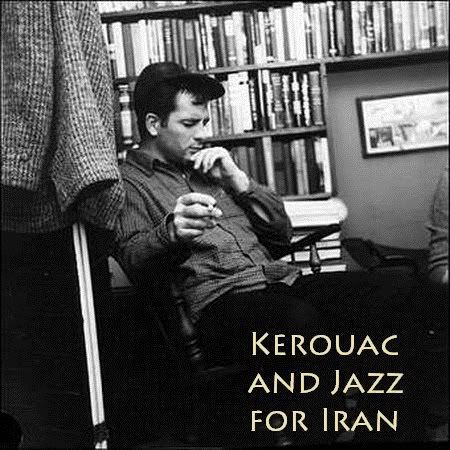
Radio Hawkins#13: On the Road with Kerouac

 برنامۀ سيزدهم
جك كرواك و موسيقي جاز
مجموعه قطعاتي از موزيسين هاي محبوب جك، كاري كه به اسم خود او نوشته و اجرا شده. اشعار او با صداي خودش و با صداي آلن گينزبورگ و مروري بر موسيقي بي باپ كه جك شاهد عيني تولد و اوج گرفتن آن بود
همراه با
لستر يانگ، برو مور، كانت بيسي، جرج شيرينگ، ساني استيت، فليپ فليپس، چارلي پاركر، ديزي گيلسپي، تلانيوس مانك

به برنامه سيزدهم در اين جا گوش كنيد


با كيفيت متوسط و متناسب با سرعت اينترنت ايران در اين جا

Tuesday, June 28, 2011

A Guide to Best Jazz Scores for Cinema#3

15 
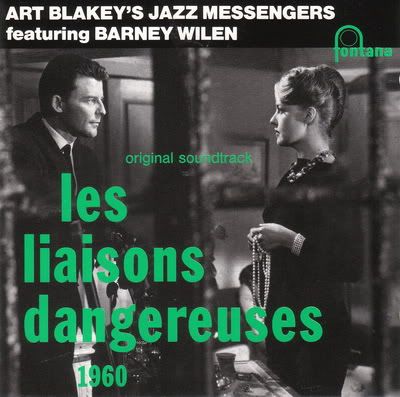
Art Blakey and Barney Wilen
Les Liaisons Dangereuses 1960
1959
Roger Vadim

Musicians: Lee Morgan, trumpet; Barney Wilen, tenor sax, soprano sax; Bobby Timmons, Duke Jordan, piano; Jymie Merritt, bass; Art Blakey, drums; John Rodriguez, bongos; Tommy Lopez, Willie Rodriguez, congas. In party sequence: Charlie Rouse, Barney Wilen, tenor sax; Thelonious Monk, piano; Sam Jones, bass; Art Taylor, drums. Appearing as themselves: Kenny Dorham, trumpet; Barney Wilen, tenor sax; Duke Jordan, piano; Paul Rovere, bass; Kenny Clarke, drums.

Listen to No Problem, composed by Duke Jordan, from the soundtrack:


14
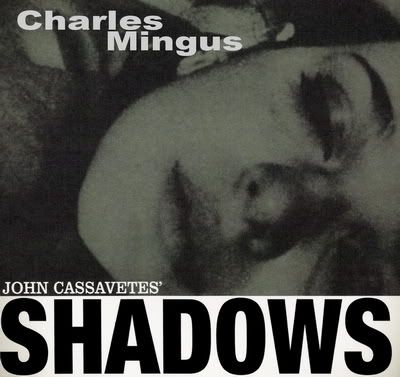
Charles Mingus and Shafi Hadi
Shadows
1958
John Cassavetes

Musicians: Shafi Hadi (Curtis Porter), sax solos; (possibly) Anthony Ortega, reeds; Jimmy Knepper, trombone; Phineas Newborn Jr., Horace Parlan, piano; Charles Mingus, bass; Dannie Richmond, drums.


13 
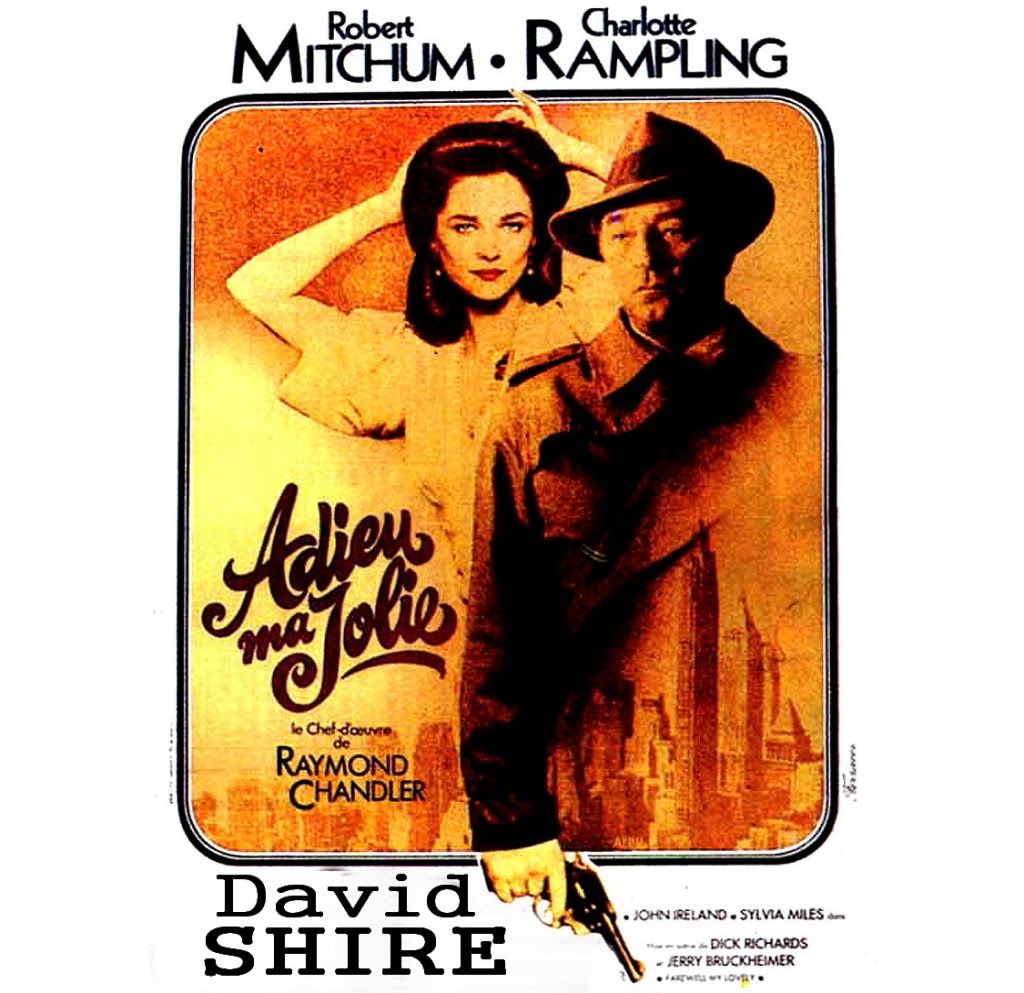
David Shire
Farewell My Lovely
1975
Dick Richards

Musicians:Cappy Lewis, trumpet; Dick Nash, trombone; Ronnie Lang, alto sax; Justin Gordon, clarinet, tenor sax; Don Menza, soprano sax; Artie Kane, piano; Al Hendrickson, Tommy Tedesco, guitar; Chuck Domanico, bass; Larry Bunker, drums; Emil Richards, percussion.

Main title music, aka the Marlow theme:


12
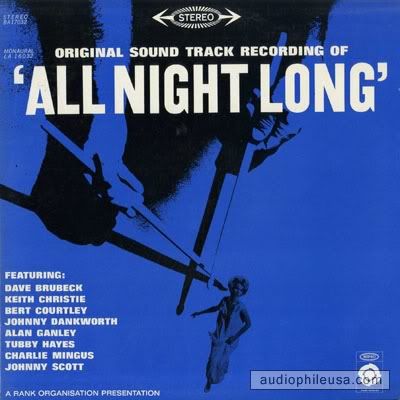
Philip Green
All Night Long
1962
Basil Dearden

Musicians: Bert Courtley, trumpet; Keith Christie, trombone; John Dankworth, alto sax; Johnny Scott, alto sax, clarinet, flute; Tubby Hayes, tenor sax, vibraphone; Colin Purbrook, Dave Brubeck, piano; Ray Dempsey, guitar; Kenny Napper, Charles Mingus, bass; Allan Ganley, drums; Barry Morgan, bongos, timbales.Allan Ganley coached and ghosted drum routines for actor Patrick McGoohan.

From the soundtrack, Brubeck plays It's a Raggy Waltz:

11 
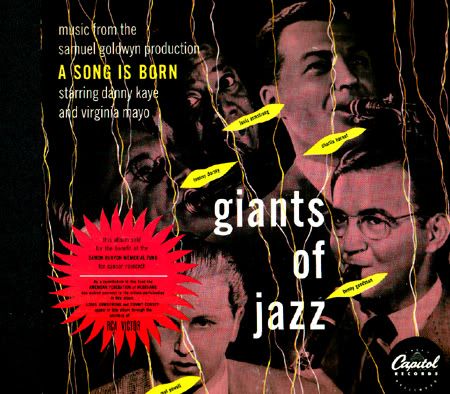
Emil Newman/Hugo Friedhofer
A Song Is Born 
1947
Howard Hawks

Music Orchestrated by Sonny Burke and Neal Hefti. 
Musicians: The Charlie Barnet Orchestra including Jimmy Salko, Jimmy Campbell, Everett McDonald, Chico Alvarez, trumpet; Freddie Zito, Phil Washburn, Herbie Harper, trombone; Charlie Barnet, Bob Dawes, Jack Henerson, George Weidler, Warner Weidler, Frank Pappalardo, reeds; Bob Bain, grt; Don Tosti, bass; Dick Shanahan, drums.
Lionel Hampton and his Orchestra, including Jimmy Nottingham, Kenny Dorham, trumpet; Britt Woodman, trombone; Bobby Plater, Charlie Fowlkes, reeds; Milt Buckner, piano; Billy Mackel, guitar; Joe Comfort, bass; Earl Walker, drums.
Tommy Dorsey Orchestra , including Charlie Shavers, Ziggy Elman, trumpet; Corky Corcoran, Marty Berman, reeds; Tony Rizzi, guitar; Louie Bellson, drums.
Encyclopedia combo including Benny Goodman Benny Goodman, clarinet; Lionel Hampton, vibraphone;
Mel Powell, piano; Al Hendrickson, guitar; Harry Babasin, bass; Louie Bellson, drums. 
Louis Armstrong and Lionel Hampton Band including Vic Dickenson, trombone; Barney Bigard, clarinet; Benny Carter, alto sax; Phil Moore, piano; Lionel Hampton, vibraphone; Laurindo Almeida, guitar; Charlie Drayton, bass; Zutty Singleton, drums.


Return to Part 2                                                      Go to Part 4

Tuesday, February 22, 2011

George Shearing: Conceptualize the World Through Sound


"Being born blind, there was nothing for me to get used to about blindness, because it was there from the start. I didn't know, and still don't, what having sight is like, but from earliest childhood I've also been aware that there isn't such a thing as a blind world. There's a sighted world to which all blind people have to adapt and adjust. In due course, as an adult, I eventually came to the conclusion that even if I were offered the chance of sight, I would refuse it, because it would be so shattering to see everything around me that I had only known as sounds up until that point.

I'd have to go through a whole new process of education, because everything from reading or writing is entirely different. I'm used to hearing cars go by, not to seeing them flash in front of my eyes. There are things I'd love to be able to do, such as to get up from a group of friends and say, "I'll see you guys later on," and mean exactly that.

Maybe we miss a lot, but for the most part that's more than made up for by what we have to replace sight – the ability to conceptualize the world through sound, or our other senses, and the close connection with all those other people who help us get our bearings in unfamiliar surroundings, whatever they may be. Living in a world in which sound plays the most important role has always been a great stimulus to me as a musician." ~ Sir George Shearing


Just a day after my arrival to London, and while I was totally confused by the underground labyrinth of it, came the news of George Shearing's death. It was the third unfortunate occurrence in a row, all happened in less than 24 hours. After overcoming the feeling of being a Cassandra, and after getting acquainted to Tube, and while my discovery of stations and streets was accompanied by Complete Live Capitol Recordings of George Shearing, on my iPod, now I've found myself again, and here is a belated tribute to the man:

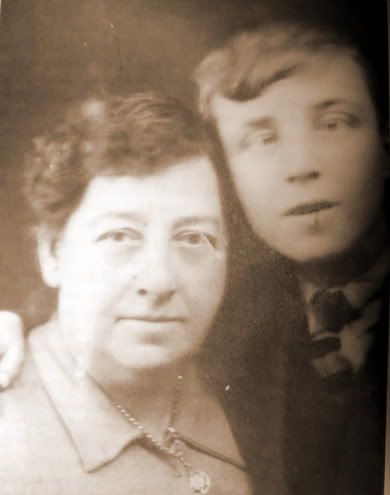
Young George with his alcoholic mother

Londoner George Shearing (born in 1919) was blind from his birth, and was a pianist from early childhood. Coming from a poor family of nine, he attended Linden Lodge School for the Blind [photo on the right] during the early 1930s. His first paid work was at a South London pub, the Mason's Arms, then played in Claude Hampton's National Institute for the Blind Band (1937). Did first solo broadcast in February 1939. Resident at the Nut House, London, from summer of 1939. Briefly in South Wales, then gigged with Stephane Grappelli before playing solo residency at the Starlight Club, London (spring 1940). Joined St Regis Hotel Quintet which was subsequently led by Harry Parry (1940), also worked at Hatchett's Club, London, with Stephane Grappelli and Dennis Moonan. I never forget the story told by Grappelli about how George lead them to their hotel room, during blackouts of night bombings of London in war days. The idea of a blind man, guiding other fellow musicians among the fog and ruins is the to the world of George Shearing music. At this stage Shearing was under the influence of Art Tatum, Fats Waller and Teddy Wilson.


Shearing with George Evans, Harry Parry then joined Ambrose's Octette from July 1941 until April 1942. Toured with Stephane Grappelli Swingtette (1943) and played night clubs, then joined Frank Weir (1944), later (1946) becoming part of Weir's two piano set-up (alongside
Ralph Sharon). Joined Harry Hayes from July to November 1946, then visited the USA for four months. Returned to Britain, again toured with Stephane Grappelli (April 1947).
On piano-accordion and piano with Frank Weir (summer 1947), then emigrated to the USA in November 1947. This geographical change caused a certain change in his music, too: Shearing who always was a swing-style player quickly adopted much of the bebop vocabulary. Though his way of playing bop has a reserved, and gentle touch. "Who needs an English Art Tatum?" says Shearing about adopting his new styles in interview with pianist Billy Taylor. And that's true. Think about hundreds of imitators who has gone with the wind and there is no trace of them anymore, especially when you're not originally an American product. Later, he added a Latin flavor to his music, which this piece could be an example of that:

Cool Mambo


In 1949, Shearing formed a quintet with a suitably soft instrumentation: vibraphone, amplified guitar, piano, bass, and drums (usually restricted to brushes). His quintet arrangements included locked-hands voicings with the vibraphonist doubling the top note and the guitar doubling the bottom. This "Shearing sound" was extraordinarily successful; it is the sound by which many fans identify him even today. “What many people didn't know about George was his courage," remembers John Levy, his bassist and manager, in an interview with Marc Myers, "in 1949, this guy had formed an integrated group with two white guys, two black guys and a white woman on stage together. Today, this might seem like so what. But back then, you just didn't do that, especially in some cities. Many people told George that he’d do better if all of his were white. He didn’t know what they were talking about. He’d get pissed and say, 'I don’t know what color they are. All I know is that they play what I like to hear and I love their intonation.' Only a few people had the nerve to come up to him and say stuff like that."

From this period Lullaby of Birdland and Conception became jazz standards. Even Miles Davis did his version of Conception, although Shearing recently complained that Miles got the bridge wrong!


From 1970s, Shearing abandoned the quintet format, thereafter worked with own trio and in duos with various double bassists as well as being featured with large orchestras. He has recorded many albums with jazz singers, including Nancy Wilson, Mel Torme, Carmen McRae, Dakota Staton, Peggy Lee, and Nat Cole.

With Nancy Wilson - On Green Dolphin Street


We know that how many critics have essential problems with easy-swinging and those pianist who have pure rhythmic/melodic approaches, like George Shearing. In one of the most famous anti-Shearing articles, Martin Williams wrote:

"What Shearing was and is doing is popularizing modern jazz to a widespread success. I am not absolutely sure that musical popularizers are a reviewer's business. They do introduce large numbers of people to a musical style—at least so I am told. But for every listener who moves on, hundreds of others stay with the popularizer; one of the originators of modern jazz, Dizzy Gillespie, had a good audience before Shearing arrived, but Shearing has a larger audience than Gillespie has or probably ever will have. In any case, popularizers always appear and are always going to appear.
However, there are popularizers and popularizers. One of Benny Goodman's functions was to spread a music that Fletcher Henderson had evolved several years before and do the same for some of Count Basic's pieces as well. Goodman contributed more than merely that, to be sure, but his treatment of Henderson's style involved no particular compromise or dilution.
I suppose that if popularizers become a constant preoccupation, a reviewer will be wasting a great deal of time. And at worst he may end up making them the objects of a kind of snobbish abuse. On the other hand, a reviewer probably should discuss
them from time to time to describe what he feels they are up to and to say how much compromise and dilution he hears in their work."

Thanks to Williams himself, who gives us the right words for it, - "snobbish abuse" - one can argue that all rock 'n rollers are popularizers of Robert Johnson, and they are audience-stealers, hence it's a waste of precious time for a critic, to take them seriously. Later he argues:

"As a pianist, Shearing is able and fluent, although as a jazzman he has occasional problems with phrasing and swing. More important, he is capable of a lot more inventiveness than he usually offers. And it seems to me that his basic compromise is to play as if he were not really emotionally involved with what he is doing, even when he allows himself to do something musical."

Well, isn't Basie that way? Looked untouched on the surface, but driving a group like the jet motor, in the moment of take off.


Beside music, Shearing's charm, humbleness and nobility rank him with the best pianists in history of jazz, like Hank Jones. One of the great pleasures of listening to his live recordings comes from his sense of humor. He has a witty introduction for almost every tune. Here is an example:


And finally, from Mosaic out-of-print boxed set, Complete Live Capitol Recordings of George Shearing, give a listen to The Nearness of You with Vibraphonist Emil Richards, guitarist Toots Thielemans, bassist Al McKibbon and drummer Percy Brice. Recorded at Hollywood Sunset Strip , 1959. It's a seminal tune that summarizes his grace, touch, swing and the way he visualized the world through sounds and tones.

The nearness of you


Sources (and Further Reading):
Who's who of British jazz /John Chilton.-2nd ed.
Jazz changes/ Martin Williams/ pp 279 - 281
Lullaby of Birdland/ George Shearing (written in collaboration with Alyn Shipton)/ This autobiography was published in 2004.

Monday, October 25, 2010

Ben Webster: Stomping Love

Nat Hentoff Original Liner Notes: Ben Webster's Soulville,1957


Johnny Griffin, one of the more venturesome of the "modern" tenors, was talking recently with Don Gold of Down Beat concerning those nonpareil jazz players who never become dated. On his list were Coleman Hawkins and Ben Webster. “Ben is phenomenal. These guys can come and play with the young cats and still fit in. These guys — like Hawk and Ben - are living legends.”

Wednesday, June 23, 2010

Babe Russin: Hello, Goodbye, Forget It


A new interest, a historical obsession and a sense of discovery, regarding the unsung heroes of jazz has been awakened in me since hearing this Mr. Babe Russin, a prolific tenor sax player with a warm swinging sound, close to what you hear from cats like Flip Phillips.

Irving "Babe" Russin (June 18, 1911 - August 4, 1984) was born in a musical family in Pittsburgh, Pennsylvania. His pianist brother was already playing in Red Nicholas band that Babe began playing professionally with the California Ramblers in 1926, Smith Ballew Orchestra, 1926-27, when he was only 15 years old. Working on and off with Red Nichols, from 1927 to 1933. He toured in Europe in 1928. His relationship with Nichols was interrupted by a run with the Ben Pollock combo. Russin became a staff musician for the CBC network in the '30s, but grew restless for music with some solo space and took an offer to work in the Benny Goodman band. A member of Goodman orchestra in legendary Carnegie Hall concert. Even there is a note of a brief join up with Count Basie Orchestra (any information regarding this Basie affair will be welcomed) Later, he joined the Tommy Dorsey band, then led his own outfit in the early part of the '40s, working out of Florida as well as New York City. His next stop was Glenn Miller's orchestra, where he soloed in the recording the Glenn Miller band made of Jerry Gray's composition, A String of Pearls for Bluebird Records in 1941 - a hit song. With Tommy Dorsey, 1942-43, and with Jimmy Dorsey's band from 1942 to 1944, then played in an armed forces band through the second World War. In the late '40s he patched things up with Goodman.

Babe Russin (middle), Trummy Young (left), Barney Bigard (right)

He appears briefly in the 1953 movie, The Glenn Miller Story. Plays on the soundtrack to the 1954 A Star is Born. He also appears in the The Benny Goodman Story, a 1956 bio-pic jazz film about his old pal.
As he got older, he preferred the life of a studio musician in California, although reunions of the Goodman band would often include him in the saxophone section. He has one album, under his name, for DOT records label, To Soothe the Savage (1956), which I have no trace of . He was still in business till 70s, when he was touring in the new nostalgic big bands, playing in European jazz festivals. He was highly influenced by Coleman Hawkins but playing in the most famous swing bands of the 20th century redirect his blowing to a more soft, swinging way.


A quick inquiry at my catalog of jazz recordings, revealed that his name is repeated over a period of 30 years, in numerous records, including with these artists:

Miff Mole, 1929.
Red Nichols, late 1920s, early 1930s.
Jack Teagarden, late 1920s, early 1930s.
Bunny Berigan, 1930s.
Lester Young, late 1930s.
Roy Eldridge, 1935-40.
Lionel Hampton, 1930s to 1940s.
Billie Holiday, late 1930s, early 1940s.
Benny Carter, mostly 1940s.
Louis Armstrong, late 1940s, early 1950s.
Jess Stacy, 1954.

His fruitful singers period in the late 1940s and all of the 1950s with:
Frank Sinatra
Sarah Vaughan
Dinah Washington
Ella Fitzgerlad
Mel Tormé

And now, let's hear him from a V-Disc recording (though it's after war) by Jimmy Mundy, waxed in late March 1946 in Los Angeles, called Hello, Goodbye, Forget It. First sax solo belongs to Babe. Other musicians are:
Trumpet section - Clyde Hurley, Ray Linn, Walter Williams, McClure Morris.
A superb trombone section - Juan Tizol, Britt Woodman, Henry Cocker, Vemon Brown.
Alto sax - Willie Smith, Les Robinson.
Baritone Sax - Dick Clark.
Piano - Milt Raskin
Guitar - Irving Ashby
Bass - Art Shapiro
Drums - Ray Hagen

Sunday, May 16, 2010

Classics 928: Louis Armstrong 1944-46

Classics 928
Louis Armstrong
1944-1946
Release Date: 1997
Rating: A

Other notable musicians in this CD: Roy Eldridge, Jack Teagarden, Coleman Hawkins, Art Tatum, Oscar Pettiford, Dexter Gordon, Bobby Hackett, Johnny Guamieri, Herb Ellis, Charlie Shavers, Jimmy Hamilton, Johnny Hodges, Don Byas, Billy Strayhorn, Duke
Ellington, Ella Fitzgerald.

label(s): Decca ,Victor, V-Disc
Number of sessions: 8
Unissued materials: Two rejected songs from Decca.
Track Highlights: Mop! Mop!, Groovin', Jack-Armstrong Blues
Other Ratings: Allmusic 4 (from 5), Penguin 4 (from 4)

Other issue or reissues: V-Disc Recordings (Collectors' Choice Music, 4510)

About the period: During the war the United States itself entered the record business, making hundreds of so-called V-discs for distribution to service bases. Most of these V-discs were standard popular fare by name bands, but a certain amount of jazz was squeezed in as well. At the same time Louis Armstrong was still popular but far from his glorious days of 1920s and 1930s.

The Album:
Beginning with a set of V-Discs cut at New York's Metropolitan Opera House on January 18, 1944. The next session is from August of 1944, when Satch cut three sides for Decca in Los Angeles. Backed by his 16-piece orchestra, he sang a couple of pop tunes, including a duet with actress Dorothy Dandridge. Back in New York at the beginning of December 1944, Armstrong cut a couple of sides with the V-Disc All-Stars. One session, held at midnight on December 7, 1944, included an all-star cast, among the musicians Teagarden and Bobby Hackett. According to one story, Armstrong walked into the studio as a surprise visitor when the session was already underway. He joined a mixed bag of musicians to cut his specialty, "Confessin'," and a blues originally issued as "Play Me the Blues," which became part of his standard repertory as "Jack Armstrong Blues." The blues features vocal exchanges between Armstrong, Teagarden, and trombonist Lou McGarity, each exhorting the other to "play me the blues," and consists largely of soloing by the principals. Armstrong plays a half-dozen choruses or more.

His only 1945 studio recordings as a leader, apparently, were two little sides for Decca. And then Esquire magazine provided another jazz context for Armstrong. The magazine had been reporting on jazz fairly regularly for over a decade. In 1943 the editors conceived the idea of a critics' poll of jazz musicians, as a kind of antidote to the Down Beat polls, which jazz fans felt were a travesty. The first poll resulted in a concert of the winners, given at the Metropolitan Opera House on January 18, 1944. Esquire continued its critics' poll through 1947. The first concert was recorded, and the winners of subsequent polls were recorded in various combinations in studios by jazz writer Leonard Feather. Armstrong won four times as a singer but only twice as a trumpet player. "Throughout, Louis parades his showy stuff, frequently on breakneck tunes taken too fast for him. He was at his worst at the Metropolitan Opera concert, flinging about random cliches, straining his way into the upper register, and generally working for cheap effects. He is somewhat better on the formally organized recording sessions: he plays a nice, if familiar, solo on "Snafu," and his opening solo on "Blues for Yesterday" is agreeable, if also familiar. But on the whole, the Esquire cuts show him at or near his worst." says James Lincoln Collier in his critical study of Armstrong's work in An American Genius.

Back to opening track, I still can't believe that Hawk wasn't much keen of Satch, according to his biography, Song of the Hawk. The Armstrong-Hawkins recorded collaboration with the Fletcher Henderson's orchestra, back in 1920s, ended on a low note, but Hawk took many things from Armstrong before his leaving for Chicago, even if he laughed at the drunk Armstrong, throwing up on Henderson, the night before his departure from the band.
Anyway the superb opening track, Mop Mop, composed by Hawk himself, is a good sign of dissolving all problems, enmities and difficulties between two giants, as time has passed.
As far as other writers comment is concerned, I prefer this one: "A delightful pot-pourri in mostly excellent sound," as been told by Cook-Morton.

--Ehsan Khoshbakht

Details:

Esquire Metropolitan Opera House Jam Session:
Louis Armstrong-t-v/Roy Eldridge-t/Jack Teagarden-tb-v/Bamey Bigard-c.J/Coleman Hawkins-ts/Art Tatum-p/AI Casey-g/Oscar Pettiford-b/Sidney Catlett-d.
  • New York, January 18, 1944.

VP-467 Mop Mop V-Disc 152-A [spoken introduction by George Simon,Armstrong & Eldridge]
VP-469 Blues V-Disc I 63-B
VP-469 Esquire Bounce V-Disc 163-8
VP-665 Basin Street Blues - vLA-JT V-Disc 234-B
VP-1025 Back Mown Blues - vLA V-Disc 366-B

Louis Armstrong And His Orchestra:
Louis Armstrong-t-v dir/Jesse Brown, Andrew "Fats" Ford-Thomas, Sleepy" Crider, Lester Currant-t/Taswell Baird, Adam Martin, Larry Anderson-tb/John Brown, Willard Brown-as/Ted McRae, Dexter Gordon-ts/Ernest Thompson-bar/Ed Swanston-p/Emmitt Slay-g/Alfred Moore-b/james "Coatsville" Harris-d/Dorothy Dandridge-v.
  • Los Angeles. August 9, 1944.

L-3500 Grooving Decca DL9225 (LP)
L-3501 Baby Don't You Cry - vLA Decca rejected
L-3502 Whatcha Say - vLA-DD Decca rejected

V-Disc All Star Jam Session:
Louis Armstrong-t-v/Billy Butterfield-t/Bobby Hackett-cornet/Lou McGarity, Jack Teagarden-tb-v/Ernie Caceres-cl/Nick Caiazza-ts/Johnny Guamieri-p/Herb Ellis-g/AI Hall-b/Cozy Cole-d.
  • New York, December 6. 1944.

VP-1054 "Jack-Armstrong" Blues - vLMG-IT V-Disc 384-A

Louis Armstrong and the V-Disc All-Stars:
Butterfield and McGarity omitted.
  • New York, December 7. 1944.
VP-1079 I'm Confessin' That I Love You - vLA V-Disc 49I-B

Louis Armstrong and His Orchestra:
Louis Armstrong-t-v dir/Billy Butterfield-t/Sid Stoneburn, Jules Rubin-as/Bill Stegmeyer-ts-cl/Arthur Rollini-ts/Paul Ricci-bar/Dave Bowman-p/Carl Kress-g/Bob Haggart-b/Johnny Blowers-d.
  • New York, January 14. 1945.
72692-A Jodie Man - vLA Decca 18652
72693-A I Wonder - vLA Decca 18652

Esquire All-American 1946 Award Winners:
Louis Armstrong-t-v/Charlie Shavers-t/Jimmy Hamilton-cl/Johnny Hodges-as/Don Byas-ts/Billy Strayhom - Duke Ellington-p/Remo Palmieri-g/Chubby Jackson-b/Sonny Greer-d.
  • New York. January 10. 1946.
PD6VC-5020 Long Long Journey - vLA Victor 40-4001

Esquire All-American 1946 Award Winners:
Louis Armstrong-t-v/Neil Hefti-t/Jimmy Hamilton-cl/Johnny Hodges-as/Don Byas-ts/Billy Strayhom - Duke Ellington-p/Remo Palmieri-g/Chubby Jackson-b/Sonny Greer-d.
  • New York. January 10. 1946.

PD6VC-502 I Snafu Victor 40-4001

Ella Fitzgerald and Louis Armstrong with Bob Haggart's Orchestra:
Bob Haggart dir. Louis Armstrong-t-v/Billy Butterfield-t/Bill Stegmeyer-cl-as/George Koenig-as/Jack Greenberg- Art Drelinger-ts/Milton Shatz-bar/Joe Bushkin-p/Danny Perri-g/Trigger Alpert-b/Cozy Cole-d/Ella Fitzgerald-v.
  • New York, January 18, 1946.

73285-A You Won't Be Satisfied (Until You Break My Heart) - vLA-EF Deuce 23496
73286-A The Frim Fram Sauce - vLA-IF Decca 23496

Louis Armstrong and His Orchestra:
Louis Armstrong-t-v -dir/ Ludwig Jordan, Ed "Moon" Mullens, "Fats" Ford, William "Chieftie" Scott-t/Russell "Big Chief" Moore, Adam Martin, Norman Powe, Al Cobbs-tb/Donald Hill, Amos Gordon -as/Johnny Sparrow, Joe Garland-ts/Ernest Thompson-bar/Ed Swanston-p/Elmer Warner-g/Arvell Shaw-b/George "Butch" Ballard-dNelma Middleton-v.
  • New York. April 27, 1946.
D6VB-1736 Linger In My Arms A Little Longer. Baby - vLA Victor 20-1912
D6VB-1737- I Whatta Ya Gonna Do - vLA Victor 20-1891
D6VB-1738-2 No Variety Blues - vLA-VM Victor 20-1891
D6VB-1739 Joseph 'N' His Brudders - vLA Victor 20-2612
D6VB- 1740 Back O'Town Blues - vLA-VM Victor 20-1912


Total Time: 70 mins. (approximately)

Friday, December 25, 2009

Al Cohn


ال كان متولد 24 نوامبر 1925 در نیویورک و مرگ در 15 فوریه 1988 . از شش سالگی پیانو می زد و از 12 سالگی کلارینت. در نوجوانی خودش به تنهایی به سراغ تنور ساکسفون رفت و کمی بعد با جو مارسالا و جرجی آلد توانایی هایش را به کمال رساند و حتی کمی بعد برای آنها دست به تنظیم آهنگ زد. در تابستان 1947 با ارکستر بادی ریچ نامی برای خود به هم زد. از نیمه دهه 1940 بیشتر انرژی خود را صرف نواختن در ارکسترهای بزرگ کرد که ارکستر مشهور وودی هرمان با نام چهار برادر یکی از آنها بود. علاقه او به کار با ارکسترهای بزرگ به خصوص تنظیم آهنگ ها و نوشتن برای آنها در دهه 1950 با ارکسترهای آرتی شاو و الیوت لارنس ادامه پیدا کرد. در 1957 با زوت سیمز ، که از زمان چهاربرادر وودی هرمان او را می شناخت، به استودیو رفت، دوستی و ضبط های مشترکی که تا دهه 1980 و مرگ او ادامه پیدا کرد. در این دوره کان به گروههای کوچکتر علاقه پیدا کرد و بعضی از بهترین کارهایی که او در استودیو انجام داده را در این روزها و کوارتت ها و کوئینتتهای او می توان جستجو کرد.

ال كان با زوت سيمز


نفس گرم و ملودیک کان در ساکسفون همواره یادآور لستر یانگ بود اما بسیاری از نشانه‌های منحصر بفردی که کان با خود به این موسیقی آورد باعث ایجاد تمایزی بی بروبرگرد میان او و ساکسفونیست های هم نسلش می شد. هوش و استعداد منحصربفردش در این موسیقی او را میان بقیه موزیسین های جاز به شخصیتی محبوب تبدیل کرده بود. او مدتی همسر مریلین مونرو، ستاره سینما، بود.
كان همواره از شیوه نواختن زوت سیمز، چارلی پارکر و سانی استیت با ستایش فراوان یاد می کرد. براي اين كه يك نمونه از كارهاي ال را بشنويد به اين‌جا برويد. اين آلبوم از كارهاي متأخر او با جيمي راولز (پيانيست) است.


Thursday, December 3, 2009

William Gottlieb's Jazz Photos, Part 1

One of 52nd Street's saints, Allen Eager was received lessons on tenor saxophone from Ben Webster. He was a fanatic about skiing, horse riding, and motor racing. Lived a long life and played with cats like Coleman Hawkins, Red Rodney, Max Roach, Al Haig, Serge Chaloff, Charlie Parker, Barney Kessel, Shelly Manne, Stan Getz, Zoot Sims, Al Cohn, Tad Dameron, Fats Navarro, Wardell Gray & Gerry Mulligan.


Born blind eminent master of jazz piano. Glenn Gould used to sit and learn from him. His music is one of the most complex creations in jazz history. He's the art; Art Tatum.

A poor boy from Red Bank, New Jersey who became one of the greatest masters of modern music. A minimalist pianist and founder of the best rhythm sections in the world. Needless to say, he is Count Basie himself.

Wednesday, November 18, 2009

Blues À La Mode (Budd Johnson, 1958)


Budd Johnson
Blues À La Mode: Budd Johnson Septet and Quintet Featuring Charlie Shavers
1958
Label: Charley/Affinity Records (Aff 169) [AKA Felsted]

Details and Credits:

Tracks 1-3-5
New York City, February 11th, 1958
Charlie Shavers (tp), Vick Dickenson (tb), Budd Johnson (tsax), Al Sears (barsax), Bert Keyes (p, org), Joe Benjamin (b), Jo Jones (d)

Tracks 2-4-6
New York City, February 14th, 1958
Charlie Shavers (tp), Budd Johnson (tsax), Ray Bryant (p), Joe Benjamin (b), Jo Jones (d)

Side A
1- Foggy Nights (Budd Johnson)
2- Leave Room in Your Heart for Me (Budd Johnson-Dobson)
3- Destination Blues (Budd Johnson)


Side B
4- À La Mode (Budd Johnson)
5- Used Blues (Budd Johnson)
6- Blues by Five (Budd Johnson)


Bud Johnson (born 1910) was one of the best players from the Texas school of tenor sax, though his playing style couldn't be always as aggressive and as staccato-like as other major players from that area. He also was playing soprano and alto saxophone, and one of my greatest experiences with his music goes back to a soprano sax introduction for Summertime in a Jimmy Rushing/Earl Hines album. He started working with bands like Terrence Holder, Jesse Stone, and George E. Lee in Kansas City. Made his recording debut with Louis Armstrong's big band (1932-1933). Worked with the Earl Hines Orchestra  as an arranger and tenor player (1932-1942). Recorded with Coleman Hawkins on the first bebop session (1944). Worked with Dizzy Gillespie and Sy Oliver (1947). Here, Budd remembers working in Earl Hines band and arrival of Dizzy:

"We didn't really have the new sound in the Earl Hines band. 'Cause we started to do a little bit of it, after we heard Dizzy. The cats said, "Oh man, that's it," and they wanted to play like that, so we'd write some of the passages and pick up on it. Of course he wasn't doing too much playing that way then. Because, I mean, like you're limited. For instance I was beginning with Sy Oliver—Red Oliver—and Sy likes [sings back beat on two and four]; that's all he likes. And when I get up to play my solo, I can't do a thing. You either wind up honking or . . .imagine when Dizzy was with Cab, it would be very difficult for him to play that progressive music against the background he had because they didn't play that way—they had a very great band, but they didn't play that way. What I'm tryin' to say is it's hard to push one style against another style. A modern cat comes in with just a plain ordinary group, and they play none of the changes that he's playing, and the drummer ain't dropping a whole lot of bombs like he's been used to hearing, and it's gotta mess with him. He can't really play his thing. When we were all with Earl's band, the progressive style of music, 'cause most of the guys of the new music that came in Earl's band were the guys that I brought in the band because they were all buddies, like Dizzy, Bird.

When I did come to New York to settle down in 1942, I joined Dizz, Oscar Pettiford, Max Roach, and all those men at the Onyx Club. We really started to get into it, getting down arrangements, head arrangements, and recordings and all of that. So that's what I did. That's when it started. The Street made everybody aware of this new music. Dizzy was the theoretician to this music to my way of thinking and my knowledge, and he was really. It was lots and lots of fun. But some guys it didn't really influence too much—a lot of guys like Don Byas and Lucky Thompson and all of 'em. They stayed more in the Hawk thing, but they got the swiftness and the changes but they didn't necessarily sound in the exact style." 

Johnson led his own groups in the 1950s, in addition to touring with Snub Mosley (1952) and Benny Goodman (1957). Working with big bands of Quincy Jones (1960) and Count Basie (1961-1962) before renewing ties with Earl Hines (1964-65). Touring USSR and South America (1966-69). On tour with Charlie Shavers (1971). He was very active in the 1970s and practically performed in all major American and European jazz festivals. He died in 1984.

Monday, November 16, 2009

Lester Young Trio (1946)


آلبوم دوشنبه ها: جنگ تازه به پایان رسیده بود که لستر چمدانی خالی و ساکسفون تنور را برداشت و از شرق به غرب رفت. در 1946 به لوس آنجلس رسید و یکی از مهم ترین تریوهای تاریخ جاز را با نت کینگ کول (پیانو) و بادی ریچ (درامز/طبل) تشکیل داد. اگرچه از نظر تکنیکی همه به این موسیقی قسم می دهند اما بگذارید بگویم از نظر احساسی لستر خالص ترین نوازنده ای است که در هر نوع متصوری از موسیقی می توان سراغ گرفت.
کمپانی verve در نسخه تازه ای که از این آلبوم روی CD منتشر کرده (که به نظرم لینک دانلود آلبوم هم به همین نسخه منتهی می شود) کار احمقانه ای کرده و چهار آهنگ به آلبوم اضافه کرده که ربطی به لستر ندارد و ضبط های اولیه دکستر گوردون در 1943 و 1944 با هری سوییت ادیسون و نت کول است که احتمالاً تنها توجیه حضور آنها در این مجموعه این است که بسیار شبیه به لستر و تحت تأثیر او در تنور می مد.

Sunday, November 1, 2009

Invitation (Al Haig, 1974)


آلبوم امروز از پيانيست بزرگ جاز، ال هيگ است. غولي ناشناخته و شاعري با دايره لغاتي پايان ناپذير در پيانوي جاز. در ميان خيل عظيمي از نام هاي بزرگ و كوچك همكاري او با ديزي گيلسپي، چارلي پاركر و چت بيكر مشهورتر از همه است. هيگ به خصوص در سال هاي اول به شدت تحت تأثير باد پاول بود.

اين آلبوم كه «دعوت» نام دارد و ژانويه 1974 در لندن ضبط شده است. كني كلارك (درامز) همراهي كننده هيگ پنجاه ساله در بخش ريتم و گيلبرت روور نوازنده باس اين آلبوم بوده است. قطعات مورد علاقه من Holyland ، Invitation و به خصوص Sambalhasa است. اما انتخاب سه ترك از آلبوم فقط كار يك آدم نادان است. بايد تمام اين آلبوم را مثل جواهري يك پارچه حفظ كرد.

Allmusic (again Mr Scott Yanow!) has presumed Al Haig as one of the “finest” pianists of bebop era. What does this moderate and hypocritical word means? He was fine? Just like that?
Mr. Yanow! Let me remind you that Al Haig was one the most lyrical and the most romantic of all those masters of jazz piano, bebop or after. Musically and intellectually he was fit to any new conceptions in jazz from a cat like Charlie Parker and Stan Getz. Just listen to a record like Invitation, history is all there.

Haig’s problem, and many other giants of that period, was living in the age of sluggish people who are 100 years behind an artist like Haig, the age of hypocrites like those who sell 2-penny stories, made by their sick minds, about a guy like Haig’s being a murderer and rapist.
Yes friends they were giants living in the age of dwarf from all kinds, dwarf critics, dwarf wives and dwarf audiences.


Al Haig Trio
Invitation
Spotlite (E) SPJ 604 CD
Al Haig (p) Gilbert "Bibi" Rovere (b) Kenny Clarke (d)
London, England, January 7, 1974

1. Holyland
2. Invitation
3. Enigma
4. Sawbo City Blues
5. If you could see me now
6. Sambalhasa
7. Daydream
8. Linear Motion