If I have to pick one trombone player whose playing embodies both the tradition and a rare timelessness that would be Victor Dickenson (1906-84).
Celebrating that artful master of melancholic humour, here is a tape worth listening to from the David W. Niven collection. Recorded live in 1970, Bobby Hackett Quintet, featuring Vic Dickenson, plays one of its regular nights at the Roosevelt Grill, located inside The Roosevelt Hotel in New York City.
The place was opened in 1924 and later became synonymous with Guy Lombardo whose orchestra performed there for nearly three decades. It was only a year before Roosevelt Grill was used as one of the locations for the copper movie The French Connection that jazz critic Whitney Balliett caught up with Hackett and Dickenson one late evening:
"My head full of cute muted trumpets and toy-soldier rhythms [of Sy Oliver band], I went over to the Roosevelt Grill for the final moments of Bobby Hackett's quintet, which will soon be dissolved when Dickenson replaces Kai Winding in the World's Greatest Jazz Band and the rare Benny Morton replaces Dickenson in Hackett's group. Hackett and Dickenson together are Jack Sprats of jazz. Hackett is cool, golden and mathematical, and Dickenson is hot, shaggy, and funny, and between them they encompass most of what is worth knowing about jazz."
Nat Hentoff Original Liner Notes: Jackie McLean's Action,1964
One of the consistently intriguing characteristics of Jackie Mclean's jazz is that while he continues to explore new directions, he is also clearly rooted in the fundamentals of modern jazz. Or, as he would put it, "I never want to go 'outside' for too long a time without coming back ' inside' again."
Nat Hentoff Liner Notes for Bob Brookmeyer's Portrait of the Artist | Republished with permission
Robert Brookmeyer is tall, lean, sardonic, epigrammatic, and utterly serious about music, if not always about himself. He has become recognized as one of the most expressive trombonists in jazz history. It is his not only that he plays the valve trombone with remarkable facility, but rather it is his imagination, intensity and cutting wit that make him an authentic jazz individualist. Although he is very much his own man, Brookmeyer reminds me of the harmonic taste and venturesomeness of the late Brad Gowans, the shaggy dog narrative humor of Vic Dickenson, and the urgency of Jimmy Harrison. I do not mean that he has necessarily been directly influenced by these men, but I do mean that he has a largeness of spirit and musicianship that these three shared.
Nat Hentoff Liner Notes for Freddie Redd’s Shades of Redd (1960) | Republished with Permission
Since his emergence as composer of the score for Jack Gelber's harrowingly exact play, The Connection (Blue Note 4027), Freddie Redd has finally been gaining some of the recognition that has eluded him for much of his playing career. Freddie also plays the taciturn pianist in the play with convincing effect. Although he hopes to work again in the theatre, Freddie remains essentially a jazz player-writer, and this album underlines his growth as a composer of vigorously expressive jazz originals.
While I was still in Boston in the early 1950s, the word spread among the more venturesome young jazzmen that a key source in town for new ideas in both improvising and composing was Jaki Byard. Gradually, Jaki's reputation began to spread through his playing and arranging for the Herb Pomeroy band; and more recently, as a result of a two-year stay with Maynard Ferguson. Jaki left Ferguson in October, 1961, and is now established in New York with his own combo. As a result of his first Prestige album, Here's Jaki, Jaki's originality and two-handed resourcefulness as a pianist are beginning to reach more and more listeners.
Duke Ellington in Berlin's Tempelhof, Feb 15, 1963.
The Duke and the Dom
Death is not the end. If one doesn't agree with such statement from a theological point of view, it's impossible to reject it from a jazzological one. The evidence to the argument is a wealth of material discovered and released years after the passing of jazz musicians, anything from first class unissued studio recordings (which is the subject of this post) to poorly recorded airchecks whose sound of hiss is sometimes stronger than the lead saxophone. If posthumous releases are signs of life, then no other jazz musician has been more alive than Ellington whose death in 1974 was the beginning of a new musical life with many first-time issues hitting the market, mounting to hundreds of hours of good quality live and studio sessions.
One of these momentous and (almost) first-time issues, recorded in Germany in 1970, will be released on 10 July 2015 by Grönland Records, exactly 45 years after the fact.
Imagine the Duke standing next to the Dom, the celestial Cologne Cathedral, just two years after his second Sacred Concert and three years shy from the Third and the last, gazing at the dark, wounded stones, looking pensive. Then a young record engineer by the name of Conny Plank approaches him, invites him over to Rhenus studio, and play him some tracks. The mutual respect grows, Duke begins to like Conny's sound, and he records 6 tracks (2 compositions x 3 takes each) at the young man's studio.
The young engineer was on his way to international fame when later he recorded Kraftwerk, NEU!, Cluster, Eurythmics, Ultravox. (If you forgive my ignorance, none of these groups I've heard before. Browsing them on the YouTube wasn't a terribly rewarding experience. Sometimes I feel It wasn't entirely bad for me that western music
was banned when and where I was growing up. Instead, I spent the first
two decades of my life listening over and over to a few tapes of Lester Young, Oscar Peterson,
Nat King Cole and Louis Armstrong.)
These recordings document Earl Hines' return to the top after a decade of obscurity in the West Coast. Here, on a March 7, 1964 date from the Little Theater in New York City, Hines teams up with bassist Ahmed Abdul-Malik and drummer Oliver Jackson for a triumphant return to form. For three numbers, his band member from the 1940s, Budd Johnson, sits in.
I'll play a tape from David W. Niven's collection, featuring some of tunes The Earl Hines Trio (and Quartet) played during this particularly significant engagement, but before that, I invite you to read the passionate notes written by the co-organizer of the event, David Himmelstein, and passages of the New Yorker review of the concert by Whitney Balliett, both as exquisite as the recordings:
"I'm a band pianist, you know. I've never given a concert like this before," said Earl 'Fatha' Hines shortly after his arrival in New York City during the first week in March 1964. The news of this historic "first" was only the beginning of a series of surprises that Hines, after a give year absence from the New York scene, was to unveil at the three weekend concerts that were part of the Jazz On Broadway series at the Little Theatre, produced by Down Beat’s New York editor, critic Dan Morgenstern and myself [David Himmelstein]. The astonishing fact that Hines - the man who can safely be said to have singlehandedly made the piano a significant solo voice in the jazz band and whose instrumental style directly influenced the course of jazz through Bud Powell - had never given a piano recital is no less remarkable than the semi-obscurity into which he had slipped during the 1950s.
I think it was John Hammond who once complained about one of the most stylish jazz pianists of all time being too shy to play piano. Of course, he was talking about Count Basie, the master of minimal (dubbed as economical) piano in the big band era. Still, I must say, comparing to Basie's organ recordings - which is the subject of this post- his piano work can be considered superabundant. Basie and organ is a beautiful but rare pairing.
Here, I'm trying to showcase his mastery at the organ from six 1952 sessions.
Before anything, I must return to some facts: Basie learned organ from Fats Waller and had a short career as the silent film accompanist. His first known recording at the organ dates back to 1939, when he accompanied Jimmy Rushing on Nobody Knows.
"Basie economized Fats' style," argues Geoff Alexander, "[he] had a sparse and 'jumping' feel to his playing, and I think influenced later organ players such as Wild Bill Davis, Milt Buckner, and Jackie Davis as much with the sound of his band as his playing."
From the early 1950s, when due to financial issues, the size of Basie orchestra drastically shrank, the small group became a favorite format. For these small group recordings, thanks to Norman Granz, Basie revisited organ almost a decade before it turned into a best-selling instrument. (In that regard think of Jimmy Smith, Jack McDuff and many others who came to prominence in the 60s.)
In 1952, Basie took the organ seat on various occasions, some under his own name as leader, and with Oscar Peterson appointed as the piano man, and at least one session under Illinois Jacquet's name, when Basie was simply minding his own (glorious) business on the organ.
These sessions, at some point released by Verve as Basie at the Organ, are examples of Basie's "cool rage", if one borrows from the Jacquet's tune that Basie plays on the side B of the LP. By "cool rage" I mean, tense but flowing; conveying a wide range of emotions but always remaining in absolute control of itself.
The eleven tracks reissued on the VLP 9074 can be heard here:
Clifford Brown was three years younger than Lee Konitz, two years Horace Silver's junior and one year Benny Golson's. All the mentioned musicians are alive, some if them still going strong, but it's painfully difficult to accept that one of the best musicians in jazz history has left us for nearly 6 decades.
As they say, The Good Die Young, but it is the time for celebration rather than mourning and lament. Today's Clifford Brown's birthday and Take the "A" Train commemorates the short and once blooming life of Clifford Brown by playing two tapes from David W. Niven's archives. Throughout the tapes, Niven injects personal observations and speculations, anecdotes, history and touching quotes which makes the tapes even more precious.
1
The Memorial Album happened to be one of my first (and due to conditions of life in Iran, one of the very few) acquired jazz CDs. The album contains two early sessions, one a quintet and the other a sextet, led by Brownie. However, Niven's tapes are not exactly track by track replica of the Blue Note release. In order to give a survey of Brownie's recording during the summer of 53, Niven has mixed takes from Brownie Speaks (Applause LP) and Memorial (LP edition).
If you are a regular visitor, you've probably noticed that recently the sound archives of David W. Niven (no relation to the charming actor, nevertheless a charming collector) and the writings of Whitney Balliett have been the focus of this blog. I hope you're enjoying this feast as much as I do.
This week's edition presents a recording from my favorite format in jazz, "A Meets B", in this case, two ténor extraordinaire meeting gently, passionately and unforgettably: Bud Freeman and Buddy Tate.
This is a live date recorded at the New Orleans Jazzclub, Holland, on March 31, 1976. Released by RIFF and also Circle on vinyl.
The local rhythm section is consisted of pianist Chris Smildiger, bassist Koos van der Sluis and drummer Ted Easton.
The year is 1957, and the session, one of the most enduring in jazz history. If you like cinema, an analogy can be made between this session and a film called RoGoPag, directed by Roberto Rossellini, Jean-Luc Godard and Piere Paolo Passolini. The session is simply called Together, alluding to the mere excitement of putting together the cream of Mainstream musicians under one roof and they blow with such versatility and ease. The Rosellini of the session is Coleman Hawkins, it's Godard, Cootie Williams, and Rex Stewart being its PPP.
For the list of other musicians supporting the Three Musketeers scroll down the page to see a scan of the liner notes, penned by no one but Monsieur André Hodeir (The LP came out in France.)
The audio file's from David W. Niven's vault, accompanied by his commentary (info mostly comes from the liner notes) between the tracks.
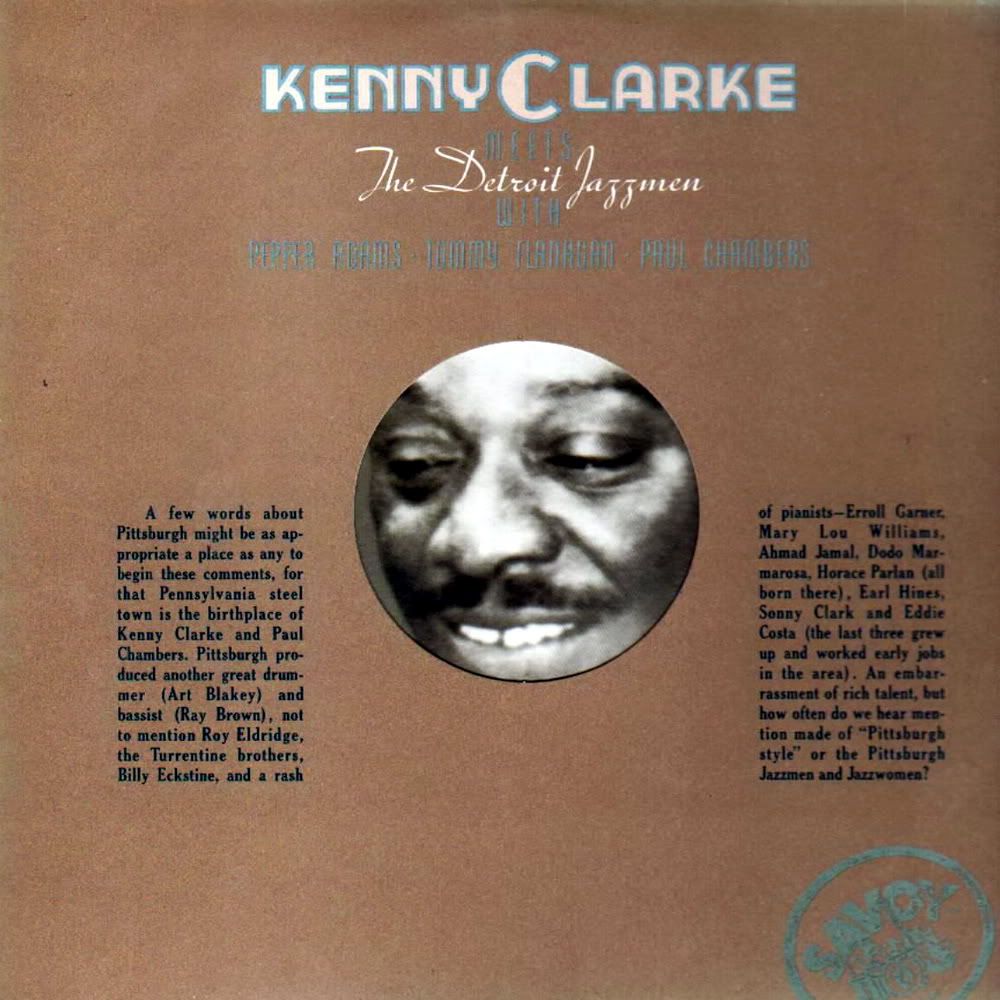
Kenny "Klook" Clarke's job as a drummer was, more or less, "establishing a pulse that both band and listener could feel as well as hear," (Joop Visser) and in the first half of the 1950s that pulse became the driving force of many Savoy recordings. Like that legendary rhythm section of Red Garland/Paul Chambers/Philly Joe Jones, the master drummer of bebop, Kenny Clarke, formed a super unit of the first rate musicians for the Savoy label, mostly consisted of Hank Jones on piano and Wendell Marshall on bass. Aside from their accompanying job, the classic Hank Jones Trio LP was an output of the auspicious collaboration. Other groups benefited from the Savoy rhythmic section were Eddie Bert Quartet, Nat Adderley Quintet, Joe Wilder Quartet and Milt Jackson Quintet; all classics of the post-bop era. Also It happened many times that Jones or Marshall were not available, so Klook teamed up with other rhythm suppliers, some of them as good as the absent gentlemen.
Occasionally, between endless sessions which sometimes lasted for 20 hours per day, Klook found time to record albums under his own name. His leadership materialized the famous LP, Bohemia After Dark and some other Savoy outputs. His last date for Savoy, as leader, was composed of, if in not Detroit-born, but the Detroit-raised musicians of extremely high caliber which was named KC Meets the Detroit Jazzmen.
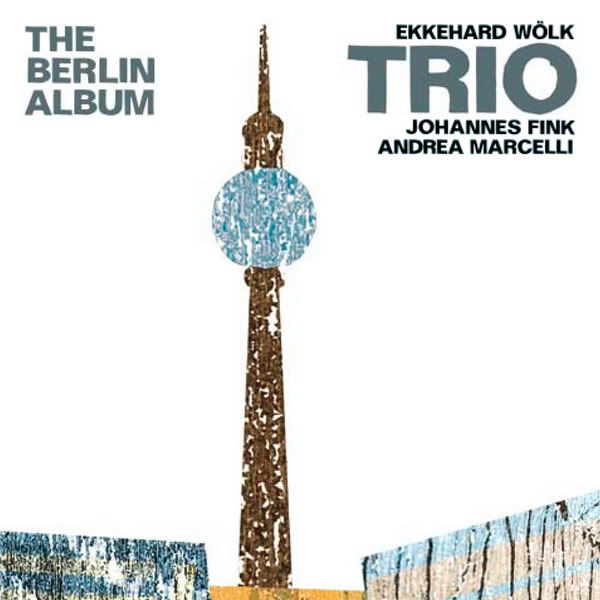
"Berlin, Berlin, the city is a sin – you never go out the way you walked in!"
After some good years of productive collaboration between Ekkehard Wölk, Johannes Fink, and Andrea Marcelli, Ekkehard has driven them into a new concept which primarily consists of excitingly fresh interpretations of well-known musical standards related to the city of Berlin. The Ekkehard Wölk's new album is simply called The Berlin Album.
In terms of structure, the work is based on the legendary 1929 silent film Menschen Am Sonntag made collectively by Robert and Curt Siodmak, Billy Wilder, Edgar Ulmer, and Fred Zinnemann which describes the course of a single Sunday in the lives of four young people in Berlin.
"It seems to me that we have created not only a multifaceted musical kaleidoscope of jazz," says Ekkehard, "but we have also managed to forge an individual and playful reverence for our adopted hometown Berlin."
Ekkehard has incorporated some of Berlin’s most prominent composers from the past whose pieces have made a permanent contribution to the musical iconography of the city.
Rex was famous for playing trumpet or cornet with valves halfway down and making a very bizarre and funny sound out of the instrument. He could talk with his instrument, well-documented a year before his death in Conversation Piece (Baden, 1966 - here on Spotify). But maybe sometimes he was playing with valves just halfway down, but his heart was always fully up and open.
Barry Ulanov calls Rex Stewart (1907-1967) a "humorist" that could play with the "vigor" and "sweetness", and a "conversationalists" in the real sense of the word. These two qualities links him immediately to two of my all time favorites of that instrument, Louis Armstrong and Cootie Williams. No doubt that Rex took many lessons from the former, and had some influences on the latter. Here I have something special for you to hear: six sides he recorded in post-war Berlin during a visit to the ruined city.
Rex reminisces that particular trip in his memoir, Boy Meets Horn, with his usual humor and sweetness:
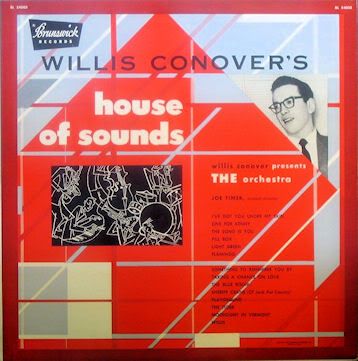
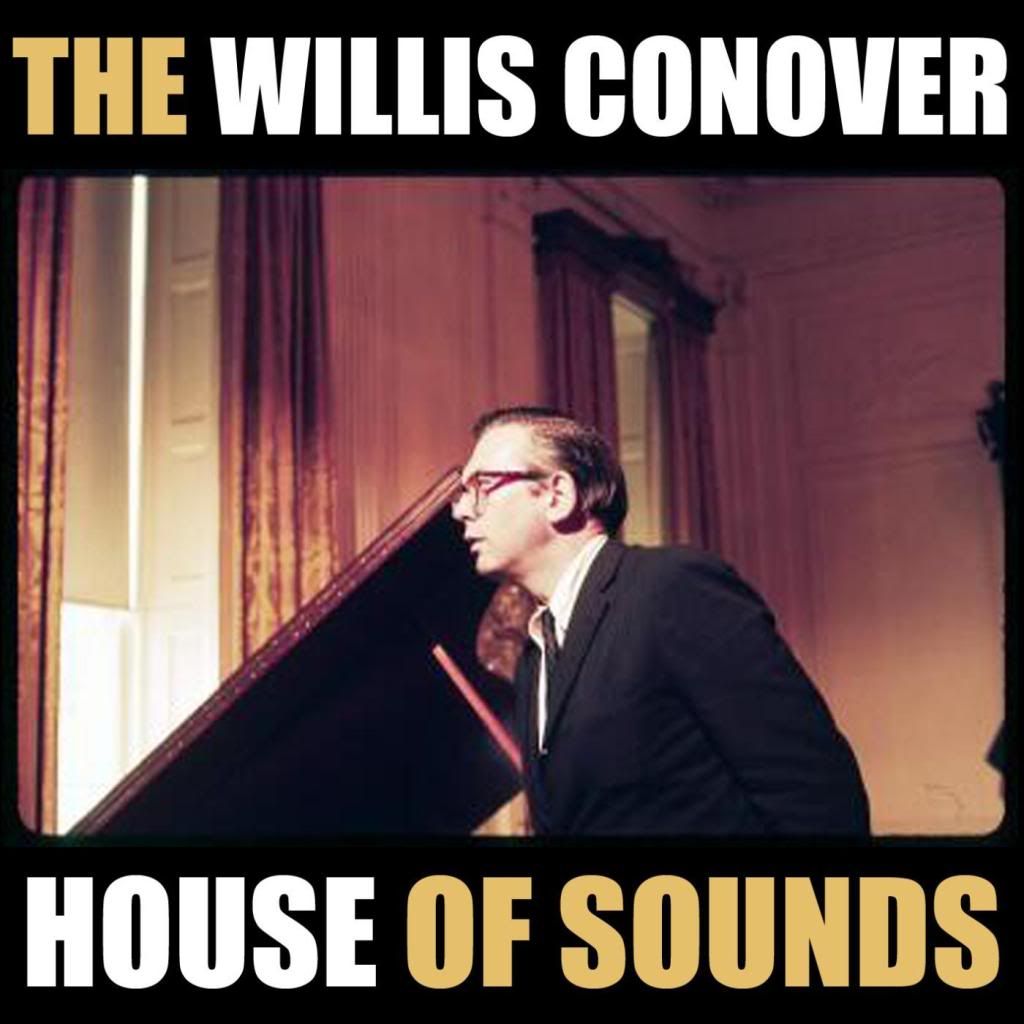
A search under Willis Conover's name to find any official recording with his presence (as a presenter, or with his voice), probably will guide us to this obscure recording from 1953. Actually it has nothing to do with Willis, at least musically. He has just introduced a band that was playing in Washington in the years he was doing his famous radio show. There is only a tune, from total 12 tracks, recorded for this session that is named after Willis Conover, and it is composed/arranged by Bill Potts, another Washingtonian whom later accompanied Lester Young in his legendary Washington sessions.
"Nobody did more for jazz on the radio than Conover," says Richard Cook in his Jazz Encyclopedia. That could be true, not only because in the 1950s he took jazz to the other side of iron curtain, but also because of the musicality and intonation of his voice that was inseparable from the music he was playing. What was the first words I heard about Thelonious Monk? They were Willis Conover's, when he introduces the pianist in the legendary 1958 Jazz on a Summer's Day documentary: "...one of the complete originals of music. A man who lives his music. A man who thinks his music, and it is possible to say that he lives and thinks of little else. We can't describe him exactly as daring because I think he is unconcerned with any opposition to his music. He concerns himself with such elements as quarter tone which he doesn't find in our western scale, so he strikes to adjoining notes, two adjoining keys, on the piano, to imply those missing notes in between. Ladies and gentlemen, Thelonious Monk!" And those words stayed with me.
Like many other recordings that I heard in my teenager years, this House of Sound came from my uncle's collection. This was his note, attached to the record:
"...[This] orchestra was named 'THE Orchestra' and enjoyed limited local reputation, though there were many marvelous instrumentalists like Ed Leddy or Walp or Swope brothers, and great reed players like Nimitz and James Parker in it’s ranks. Most of its members had a long period of play with famous white big bands of those days like those of Gene Krupa, Boyd Raeburn, Woody Herman, Elliot Lawrence and Charlie Barnet amongst others. Here again we have the pleasure of listening to some beautiful trumpets and trombones and a very fine tuned drum work of Joe Timer, who died two years later at the age of 32. Timer was a fine composer and arranger. He was very much in Klook’s tradition. In the present session he leads the orchestra. I enjoyed mostly the trumpet section and especially the lead trumpet of Ed Leddy. There is also the very fine arrangement of The Song Is You by then very young arranger John Mandel, who later enjoyed the fame of being one of the most sought for score writers for movie industry. Markowitz has a beautiful solo on Moonlight..."
I must add one more thing to the history of this interesting, and sadly forgotten orchestra that when Charlie Parker was in Washington, DC, they accompanied him in "Club Kavakos" in February 22, 1953. I hope in one of the last Sundays of the summer, you enjoy listening to this record:
Willis Conover's House of Sounds Presents THE Orchestra
Joe Timer & THE Orchestra (AKA Joe Theimer - see available Charlie Parker discographies from 1953)
Recording date: 1953, (probably Washington D. C.)
Release Date: Aug 21, 1953
Total Time: 46:00
Reissue on Vinyl by Jasmine, JASM 1016 (Jasmine was a London-based label, established in 1982, and apparently still working on the reissue of jazz classics.)
Line-up:
Bob Carey, Ed Leddy, Marky Markowitz, Charlie Walp (tp) Dan Spiker, Earl Swope, Rob Swope (tb) Jim Riley (as) Ben Lary, Jim Parker, Angelo Tompros (ts) Jack Nimitz (bars) Jack Holliday (p) Merton Oliver (b) Joe Theimer (d, cond)
Side A:
1 I've Got You Under My Skin (Composed by Cole Porter; Arranged by Ralph Mutchler)
order of soli: Markowitz; Riley; Holliday.
2 One For Kenny [Clark] (Composed & arr. by Joe Timer)
order of soli: Markowitz; Carey; Leddy; Walp; Holliday.
3 The Song Is You (Composed by J. Kern, O. Hammerstein II; arr. by Johnny Mandel)
order of soli: Earl Swope; Walp.
4 Pill Box (Composed and arr. by Bill Potts)
order of soli: Holliday; Robbie Swope; Earl Swope; Nimitz; Walp.
5 Light Green (Composed and arr. by Bill Potts)
order of soli: Holliday; Oliver; Earl Swope; Walp; Tompros
6 Flamingo (Composed by Ted Grouya, Edmund Anderson; arr. by Joe Timer)
Solo: Walp
Side B:
1 Something to Remember You by/Taking a Change on Love/Blue Room (Composers Schwartz, Dietz/Duke, Fetter, Latouche/Rodgers, Hart; arr. by Joe Timer)
2 Sheriff Crane [AKA Jack Pot County] (Composed & arr. by Jack Holliday)
order of soli: Tompros; Holliday; Walp; Earl Swope; Timer.
3 Playground (Composed and arr. by Bill Potts)
order of soli: Tompros; Robbie Swope; Riley; Walp; Markowitz; Leddy; Holliday
4 Tiger (Composed & arr. by Harvey Leonard)
order of soli: Markowitz; Earl Swope; Tompros; Lary.
5 Moonlight in Vermont (Composed by John Blackburn and Karl Suessdorf; arr. by Jack Holliday)
Solo: Markowitz.
6 Willis [Conover] (Composed and arr. by Bill Potts)
order of soli: Holliday; Earl Swope; Tompros; Markowitz; Nimitz.
A Survey of COLEMAN HAWKINS with FLETCHER HENDERSON
according to CHRONOLOGICAL CLASSICS reissues.
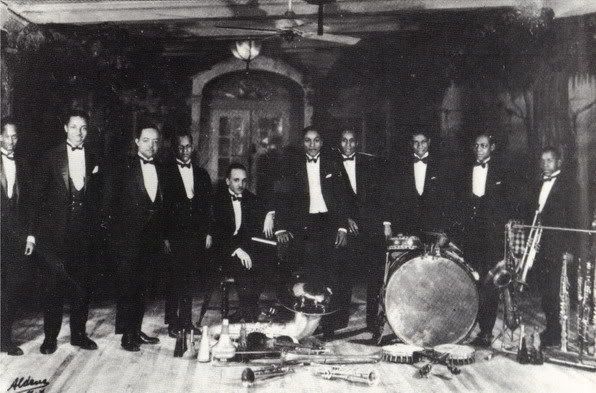
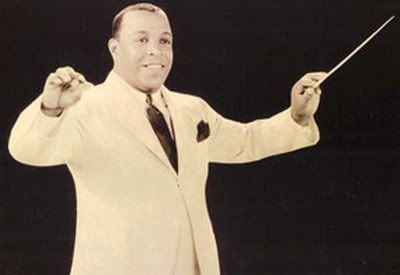
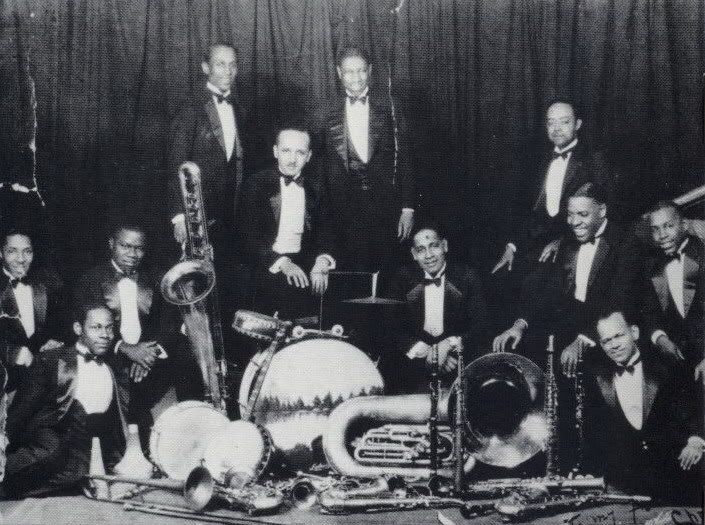
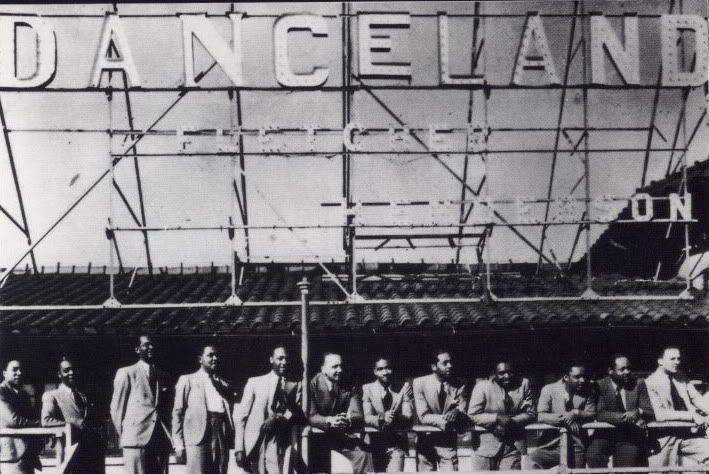
One of the first black big band of jazz, if not the first, was organized in New York in 1922 by a former blues and stride pianist, balding, scholarly-looking Fletcher Henderson who had arrived two years earlier from Georgia to study chemistry. That was the beginning of the story.
Fletcher's ideas were far ahead of anybody else at the time, partly because of all the experience he had with the great soloists in his different bands, and partly because he was such an outstanding musician himself. --Benny Goodman
Far from having an underprivileged background, Henderson, his younger brother Horace, and their sister Irma grew up in a middle-class African-American family in Georgia. Both parents were musicians and teachers, his father working in a local school and his mother teaching piano. Despite Fletcher's main interests being in the sciences and on the sports field, his family's devoted, even excessive, musical zeal led him to become an accomplished all-round musician. His father's stern attitude—sometimes locking the boy up to ensure he practiced—developed Fletcher's skills to a very high level, and he never had difficulty sight-reading, writing music, or hearing exact pitches.
After arriving to New York City in 1920 Henderson realized he was unlikely to make his living as a chemist. He found that the barriers for someone of his racial background were formidable. He therefore turned to his musical skills and took a job as a song plugger, playing and demonstrating new songs for the publishing company run by blues composer W. C. Handy and his partner Harry Pace. When Pace and Handy set up a new firm to make phonograph records, Henderson became its musical director. As a consequence, he came to make dozens of discs with blues singers, and went out on the road in the backup band for the label's first star, Ethel Waters.
Bugle Blues (Introducing Old Miss Blues.1), Ethel Waters, September, 1921
Henderson on piano and one of real dinosaurs of jazz, Garvin Bushel, on clarinet. Bushel later went to play with John Coltrane.
At a time when Chicago dominated developments in jazz, there was a hunger for similar music in New York City. In the record studios and at many of the city's clubs, Henderson's organizational talents and instrumental skills made him a man in demand. He backed Bessie Smith, and as music director for Pace and Handy's Black Swan label, he was able to assemble bands of the city's best musicians. He was already nicknamed "Smack," from the habit of smacking his lips, and also a punning reference to his one-time prowess with the baseball bat.
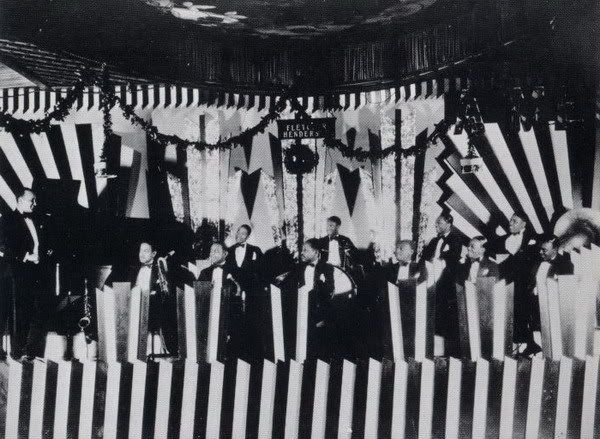
With a group of recording colleagues, he opened at the Club Alabam in 1924, and later that year transferred to the Roseland Ballroom. Playing there for the hall's affluent white customers for much of the next 10 years, Henderson built the Roseland into a leading venue for jazz in New York and established his band's reputation as the greatest jazz orchestra in the city. From the start, he employed some outstandingly talented players, including Coleman Hawkins on tenor saxophone, drummer Kaiser Marshall, and—most significantly—Don Redman on alto sax and as the band's arranger.
Don Redman
Don Redman Effect
Redman began to develop the pioneering work of the early West Coast arranger Ferde Grofe and his colleague and drummer Art Hickman. He started experimenting with separate reed and brass sections, setting a kind of musical question and answer between two section, in a form of what in classical music is called counterpoint. His arrangements smoothly incorporated even the most individual solos and invented jazz for orchestra based on the coexistence of written scores and on improvised solos, an epochal change of format for jazz music. He managed to harmonize the language of the sections of the orchestra and the language of the soloing instruments.
When he started writing for Fletcher Henderson, he captured something of the feel of a jazz soloist in the notes he wrote for all the saxophones to play together, but to start with, the band still sounded stilted, lacking the innate swing of its Chicago or New Orleans counterparts. Henderson himself contributed to the band's stiffness. His classical training had not given him any idea of jazz rhythm, and he had to learn how to play in a jazzier way, losing the ragtime stiffness that many New Yorkers equated with jazz. However, his acute ear and what became a legendary ability for talent-spotting came to his aid, and he brought Louis Armstrong from Chicago to inject the missing ingredients into the band, while Coleman Hawkins was already in the seat of lead first tenor sax.
Hawk Flies!
Coleman Hawkins joined the Henderson Orchestra in the year of 1921, and stayed till 1934. "When one listens to Hawkins on his very earliest records, one hears no promise of his stature as a player. One hears a young man performing with calculated and rather superficial raucousness," said Martin Williams biassedly about Coleman Hawkins in Fletcher Henderson Orchestra, "this clowning soloist obviously knows his instrument, knows his chords, and has a sure sense of time and tempo."
As time moves on in Henderson Orchestra we hear Coleman Hawkins's increasing reliance on the vertical, his growing knowledge of chords, and on spreads of arpeggios. Triplets and more complex phrases flutter and curve away from the beat, apparently without intending to swing. Although the ideas in these solos are fine, the rhapsodic phrases are delivered with an earnestness that is almost affected. Max Harrison points at how Coleman Hawkins of that period shows signs of the mastery he was to develop over the next few years. "The phrasing is less rigid, the tone takes on an edge and buoyancy; in the final chorus he even throws in a two-bar break which hints at The eel, that saxophone figure which Bud Freeman was to make famous. [He was] the musician who bestrode the orchestra, whether stomping along enthusiastically in You Rascal, You, I'm Crazy 'bout My Baby and Sugar Foot Stomp or exploiting, in Just Blues and House of David Blues, that rhapsodic manner which proclaimed him one of the music's first romantics. His harmonic anticipation produced solos that stretched ahead, creating, in retrospect, a remarkable sense of inevitability. Half a century on, the listener still finds himself catching his breath, that old magnificence as seductive as ever.
In 1934 Hawkins left and went to Europe. He was far from home for 5 years.
Satch Comes In
Armstrong made a greater contribution to Henderson's band than his one-year stay and 48 discs might suggest. There are highlights among their recordings, like Shanghai Shuffle and Copenhagen, but the startling ingredient Armstrong added is evident from a disc like I Miss My Swiss, where the jerky rhythms of the band suddenly give way to his elegant, flowing cornet improvisations. The band's other soloists were quick to realize that this was the way forward, and by the time Louis left, as his successor, Rex Stewart, put it: "Henderson's book of arrangements was written around Louis's endings and the interplay between Hawk and Louis." Henderson had learned how to combine strong jazz solos with the style of arrangement he and Redman were developing, and the band read the music with far greater freedom after Armstrong's rhythmic approach wore off on the other musicians. Furthermore, the brilliant solo presence of Armstrong had made the band a talking point among musicians and public alike. We will wait for Armstrong freak, Ricky Riccardi to enlighten us with his analysis of what Satchmo did for Henderson orchesta, and what he achived in collaboration with the fellow musician, Hawk.
Satchmo-Hawk summit
The chance of a lifetime to hear Satchmo and Hawk together, but the result, or what has recorded, is not as groundbreaking as one's imagination tends to picture. Armstrong was without question at the peak of his popularity and influence on jazz, both on orchestral approaches and personal statements of a instrumentalist. On the contrary, Hawk was still searching and according to John Chilton he took many from Satchmo. Both Chilton and Max Jones points that Hawk never did like Armstrong (which is very sad) and even grabbed any chance to ridicule the sentimental, shy, and small-town-boy-mannered Armstrong. Apparently there was a hidden competitive confrontation between these two giants, or more likely, from Hawk to Satch.
one of the photos of that period, shows Hawkins and Armstrong together (left, next to last)
After Redman
After Redman left in 1927, Henderson took up composing and arranging chores with the collaboration of alto saxophonist Benny Carter who had joined in 1928. Henderson subscribed to the same general philosophy of sound, but greatly simplified Redman's intricate arrangements. The most significant innovation of this period was the replacement of the tuba with John Kirby's double bass, for example in Chinatown, My Chinatown (October 1930), an act (inspired by Jean Goldkette's bassist Steve Brown) that would change the rhythm section of jazz forever. Henderson continued to mix arrangements with high-profile soloists such as Stewart and fellow trumpeters Tommy Ladnier, Henry "Red" Allen, Joe Thomas, and Roy Eldridge, clarinetist Buster Bailey, and trombonists Benny Morton, Claude Jones, and Jimmy Harrison. His preeminent saxophonist still was Hawkins, who eventually was replaced by Lester Young (briefly) and Chu Berry.
Under the influence of Fletcher Henderson's orchestra, jazz big bands soon came to be dominated by the three-section dogma: a reed section (saxophones, clarinets), a brass section (trumpets, trombones), and a rhythm section (piano, tuba, banjo, drums) that were clearly separated although they operated jointly. Keep a Song in Your Soul is a good example of how this formula works.
Keep a Song in Your Soul, 1930 solos by Jimmy Harrison (or Claude Jones), Benny Carter, Rex Stewart
After the Crash
Despite Henderson's obvious talent for playing, arranging, finding talent, and publicity, he was also a chaotic bandleader. At Roseland, with a loyal public, this barely mattered, but on the road, rumor had it that the band never left for the next engagement until so late they would have to drive at outrageous speeds to get there on time. They often failed to do so. Amid this fast living atmosphere in which the band flaunted its fast sedans and flashy clothes, Henderson himself was severely injured in an August 1928 automobile accident, after which he was even less reliable. He would lose concentration while starting the band off, and was equally disorganized about broadcasts, losing out to less inspired musicians who were prepared to meet their obligations.
Nevertheless, numerous musicians attest that Henderson's band, for all its underlying chaos, was the band everyone wanted to be in because it allowed its soloists the most room to stretch out and play, amid challenging arrangements.
The band weathered the Great Depression, but in the 1930s gradually lost its supreme position, mostly after Hawk's departure. To keep going, Henderson sold arrangements to Benny Goodman, who made his version of King Porter Stomp, among others, nationally famous. Henderson finally gave up bandleading and joined Goodman as a permanent arranger in 1939, although he tried his hand as a leader again from time to time in the 1940s till a stroke left partially paralyzed in 1950.
Without Henderson's innovations, the jazz big band might not have developed as it did.
Year by year, with Smack and Bean
Fletcher Henderson - 1923 (The Chronological Classics, 697)
In August 1923, Fletcher Henderson and Andrew Sissle opened their own song-publishing house in New York, the “Down South Music Publishing Company". Many of the compositions in this year came from its catalogue and were occasionally recorded for various companies. The short-lived enterprise was later taken over by Irving Mills, who changed its name to “Majestic Music lnc.".
This 20 tracks, made within a time span of less than six months, document the steady improvement and gradual enlargement of Fletcher’s band. In June and October, Fletcher made two similar versions of Down South Blues, the tune which probably inspired the name of his aforementioned publishing company. Old Black Joe's Blues and 31st Street Blues were issued as by “Henderson’s Club Alabam Orchestra", although Fletcher opened at that venue only several weeks later! Coleman Hawkins’ tenorsax contributions on these two early numbers are particularly noteworthy.
Arwulf Arwulf writes that Hawkins once said that Fletcher Henderson's band came across better when heard live than replayed off of old records. Hawkins insisted that Henderson's recordings sounded "like cats and dogs fighting."
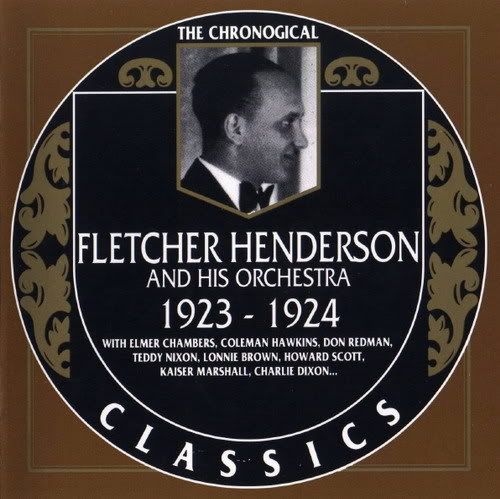
Fletcher Henderson - 1923-24 (The Chronological Classics, 683)
Liner Notes says: "These recordings of Fletcher Henderson traces an important transitional phase of the band. Although not as impressive as King Oliver's music from the same period, several of these cuts still delight today's listener. The opening Charleston Crazy includes a powerful break by Howard Scott, after Elmer Chambers' solo. Collectors once even suggested this break might have been played by Freddie Keppard! Henderson's Sawin’ Six (actually eight musicians) recorded two compositions by cornetist Thomas Morris. Morris himself had recorded both Lonesome journey Blues and Bull Blues earlier that same year.Coleman Hawkins' solos extensively on Swanee River Blues, both in “straight” and “hot” style. ln January 1924, Fletcher Henderson was particularly busy, recording for no fewer than four different companies. The cornet breaks by Chambers and Scott on “Warhorse Mama" had certainly been influenced by the King Oliver - Louis Armstrong partnership.
Martin Williams in his analysis of Hawk's career goes back to the early days of Hawk in bands such as Fletcher Henderson’s and McKinney’s Cotton Pickers: “Yet, when one listens to Hawkins on his very earliest records, one hears no promise of his stature as a player. One hears a young man performing with calculated and rather superficial raucousness, a slap-tongue tenor player with little more than shallow irreverence to recommend him. However, one can note that, this clowning soloist obviously knows his instrument, knows his chords, and has a sure sense of time and tempo."
Fletcher Henderson - 1924 vol. 1 (The Chronological Classics, 673)
The former “Little Club" in the basement of 2I6 West 44th Street reopened in January 1924, after its experiments with Russian folklore-entertainment had proved a failure. The New York Times advertised its new attraction on January I6: “Dance to the tunes of the famous Fletcher Henderson's Recording Orchestra together with the Creole Follies, featuring Edith Wilson and 20 Creole Beauties. Sunday Dinner, 5 to 9 p.m., $ 3 with Dancing and Revue."
Besides recording regularly with his own band, Fletcher also accompanied many blues singers during this period. Many of the cuts included here do not rank among Fletcher's most memorable sides, but nevertheless merit reissue. lt should not be overlooked that these pieces were mainly intended for use in stage productions, a fact apparently not even fully realized at the time, an advertisement for the original 78-record of Chattanooga and Ghost Of The Blues describing the music as a “weird, wild mixture of jazz and soothing symphony"!
Don Redman's Tea Pot Dome Blues, alluding to one of the biggest political and financial scandals of the twenties, is among the best cuts of this CD. Cornettist Howard Scott, who was rarely given solo spots, plays a short but effective muted solo after Teddy Nixon's trombone contribution. We should also note Don Redman's solo on After The Storm, not on saxophone or clarinet but - probably the instrument's first appearance on any jazz record - on oboe!
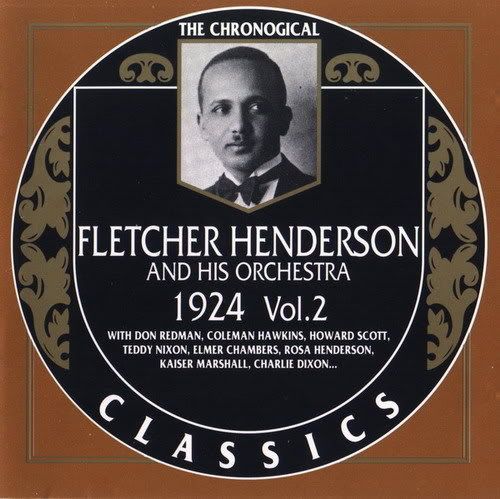
Fletcher Henderson - 1924 vol. 2 (The Chronological Classics, 657)
After almost six months of nightly appearances at the "Club Alabam", Fletcher Henderson and his Orchestra moved to one of the most popular venues of the time, the "Roseland Ballroom" on 51nd Street and Broadway in Manhattan. Their opening on July 16, 1924 was widely advertised in the contemporary press: “The Fletcher Henderson Recording Orchestra opens Wednesday at Roseland, dancing palace, for an indefinite engagement” (Billboard, july 19, 1924). This first booking ended in late September, but Fletcher’s band frequently returned to the Roseland throughout the twenties.
All of these sides have been waxed during the summer of 1924. This was one of Fletcher's busiest years, as far as recordings are concerned. The opening cuts, by a slightly reduced band, include fine muted-cornet solos by Howard Scott. It should not be overlooked that Henderson's was not merely a hot-jazz orchestra: it played many “straight" dance-arrangements as well.
Trombonist Big Charlie Green joined Henderson when the band opened at the “Roseland Ballroom", and his remarkable trombone can be heard on most of the ensuing recordings. He stayed with Fletcher until 1926. His breaks on Hard Hearted Hannah (both versions) and his neat solo on Gouge Of Armour Avenue show he is a skilled musician who fits the orchestra well. The closing Meanest Kind O' Blues, another great rarity among Henderson collectors, features both Green and Scott, plus an extended clarinet duet by the band's leading soloists, Don Redman and Coleman Hawkins.
Notice: Some Henderson experts believe that Oh! Eva, from this set, is not a Henderson recording.
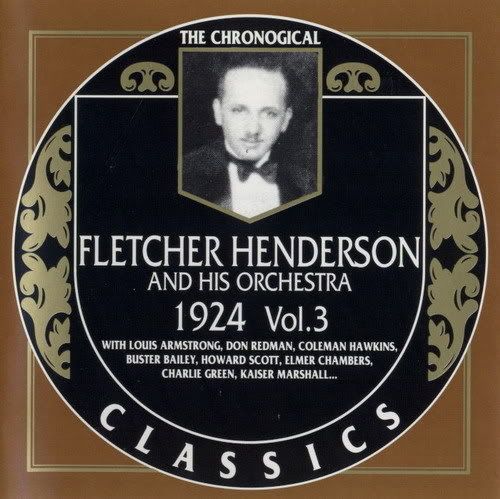
Fletcher Henderson - 1924 vol. 3 (The Chronological Classics, 647)
Satchmo arrives here.Don Redman said, "He was big and fat and wore high-top shoes with hooks in them, and long underwear down to his socks." Years later Henderson remembered Armstrong looking down at his music, conscious of being the new boy stared at by the others. "Just then Escudero's bass accidentally fell against Charlie Green's trombone. Big Green turned around and yelled: "Why you hit my horn, you son of a bitch." And Louis let out a deep breath and said to himself, "I know I'm going to like this band."
Armstrong himself remembered:
I joined the band right after Oliver. They were rehearsing up in Harlem and I walks up and says, "How do, Mr. Fletcher; I'm the trumpet player you sent for." All he says is "Your part's up there." It was Minnetonka and that's the first part I played, third trumpet.
Well, you know how musicians are, especially in those days; they didn't say much but everybody was lookin' out of the corners of their eyes. I was a new man, so they simply ignored me to an extent, and so I didn't say nothing to them. But I'm saying to myself: "This bunch of old . . . stuck up. . . ." Well, they were big shots then, Kaiser Marshall and all those cats, so sharp. I had just left Chicago, where the way we used to do it was just take the wind in, and take what's left of it and blow out—and now I got to watch this part. I was pretty stiff, so they didn't know whether I could play or not.
After two weeks I still hadn't even stretched. Then it happened one night at the Roseland. They had sent for Buster Bailey: they had an opening for saxophone and clarinet, and I knew Buster could play.
So he comes in, and then I kind of had company in the band, and that made a difference. They jumped on Tiger Rag, I think it was, and they gave me about four choruses—following Buster made me really come on a little bit. From then on, I was in with the band.
The first session with Armstrong took place on October 7, 1924, when he had been with the band for perhaps two weeks. The orchestra cut two dreadful tunes, Manda and Go Long Mule, and it is abundantly clear that these were no jazz records and this was not yet a jazz band. Armstrong, however, was a jazz musician,
Fletcher Henderson - 1924-25 (The Chronological Classics, 633)
Armstrong made about fifteen solos with the Henderson band. One of the most important record he made with the Henderson band was one derived directly from the New Orleans mode, Sugar Foot Stomp. It is simply an arranged version of the Oliver classic Dippermouth Blues, with a new title. According to Don Redman, when Armstrong arrived in New York, he brought with him lead sheets of some of the tunes the Oliver band had been doing and asked Redman to arrange one for him. Redman, who was no doubt familiar with the Oliver records, chose Dippermouth Blues. The arrangement he made is much simpler than his usual manner, in which the music tends to jump nervously around the orchestra, and it deliberately reflects the New Orleans style. There are several choruses arranged to give the effect of a New Orleans ensemble and a clarinet trio, which paraphrases distantly Johnny Dodds's classic chorus on the original. Taken as a whole, it is one of the first of the Henderson records to really swing from beginning to end. The public seemed to agree: Redman said, "That recording was the record that made Fletcher Henderson nationally known." Columbia kept it in print for ten years.
Meanwhile, Armstrong was taking another step that was to have enormous consequences for him and inevitably, for the history of jazz: he began to sing with the Henderson band. Armstrong told an interviewer years later:
"Fletcher didn't dig me like Joe Oliver. He had a million dollar talent in his band and he never thought to let me sing or nothin'. I'd say, 'Let me sing' and he'd say, 'no, no.' All he had was the trumpet in mind, and that's where he missed the boat..."
Sugar Foot Stomp, 1925
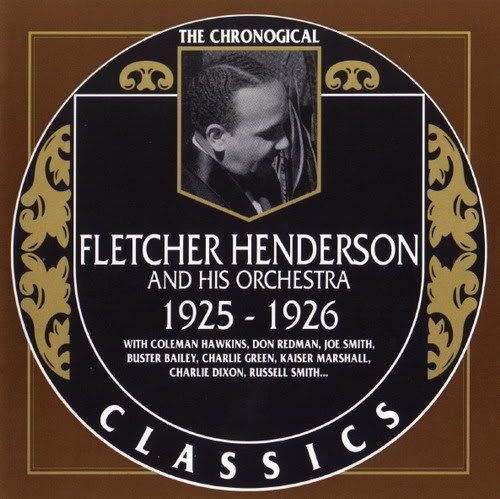
Fletcher Henderson - 1925-26 (The Chronological Classics, 610)
After another extended residency at the “Roseland Ballroom” in New York that ended in January 1926, Fletcher Henderson and his Orchestra played for two weeks in Detroit. On February 18, 1926, Fletcher's big band appeared for the first time in Chicago. Contemporary newspapers raved about this event:
“Fletcher Henderson and his band played in Chicago this week. This organization has lived up to all that has been said concerning its distinction. Soft, sweet and perfect in dance rhythm is one of the artistic assets of the band, and his boys get “hot", too - not the sloppy New Orleans hokum, but real peppy blue syncopation.” (Chicago Defender, February 20, 1926)
This volume opens with a small-group session by the Dixie Stompers. Clap Hands! Here Comes Charlie includes a short solo by Coleman Hawkins on bass-saxophone and an impressive trumpet break by Joe Smith. Don Redman sings on the Dixie Stompers’ I Found A New Baby and most probably arranged Black Horse Stomp.
Max Harrison wrote: "For an ensemble destined to exert such a substantial influence on orchestral jazz during the 1920s, Henderson's very earliest band was remarkably stodgy and unenterprising. Interest generally focused — late in 1924 and throughout 1925, anyway — upon the solos that Armstrong played. In fact, his impact on the orchestra was considerable, especially his rhythmic vivacity, a quality promptly copied by other musicians and reflected in the arrangements that Redman was concocting. Hot mustard is an outstanding example, even if the rapid alternation of different instrumental groupings, much admired at the time, now seems a trifle choppy. But a shaping intelligence was obviously at work, devising scored passages which sounded like jazz solos, but also using soloists as part of a composition, as Jelly Roll Morton had already done and as Ellington was about to do, even if the solo passages themselves were often very short. Hot mustard contains no solo longer than eight bars, apart from Henderson's own twelve-bar piano chorus."
Hot Mustard, 1926
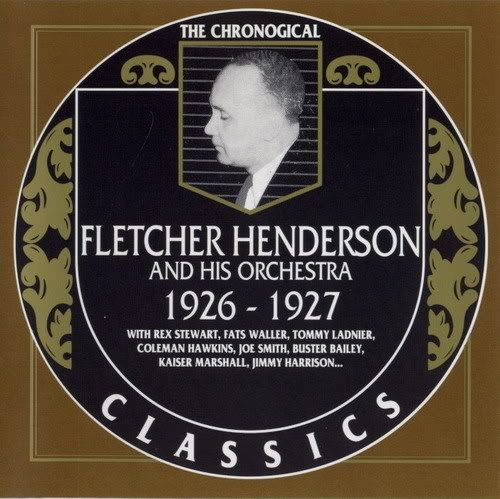
Fletcher Henderson - 1926-27 (The Chronological Classics, 597)
Written in the liner notes, we read "Fletcher Henderson’s already star-studded orchestra was able to enlist two further musicians of note in 1926. Trombonist Benny Morton, who joined Fletcher’s band in April of that year, stayed over this years. He then played with Chick Webb, before moving on to Don Redman’s Orchestra. Trumpeter Tommy Ladnier spent a year with Henderson from November 1926, a period sandwiched between his extended European tours as a member of Sam Wooding’s band. Both great musicians are prominent on several of the present sides!"
The Stampede, 1926
The Stampede, made a few months after Armstrong's departure from the orchestra includes some fierce playing by Coleman Hawkins and Joe Smith. Cornetists Rex Stewart and Joe Smith burst forth with brass hyperboles, reaching for Armstrong's excitement. Coleman Hawkins follows Armstrong's lead too, but he treats his style not as a series of effects but rather as a series of definite musical ideas in a cohesive structure.
The intro to the second side has a brief organ solo by Fats, followed by several trumpet solos probably the work of Tommy Ladnier. Evelyn Preer Thompson's vocal tracks rank among the rarest in Fletcher Henderson’s entire discography. The Dixie Stompers’ Snag It is none other than the famous King Oliver composition first recorded ten months earlier. In Don Redman’s arrangement, Ladnier and Smith play the solos. Eight years before the official beginning of the swing era, Fletcher Henderson's orchestra was outswinging everyone.
The Henderson Stomp; 1926; cc 597
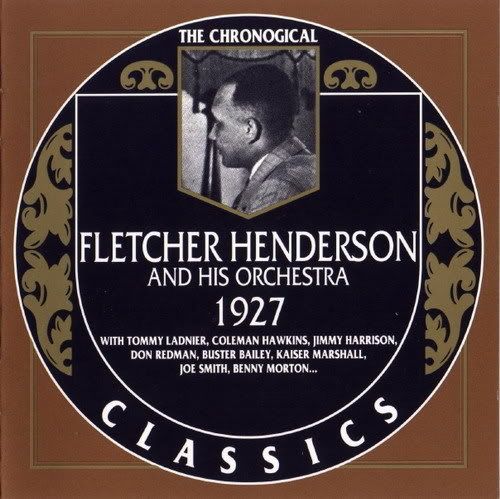
Fletcher Henderson - 1927 (The Chronological Classics, 580)
The year of 1927 was one of the busiest for Fletcher Henderson and his Orchestra. Besides visiting the recording studios more frequently than most other bands, they also toured regularly and played the best known venues in New York. May 15, 1927 must have been an unforgettable night at the Savoy Ballroom with a "Battle of Jazz" between Fletcher Henderson, Fess Williams, Chick Webb and King Oliver - all present with their regular bands! In this set, Whiteman Stomp and I'm Coming Viginia, arranged by Don Redman, were made only four days before the above-mentioned “Battle of jazz", and give an idea of the quality of Fletcher's band at that time. There is another gap in his discography, since there are no traceable recordings by the band for some four months. The reason is that they were away on an extended tour of the Midwest, working their way slowly back to New York, for the end of September. The two excellent sides by a small contingent from the band must have been made soon after their return.
Martin Williams calls Hawkins of this period "disappointing". He argues that "Hawkins of this period is the Hawkins of the twelve-bar blues," and that by nature "he is not a blues man, and he seems to have known it. But unlike some of the early stride pianists, he was not content merely to play the blues form without the feeling. And unlike, say, Earl Hines or Benny Carter, he was not prone to work out a personal and introspective style within the idiom. Hawkins set out to learn to play the blues with blues feeling. He did learn and he has played some very good blues, but to the end of his life he sounded as if the slow blues were, for him, something acquired."
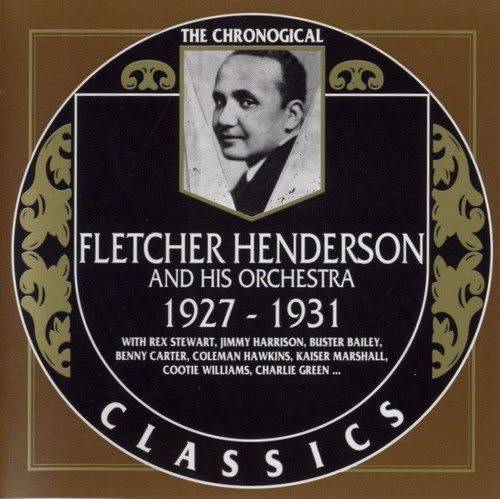
Fletcher Henderson - 1927-31 (The Chronological Classics, 572)
Max Harrison writes: "The 1928 arrangements are mixed, reflecting the wideness of his borrowings. D-natural blues gets off to a laboured start and generally lacks sparkle and variety, yet it shows more promise than Oh, baby, Feeling good, I'm feeling devilish and Old black Joe blues, which fall back upon Redmanesque devices, rather lamely emulated, and lack the redeeming joyousness of the 1927 tracks. Stark and Stewart, replacing Ladnier and Joe Smith, play excellent solos, as do Bailey and Harrison; but some of these numbers suffer from bad recording quality. Easy money, a Carter arrangement, has some of its most hopeful scoring — for example, the lightly riffing saxophones behind Stark's first solo — sadly impeded by prominent banjo chords. Hawkins is plainly beginning to find his second, more expressive, self here.
King Porter Stomp
Martin Williams argues that Blazin', from this set, seems to one of the best early revelations of a developing Coleman Hawkins style, and in it we hear the increasing reliance on the vertical, on Hawkins's exact and growing knowledge of chords, and on spreads of arpeggios. He says "from a sound, youthful grounding in music, especially in piano instruction, Hawkins knew the notes in chords and learned to form passing chords between assigned ones. He also had the clear example of jazz reed players like Jimmy Noone and Buster Bailey who played arpeggio styles. But it is interesting to learn that an encounter with the harmonic and embellishmental sophistication of pianist Art Tatum was a turning point in Hawkins's development."
Blazin'
The first session is of minor interest since it includes some sub-standard vocals by Andy Razaf whose lyrics to some of Fats Waller's best compositions are unforgettable. The next two sides are entirely different: This first of several issued versions of King Porter Stomp has some outstanding solos by trumpeters Bobby Stark and Joe Smith as well as 16 fierce bars by Coleman Hawkins! Bobby Stark is again prominent in the following session which he himself has called his best recording-date ever. Listen to him on Oh Baby where sounds very modern for the time! Another of Fletcher's trumpet-players, Rex Stewart, can be heard on Freeze And Melt and Raisin’ The Roof where he plays an extended solo before Coleman Hawkins’ tenor. This one was probably arranged by Benny Carter who had certainly done the next two, Somebody Loves Me as well as a few others presented here. The latter features one of the unique talking-vocals by Jimmy Harrison. Now listen to the excitement and modernity of Smack's band in the following track:
Chinatown, My Chinatown, 1930
Hawkins's solo on Chinatown shows his new approach,he approach that Martin Williams believes it is as if in making all the chords, Hawkins also became determined to make all the beats, and he made them in a more or less regular, heavy/light/heavy/light pattern.
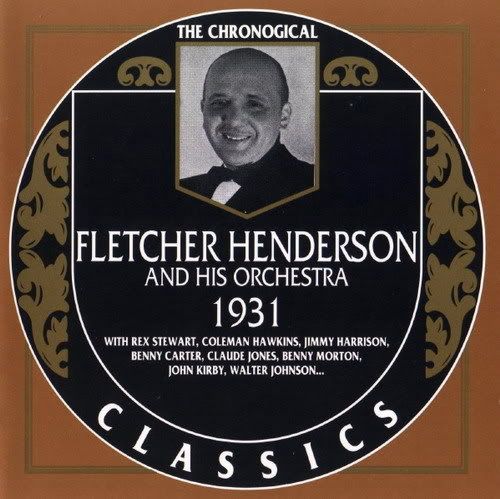
Fletcher Henderson - 1931 (The Chronological Classics, 555)
Because these tracks by Fletcher Henderson were made for a variety of individual record-companies, some of them were issued at the time under curious and slightly bizarre pseudonyms, e. g.: “Fletcher Henderson and his Baltimore Bell Hops”, “The Savannah Syncopators”, “Duke Wilson and his Ten Black Berries", “Ray Nichols and his Four Towers Orchestra” or “The Duke of Harlem and his Flunkies”!
The set opens with Sweet And Hot, a delightful arrangement by Benny Carter- his scoring for a saxophone-section was already fully developed at that early date! The four sides made for the short-lived Crown label are excellent despite the uneven singing of an unidentified vocalist. The best recording of the batch, Star Dust, is also likely the work of Benny Carter although some sources give another name. Singin' The Blues is closely associated with the legendary Bix Beiderbecke who had recorded it in 1927. The interpretations by Fletcher Henderson have Rex Stewart copying Bix' solo almost note by note and are therefore among the very few occasions where a black artist modelled his playing after a white musician!
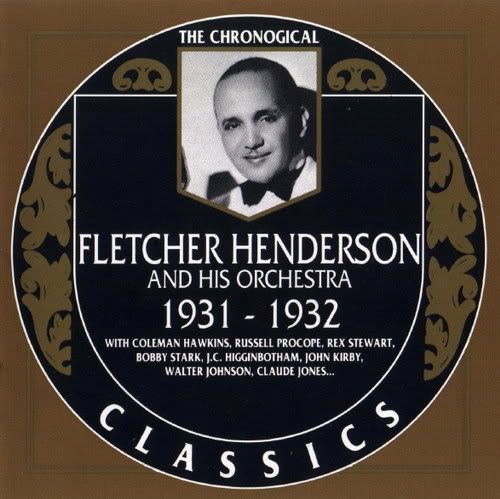
Fletcher Henderson - 1931-32 (The Chronological Classics, 546)
Recorded in the worst period of the great depression that had hit the United States in 1929. Very few jazz records were cut and those actually issued sold poorly. Fletcher Henderson’s were no exception but he was at least able to record regularly and the quality of his music was not marred by the difficult economic circumstances!
This set includes all sides made by Henderson orchestra between the end of July, 1931 and March of the following year. The first two sides with singing by Dick Robertson have solos by Coleman Hawkins and Bobby Stark. The six following sides, made for the Crown label, are better known. Sugar Foot Stomp, Fletcher’s revision of Louis Armstrong and King Oliver's Dipper Mouth Blues, has another fiery solo by the neglected Bobby Stark. The two slower arrangements by Nat Leslie remind of similar things by Duke Ellington.
During this period, and due to depression, Henderson was often stuck recording commercial leftover like My Sweet Tooth Says I Wanna (But My Wisdom Tooth Says No), I Wanna Count Sheep (Till the Cows Come Home) and Strangers, but in most cases his all-star orchestra was able to overcome the material.
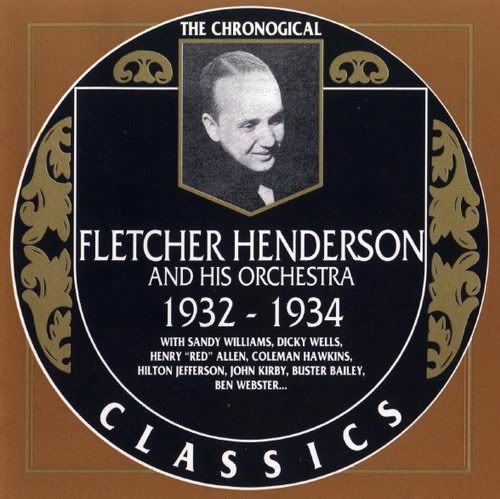
Fletcher Henderson - 1932-34 (The Chronological Classics, 535)
The opening Honeysuckle Rose is among the earliest versions of Fats Waller's hit. Some typical playing by J.C. Higginbotham ls followed by Hawkins’ unmistakable tenor.
Queer Notions, a Hawkins original arranged by Horace Henderson, is a very adventurous piece of music for its time! Here, it is instructive to hear Allen and Hawkins improvising together in passages which in Max Harrison's words "anticipates something of the spaciousness of the modal jazz of the 1960s". The other three items from the session of September 22, 1933 are particularly nice, too. Coleman Hawkins' soloing on It's Talk Of The Town is of the same quality as his legendary Body And Soul, which was only made six years later!
It's Talk Of The Town
The last two dates included in this CD present some of Fletcher Henderson’s most swinging charts. Big John’s Special was one of the band's trademarks but became really well known as a tune after Benny Goodman had played it in his first Carnegie Hall Concert in 1938. The same also goes for the tremendously swinging Down South Camp Meeting, which only became a hit with Goodman's recording of three years later but here then are the original versions played by the incomparable orchestra of Fletcher Henderson!
Well, this is not the end of Henderson Orchestra, though it is the beginning of the end. But certainly it is the last year for Coleman Hawkins, who soon leaves for Europe. Martin Williams makes a point that Hawkins's two choruses on Hokus Pokus from 1934 are probably the best of all his solos with Henderson.
Hokus Pokus
Best Alternative for out of print classic CDs isA Study in Frustration: Fletcher Henderson Story (Thesaurus of Classic Jazz) 1923-38 in 3 CD, Columbia, 57596
Sources and References
A mass of detail on Fletcher Henderson career on records can be found in Walter C. Allen’s “Hendersonia", still the most comprehensive study ever published on an individual jazz musician.
IN PRINT: Hendersonia by Walter C. Allen Song of the Hawk by John Chilton Louis Armstrong, an American genius by James Lincoln Collier Jazz Makers, Vanguards of Sound by Alyn Shipton A History of Jazz Music by Piero Scaruffi The History of Jazz by Ted Gioia The Essential Jazz Records, Vol.1: Ragtime to Swing by Max Harrison, Charles Fox and Eric Thacker The Penguin Guide to Jazz Recordings by Brian Morton and Richard Cook Classics' Original Liner Notes by Anatol Schenker
ONLINE: Scott Yanow entries for Fletcher Henderson Classics reissues from All Music Guide.