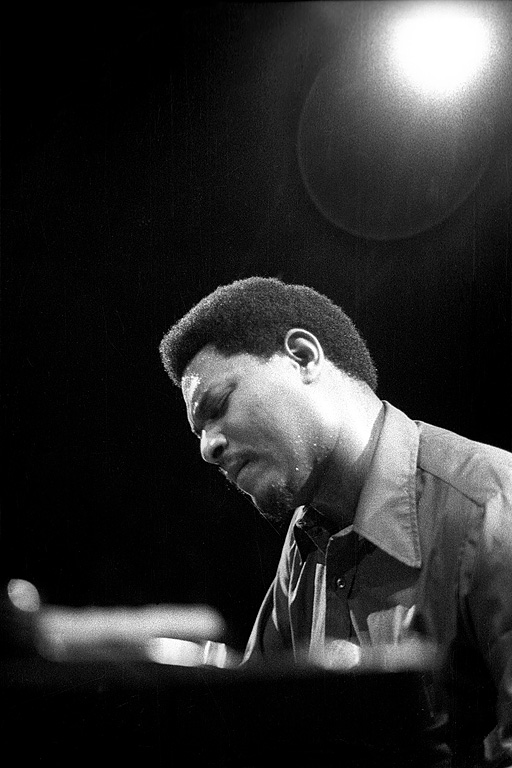
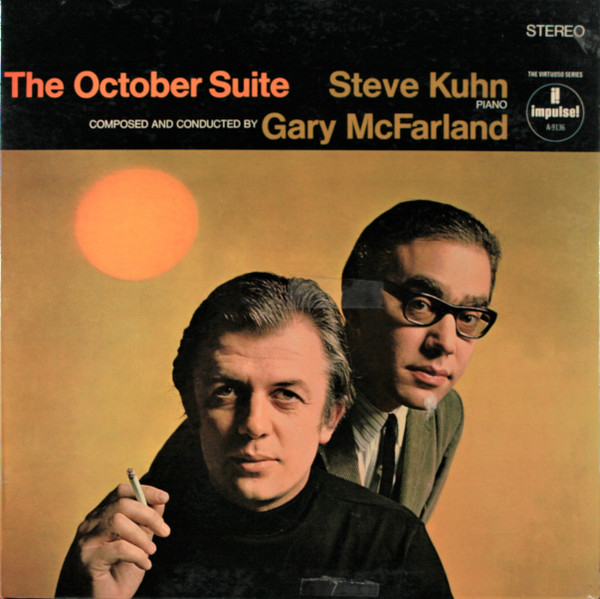
So far Steve Kuhn has primarily been heard in two contexts—as a sideman and as leader of a trio. This album, however, focuses on him as solo pianist in settings written specifically for him by Gary McFarland. For Gary the assignment was stimulating because, as he observed, he didn’t have to restrict himself to any particular idiom. Knowing the broad scope of Kuhn’s capacities, Gary felt free to try any approach he wanted in the confidence that Kuhn would respond resourcefully—and with individuality.
Showing posts with label Nat Hentoff. Show all posts
Sunday, July 20, 2025
Monday, April 17, 2023
Nat Hentoff on Ahmad Jamal | RIP Ahmad Jamal (1930-2023)
"Listen," Miles said then and later in an interview for The Jazz Review, "to the way Jamal uses space. He lets it go so that you can feel the rhythm section and the rhythm section can feel you. It's not crowded.
Sunday, January 8, 2017
Man of Words: Nat Hentoff (1925-2017)
![]() |
| Naiel Ibarrola's illustration for the back cover of the Persian edition of Jazz by Nat Hentoff and Albert J. McCarthy, a book that was never published. |
Nat Hentoff On Benny Golson
Interesting is easy; beautiful is difficult
Nat Hentoff's liner notes for
Benny Golson's New York Scene (1957)
With very few exceptions, the first recognition a superior jazz musician receives is from other players. Some time later, the critics begin to comprehend, and later still the public may. There has been talk about Benny Golson as a player and writer among musicians, for example, for several years. The late Clifford Brown, for one, in a conversation in early 1954, emphasized Golson’s capacities and predicted the eventual public realization of his value.
Jackie McLean: Gettin' Inside the Song!
Nat Hentoff Original Liner Notes: Jackie McLean's Action,1964
One of the consistently intriguing characteristics of Jackie Mclean's jazz is that while he continues to explore new directions, he is also clearly rooted in the fundamentals of modern jazz. Or, as he would put it, "I never want to go 'outside' for too long a time without coming back ' inside' again."
Portrait of the Artist (Bob Brookmeyer, 1959) | Liner notes by Nat Hentoff
Nat Hentoff Liner Notes for Bob Brookmeyer's Portrait of the Artist | Republished with permission
Robert Brookmeyer is tall, lean, sardonic, epigrammatic, and utterly serious about music, if not always about himself. He has become recognized as one of the most expressive trombonists in jazz history. It is his not only that he plays the valve trombone with remarkable facility, but rather it is his imagination, intensity and cutting wit that make him an authentic jazz individualist. Although he is very much his own man, Brookmeyer reminds me of the harmonic taste and venturesomeness of the late Brad Gowans, the shaggy dog narrative humor of Vic Dickenson, and the urgency of Jimmy Harrison. I do not mean that he has necessarily been directly influenced by these men, but I do mean that he has a largeness of spirit and musicianship that these three shared.
Shades of Redd (Freddie Redd, 1960) | Liner notes by Nat Hentoff
Since his emergence as composer of the score for Jack Gelber's harrowingly exact play, The Connection (Blue Note 4027), Freddie Redd has finally been gaining some of the recognition that has eluded him for much of his playing career. Freddie also plays the taciturn pianist in the play with convincing effect. Although he hopes to work again in the theatre, Freddie remains essentially a jazz player-writer, and this album underlines his growth as a composer of vigorously expressive jazz originals.
Hi-Fly (Jaki Byard, 1962) | Liner notes by Nat Hentoff
Nat Hentoff Liner Notes for Jaki Byard's Hi-Fly
While I was still in Boston in the early 1950s, the word spread among the more venturesome young jazzmen that a key source in town for new ideas in both improvising and composing was Jaki Byard. Gradually, Jaki's reputation began to spread through his playing and arranging for the Herb Pomeroy band; and more recently, as a result of a two-year stay with Maynard Ferguson. Jaki left Ferguson in October, 1961, and is now established in New York with his own combo. As a result of his first Prestige album, Here's Jaki, Jaki's originality and two-handed resourcefulness as a pianist are beginning to reach more and more listeners.
MyCoy Tyner's The Real McCoy | Liner notes by Nat Hentoff
Republished with permission. And beyond that authority, which comes from thorough musicianship, is an incisive individuality of expression. As for Tyner, Coltrane's remark about the clearness of his ideas is so well taken that anyone - whether he knows one chord or one time signature from another - ought to have no problem following the way Tyner's solo here is inexorably built.
"After writing the melody of 'Search for Peace,'" Tyner says, "I chose this title because the song has a tranquil feeling. Tranquil and personal. It's very difficult to verbalize about music; the important thing is what the listener himself gets from the act of listening. But insofar as I can verbalize about this piece, it has to do with a man's submission to God, with the giving over of the self to the universe."
Thursday, June 4, 2015
Harold Land's Invitation
Harold Land: various liner note transcriptions and an exclusive video
"The evolution of Harold Land as a jazzmaker has brought to focus certain facts about this perennial master of the tenor saxophone. Aside from his unique inflections, personalized expressions, there is his engaging capacity to bring out in a performance extremely rich and rewarding moments of creativity and innovations." -- Leroy Robinson
"A soft-spoken man whose personality rarely suggests the incandescence of his instrumental sound, Land was born December 18, 1928 in Houston, Texas. The family moved to San Diego when he was five; it was during his high school years there he became interested in music and in 1945 was presented with his first saxophone. His early influences were the big, warm tones of Coleman Hawkins and Lucky Thompson; later Charlie Parker's new concepts helped determine his direction. He was just out of high school when a bass player named Ralph Houston helped him join the Musicians' Union. After working in Houston's band, he spent a long while soaking up experience at the Creole Palace where a small combo, usually five or six pieces, was led by Froebel Brigham, a trumpeter. "During both these jobs my closest friend and musical colleague was the drummer, Leon Petties," Harold remembers. "We played the floor show and jazz sets too. Sometimes men like Hampton Hawes, Teddy Edwards and Sonny Criss came down from Los Angeles and worked with us—this provided a great stimulus." Later, Land and Petties went on the road for about a year, first with a group led by guitarist Jimmy Liggins, and then in the band of his celebrated brother, Joe 'Honeydripper' Liggins. Harold recalls this rhythm-and-blues experience as valuable in rounding out his musical education. After putting in additional time back at the Creole Palace, Harold decided in 1954 to try his luck in Los Angeles. For several months there were various odd jobs, none very rewarding. The turning point came one night when Clifford Brown took his combo-leading partner, Max Roach, to hear Harold play in a session at Eric Dolphy's house. "Eric had known me since the San Diego days, and after I moved to L.A. we became good friends," Harold says. "He was beautiful. Eric loved to play anywhere, any hour, of the day or night. So did I. In fact, I still do." The unofficial audition led to Harold's being hired by Brown and Roach. As jazz night club audiences around the country were exposed to the freshness and vitality of Land's playing, he seemed to be well on his way; but in 1956 he had to leave the quintet and return to Los Angeles because of illness in the family. If, during the balance of the 1950s, he had continued to tour with name groups, there is little doubt that his reputation would have been established sooner and much more firmly on an international level." -- Leonard Feather
Wednesday, March 13, 2013
Hentoff on Donald Byrd
| Byrd in Paris with Walter Davis (p), Bobby Jaspar (ts) and Doug Watkins (b). |
Trumpet player, composer, band leader and jazz educator Donald Byrd passed away last month. He left a prodigious legacy behind which among them his long and abundant tenure with Pepper Adams remains my favorite.
(a fast dissolve to Nat Hentoff)
Nat Hentoff, during his exuberantly active years as the session attendant, liner note author and producer, wrote more liner notes for Donald Byrd than any other trumpet player of the 1960s. What follows is a small part of Hentoff's illustration of Byrd, as well as his attempt to reflect Byrd's views on various issues - from educating jazz to church music and evaluation of his colleagues.
Byrd Emerges
The continuing growth of Donald Byrd as a uniquely melodic improviser with authoritative command of his instrument has not been sufficiently underlined, it seems to me, in the past couple of years. Several critics have, however, been cognizant of Byrd's increasingly substantial achievement. Frank Kofsky, for one, noted in Down Beat that "the history of Byrd's recording career has been one of consistent improvement; and the British critic, Michael James, has observed in the Jazz Review that Byrd's "tone sings loud and clear throughout the range of his horn, and his invention has more that kept pace with his improved technique...There is not a hint of blandness technical confidence will sometimes bring."
Also heartening is the fact that Byrd does not find necessary to pound home the point that he has roots. A blues feeling courses through everything he plays, but he is also able to range through a much wider variety of moods than are several of his more self-consciously "hard" contemporaries. There is in Byrd a linkage to sunny, light-hearted jazz playing as well as to vigorously assertive self-expression.
Friday, January 25, 2013
Rollin' Around the Horn: Hawk, Dizz, Getz, Mex
Rollin' Around the Horn
Nat Hentoff's Liner Notes for
Sittin' In (Verve/Clef)
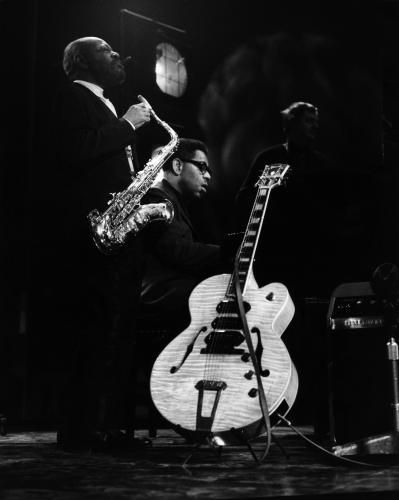
About 6 a.m., a few days before the July 4, 1957 weekend, three tenors, a trumpet and a rhythm section convened in a New York recording studio. They left about five hours later - and this is the result. It marks the first time that Coleman Hawkins, Paul Consalves, and Stan Getz have ever recorded together. It's also a reunion between Dizzy and Hawk. They were responsible for an historic date in 1944 at which sessions titles like Woody n' You and Disorder at the Border were recorded. It was musically an important early modern jazz event but also was a rare graphic indication for that warring time that the “bop" movement was not a break with the jazz tradition; for after all, Coleman Hawkins had Dizzy on his date.
“I never worry about styles noway,” Coleman said recently. “I like to get fellows together that play.” Coleman approves of both his reed colleagues on this session, and adds: “You know Paul’s been playing a long time and deserves a lot more credit than he’s gotten."
“Paul,” Stan Getz commented on the session, “plays a ballad that's just beautiful. His ballad playing on the date gassed us all. I've always loved the way Coleman plays; he’s always had his own style, his own way. His work has lucidity and freedom. He seems to just roll around the horn and his sound is so full.”
Saturday, December 17, 2011
Tuesday, October 4, 2011
Pee-Wee
One night, at the end of a a gig in a dive in Boston - a small, narrow, cheerless room - Pee Wee Russell was confronted by a student at the nearby New England Conservatory of Music who unrolled a series of music manuscript pages.They were densely covered with what looked like notes of extraordinary complex avant-garde classical composition. "I brought this for you," the young man said to Pee Wee, who stared at him if he were a Martian. "It's one of your solos from last night. I transcribed it."Shaking his head, Pee Wee looked at the manuscript. "This can't be me. I can't play this."The student assured Pee Wee that the transcribed solo - with its fiendishly difficult and startling turns of invention - was indeed Pee Wee's."Well," the shy clarinetist said, "even if it is, I wouldn't play it again the same way - even if I could, which I can't."
-- Nat Hentoff, Speaking Freely
Monday, October 25, 2010
Ben Webster: Stomping Love
Nat Hentoff Original Liner Notes: Ben Webster's Soulville,1957
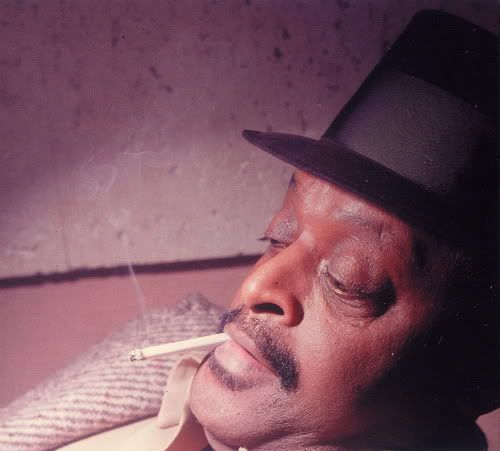
Johnny Griffin, one of the more venturesome of the "modern" tenors, was talking recently with Don Gold of Down Beat concerning those nonpareil jazz players who never become dated. On his list were Coleman Hawkins and Ben Webster. “Ben is phenomenal. These guys can come and play with the young cats and still fit in. These guys — like Hawk and Ben - are living legends.”
Friday, September 17, 2010
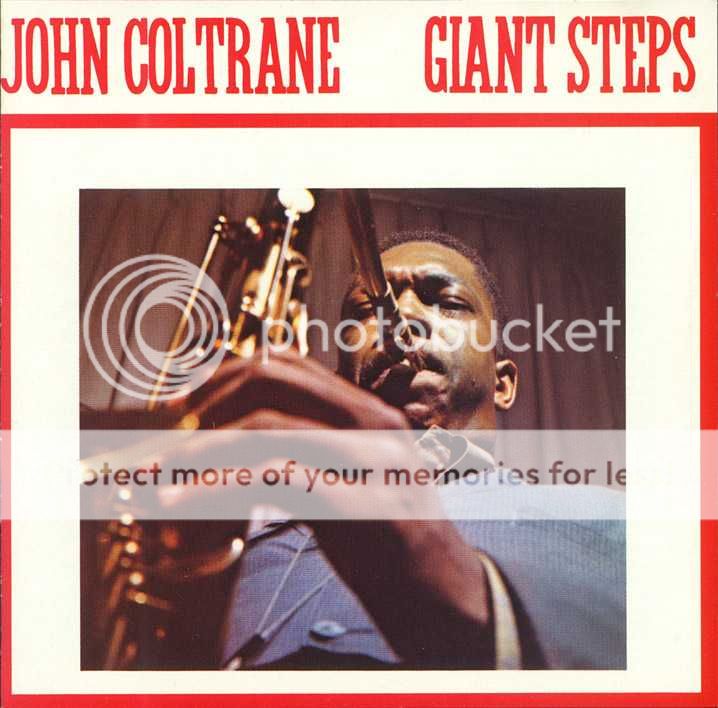
Giant Steps (John Coltrane, 1959)

Along with Sonny Rollins, John Coltrane has become the most influential and controversial tenor saxophonist in modern jazz. He is becoming, in fact, more controversial and possibly more influential than Rollins. While it's true that to musicians especially, Coltrane's fiercely adventurous harmonic imagination is the most absorbing aspect of his developing style, the more basic point is that for many non-musician listeners, Coltrane at his best has an unusually striking emotional impact. There is such intensity in his playing that the string of adjectives employed by French critic Gerard Bremond in a Jazz-Hot article on Coltrane hardly seems at all exaggerated. Bremond called his playing "exuberant, furious, impassioned, thundering."
There is also, however, an extraordinary amount of sensitivity in Coltrane's work. Part of the fury in much of his playing is the fury of the search, the obsession Coltrane has to play all he can hear or would like to hear -- often all at once -- and yet at the same time make his music, as he puts it, "more presentable." He said recently, "I'm worried that sometimes what I'm doing sounds like just academic exercises, and I'm trying more and more to make it sound prettier." It
seems to me he already succeeds often in accomplishing both his aims, as sections of this album demonstrate.
This is the first set composed entirely of Coltrane originals. John has been writing since 1948. He was born in Hamlet, North Carolina, September 23, 1926. His father played several instruments, and interested his son in music. At 15, John learned E-flat alto horn and clarinet, and in high school, he switched to tenor. He studied. in Philadelphia at the Granoff Studios and the Ornstein School of Music, became a professional at 19, and played in a Navy band based in Hawaii from 1945-46. From 1947-49, he worked with Joe Webb (Big Maybelle was in the same entourage), King Kolax, Eddie Vinson and Howard McGhee. Charlie Parker had become a dominant influence on his playing.
He was on alto with the Dizzy Gillespie band in 1949, and after Dizzy disbanded, John returned to Philadelphia, discouraged and trying to find his own way in music. From 1952-53, he was with Earl Bostic, and then played with Johnny Hodges, Jimmy Smith, and Bud Powell.
He first joined Miles Davis from 1955-56. Miles regards Coltrane and Rollins as the two major modern tenors. "I always liked Coltrane." Miles said recently. "When he was with me the first time, people used to tell me to fire him. They said he wasn't playing anything. They also used to tell me to get rid of Philly Joe Jones. l know what I want though. I also .don't understand this talk of Coltrane being difficult to understand. What he does, for example, is to play five notes of a chord and then keep changing it around, trying to see how many different ways it can sound. It's like explaining something five different ways. And that sound of his is connected with what he's doing with the chords at any given time."
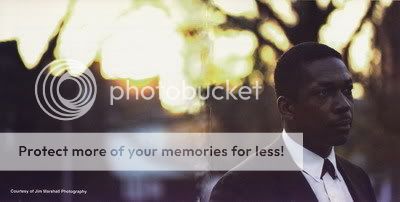
Miles encouraged Coltrane and also stimulated his harmonic thinking. In terms of writing as well, John feels he's learned from Miles to make sure that a song "is in the right tempo to be its most effective. He also made me go further into trying different modes in my writing." After two years with Miles? there was a period in 1957 with Thelonious Monk that Coltrane found unusually challenging. "I always had to be alert with Monk," he once said, "because if you didn't keep aware all the time of what was going on, you'd suddenly feel as if you'd stepped into an empty elevator shaft."
Coltrane worked briefly with a Red Garland quintet, then rejoined Miles, and has been with him ever since. He has nothing of his own in the Davis book at present, but he has devoted more and more of his time to composing. He is mostly self-taught as a writer, and generally starts his work at the piano. "I sit there and run over chord progressions and sequences, and eventually, I usually get a song -- or songs -- out of each little musical problem. After I've worked it out on the piano, I then develop the song further on tenor, trying to extend it harmonically." Coltrane tries to explain what drives him to keep stretching the harmonic possibilities of improvisation by saying, "I feel like I can't hear but so much in the ordinary chords we usually have going in the accompaniment. I just have to have more of a blueprint. It may be that sometimes I've been trying to force all those extra progressions into a structure where they don't fit, but this is all something I have to keep working on. I think too that my rhythmic approach has changed unconsciously during all this, and in time, it too should get as flexible as I'm trying to make my harmonic thinking."
In her analysis of Coltrane's style in the November and December, 1959, issues of The Jazz Review, pianist Zita Carno pointed out that Coltrane's range "is something to marvel at: a full three octaves upward from the lowest note obtainable on the horn (concert A-flat)...There are a good many tenor players who have an extensive range, but what sets Coltrane apart from the rest of them is the equality of strength in all registers, which he has been able to obtain through long, hard practice. His sound is just as clear, full and unforced in the topmost notes as it is down in the bottom." She describes his tone as "a result of the particular combination of mouthpiece and reed he uses plus an extremely tight embouchure" and calls it "an incredibly powerful, resonant and sharply penetrating sound with a spine-chilling quality."
Of the tunes, Coltrane says of Giant Steps that it gets its name from the fact that "the bass line is kind of a loping one. It goes from minor thirds to fourths, kind of a lopsided pattern in contrast to moving strictly in fourths or in half-steps." Tommy Flanagan's relatively spare solo and the way it uses space as part of its structure is an effective contrast to Coltrane 's intensely crowded choruses.
Cousin Mary is named for a cousin of Coltrane who is indeed called Mary. The song is an attempt to describe her. "She's a very earthy, folksy, swinging person. The figure is riff-like and although the changes are not conventional blues progressions, I tried to retain the flavor of the blues."
Countdown's changes are based in large part on Tune Up, but against that, Coltrane uses essentially the same sequence of minor thirds to fourths that characterizes Giant Steps. His solo here, and in the others as well, illustrates Zita Carno's point that Coltrane, for all he's trying to express in any given solo, has a remarkable sense of form.
Syeeda 's Song Flute has a particularly attractive line and is named for Coltrane's 10-year-old daughter. "When I ran across it on the piano," he says, "It reminded me of her because it sounded like a happy, child's song."
The tender Naima -- an Arabic name -- is also the name of John's wife. "The tune is built," Coltrane notes, "on suspended chords over an Eb pedal tone on the outside. On the inside-- the channel -- the chords are suspended over a Bb pedal tone." Here again is demonstrated Coltrane's more than ordinary melodic imagination as a composer and the deeply emotional strength of all his work, writing and playing.
There is a "cry" -- not at all necessarily a despairing one -- in the work of the best of the jazz players. It represents a man's being in thorough contact with his feelings, and being able to let them out, and that "cry" Coltrane certainly has.
Mr. P.C. is Paul Chambers who provides excellent support and thoughtful solos on the record as a whole and whom Coltrane regards as "one of the greatest bass players in jazz. His playing is beyond what I could say about it. The bass is such an important instrument, and has so much to do with how a group and a soloist can best function that I feel very fortunate to have had him on this date and to have been able to work with him in Miles' band so long." Tom Dowd's engineering, incidentally, has caught Paul's sound as well as it's ever been heard on records, and for an insight into the importance of the bass's function, it might be valuable to go through the record once, paying attention primarily to Paul. Also worth noting is the steady, generally discreet drumming of Arthur Taylor and Jimmy Cobb throughout.
What makes Coltrane one of the most interesting jazz players is that he's not apt to ever stop looking for ways to perfect what he's already developed and also to go beyond what he knows he can do. He is thoroughly involved with plunging as far into himself and the expressive possibilities of his horn as he can. As Zita Carno wrote, "the only thing to expect from John Coltrane is the unexpected." I'd qualify that dictum by adding that one quality that can always be expected from Coltrane is intensity. He asks so much of himself that he can thereby bring a great deal to the listener who is also willing to try relatively unexplored territory with him.
There is also, however, an extraordinary amount of sensitivity in Coltrane's work. Part of the fury in much of his playing is the fury of the search, the obsession Coltrane has to play all he can hear or would like to hear -- often all at once -- and yet at the same time make his music, as he puts it, "more presentable." He said recently, "I'm worried that sometimes what I'm doing sounds like just academic exercises, and I'm trying more and more to make it sound prettier." It
seems to me he already succeeds often in accomplishing both his aims, as sections of this album demonstrate.
This is the first set composed entirely of Coltrane originals. John has been writing since 1948. He was born in Hamlet, North Carolina, September 23, 1926. His father played several instruments, and interested his son in music. At 15, John learned E-flat alto horn and clarinet, and in high school, he switched to tenor. He studied. in Philadelphia at the Granoff Studios and the Ornstein School of Music, became a professional at 19, and played in a Navy band based in Hawaii from 1945-46. From 1947-49, he worked with Joe Webb (Big Maybelle was in the same entourage), King Kolax, Eddie Vinson and Howard McGhee. Charlie Parker had become a dominant influence on his playing.
He was on alto with the Dizzy Gillespie band in 1949, and after Dizzy disbanded, John returned to Philadelphia, discouraged and trying to find his own way in music. From 1952-53, he was with Earl Bostic, and then played with Johnny Hodges, Jimmy Smith, and Bud Powell.
He first joined Miles Davis from 1955-56. Miles regards Coltrane and Rollins as the two major modern tenors. "I always liked Coltrane." Miles said recently. "When he was with me the first time, people used to tell me to fire him. They said he wasn't playing anything. They also used to tell me to get rid of Philly Joe Jones. l know what I want though. I also .don't understand this talk of Coltrane being difficult to understand. What he does, for example, is to play five notes of a chord and then keep changing it around, trying to see how many different ways it can sound. It's like explaining something five different ways. And that sound of his is connected with what he's doing with the chords at any given time."
Miles encouraged Coltrane and also stimulated his harmonic thinking. In terms of writing as well, John feels he's learned from Miles to make sure that a song "is in the right tempo to be its most effective. He also made me go further into trying different modes in my writing." After two years with Miles? there was a period in 1957 with Thelonious Monk that Coltrane found unusually challenging. "I always had to be alert with Monk," he once said, "because if you didn't keep aware all the time of what was going on, you'd suddenly feel as if you'd stepped into an empty elevator shaft."
Coltrane worked briefly with a Red Garland quintet, then rejoined Miles, and has been with him ever since. He has nothing of his own in the Davis book at present, but he has devoted more and more of his time to composing. He is mostly self-taught as a writer, and generally starts his work at the piano. "I sit there and run over chord progressions and sequences, and eventually, I usually get a song -- or songs -- out of each little musical problem. After I've worked it out on the piano, I then develop the song further on tenor, trying to extend it harmonically." Coltrane tries to explain what drives him to keep stretching the harmonic possibilities of improvisation by saying, "I feel like I can't hear but so much in the ordinary chords we usually have going in the accompaniment. I just have to have more of a blueprint. It may be that sometimes I've been trying to force all those extra progressions into a structure where they don't fit, but this is all something I have to keep working on. I think too that my rhythmic approach has changed unconsciously during all this, and in time, it too should get as flexible as I'm trying to make my harmonic thinking."
In her analysis of Coltrane's style in the November and December, 1959, issues of The Jazz Review, pianist Zita Carno pointed out that Coltrane's range "is something to marvel at: a full three octaves upward from the lowest note obtainable on the horn (concert A-flat)...There are a good many tenor players who have an extensive range, but what sets Coltrane apart from the rest of them is the equality of strength in all registers, which he has been able to obtain through long, hard practice. His sound is just as clear, full and unforced in the topmost notes as it is down in the bottom." She describes his tone as "a result of the particular combination of mouthpiece and reed he uses plus an extremely tight embouchure" and calls it "an incredibly powerful, resonant and sharply penetrating sound with a spine-chilling quality."
Of the tunes, Coltrane says of Giant Steps that it gets its name from the fact that "the bass line is kind of a loping one. It goes from minor thirds to fourths, kind of a lopsided pattern in contrast to moving strictly in fourths or in half-steps." Tommy Flanagan's relatively spare solo and the way it uses space as part of its structure is an effective contrast to Coltrane 's intensely crowded choruses.
Cousin Mary is named for a cousin of Coltrane who is indeed called Mary. The song is an attempt to describe her. "She's a very earthy, folksy, swinging person. The figure is riff-like and although the changes are not conventional blues progressions, I tried to retain the flavor of the blues."
Countdown's changes are based in large part on Tune Up, but against that, Coltrane uses essentially the same sequence of minor thirds to fourths that characterizes Giant Steps. His solo here, and in the others as well, illustrates Zita Carno's point that Coltrane, for all he's trying to express in any given solo, has a remarkable sense of form.
Syeeda 's Song Flute has a particularly attractive line and is named for Coltrane's 10-year-old daughter. "When I ran across it on the piano," he says, "It reminded me of her because it sounded like a happy, child's song."
The tender Naima -- an Arabic name -- is also the name of John's wife. "The tune is built," Coltrane notes, "on suspended chords over an Eb pedal tone on the outside. On the inside-- the channel -- the chords are suspended over a Bb pedal tone." Here again is demonstrated Coltrane's more than ordinary melodic imagination as a composer and the deeply emotional strength of all his work, writing and playing.
There is a "cry" -- not at all necessarily a despairing one -- in the work of the best of the jazz players. It represents a man's being in thorough contact with his feelings, and being able to let them out, and that "cry" Coltrane certainly has.
Mr. P.C. is Paul Chambers who provides excellent support and thoughtful solos on the record as a whole and whom Coltrane regards as "one of the greatest bass players in jazz. His playing is beyond what I could say about it. The bass is such an important instrument, and has so much to do with how a group and a soloist can best function that I feel very fortunate to have had him on this date and to have been able to work with him in Miles' band so long." Tom Dowd's engineering, incidentally, has caught Paul's sound as well as it's ever been heard on records, and for an insight into the importance of the bass's function, it might be valuable to go through the record once, paying attention primarily to Paul. Also worth noting is the steady, generally discreet drumming of Arthur Taylor and Jimmy Cobb throughout.
What makes Coltrane one of the most interesting jazz players is that he's not apt to ever stop looking for ways to perfect what he's already developed and also to go beyond what he knows he can do. He is thoroughly involved with plunging as far into himself and the expressive possibilities of his horn as he can. As Zita Carno wrote, "the only thing to expect from John Coltrane is the unexpected." I'd qualify that dictum by adding that one quality that can always be expected from Coltrane is intensity. He asks so much of himself that he can thereby bring a great deal to the listener who is also willing to try relatively unexplored territory with him.
Friday, August 13, 2010
The Last of the Jazz Giants
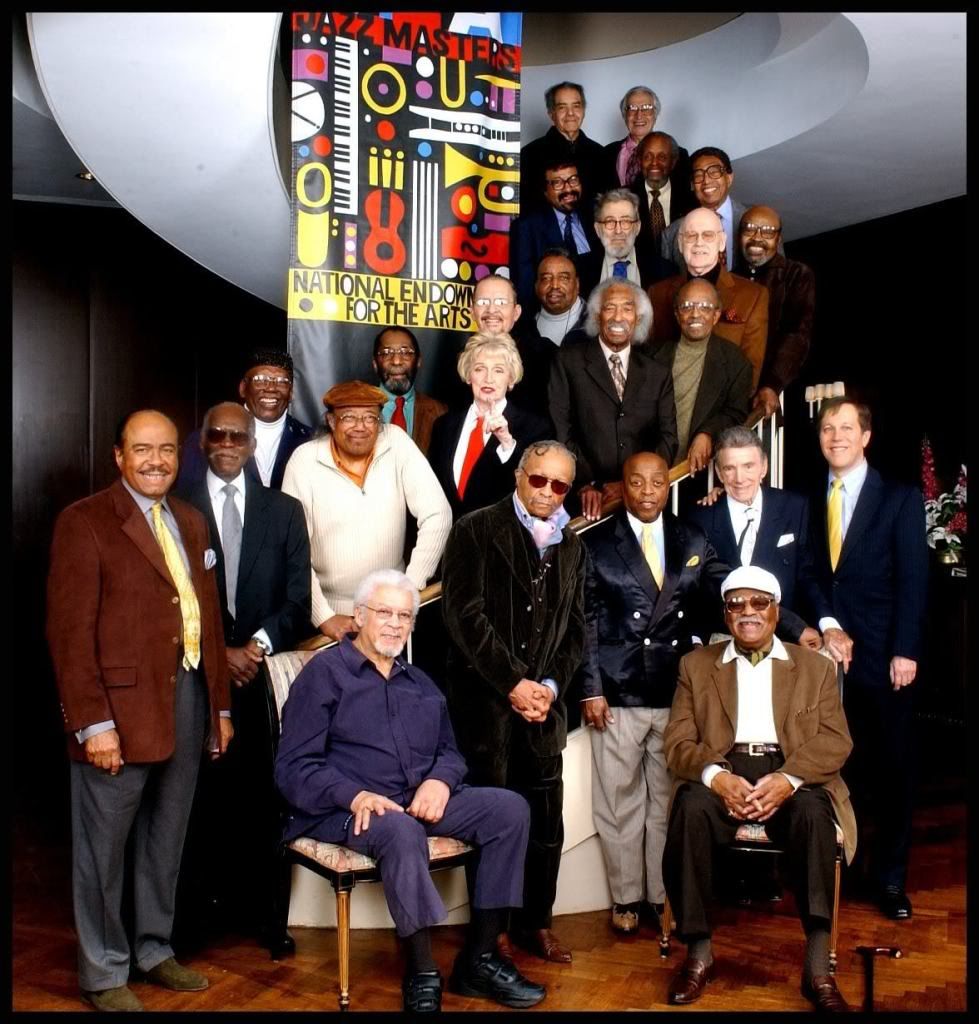
NEA Jazz Masters, 2004
left to right from back row:
George Russell, Dave Brubeck
David Baker, Percy Heath, Billy Taylor
Nat Hentoff, Jim Hall, James Moody
Jackie McLean, Chico Hamilton, Gerald Wilson, Jimmy Heath
Ron Carter, Anita O'Day
Randy Weston, Horace Silver
from left two standing gentlemen down the stairs: Benny Golson, Hank Jones
seated from left: Frank Foster, Clark Terry
and behind them, left to right: Cecil Taylor, Roy Haynes, Louie Bellson and Dana Gioia (chairman of NEA)
photo by Tom Pich
left to right from back row:
George Russell, Dave Brubeck
David Baker, Percy Heath, Billy Taylor
Nat Hentoff, Jim Hall, James Moody
Jackie McLean, Chico Hamilton, Gerald Wilson, Jimmy Heath
Ron Carter, Anita O'Day
Randy Weston, Horace Silver
from left two standing gentlemen down the stairs: Benny Golson, Hank Jones
seated from left: Frank Foster, Clark Terry
and behind them, left to right: Cecil Taylor, Roy Haynes, Louie Bellson and Dana Gioia (chairman of NEA)
photo by Tom Pich
©National Endowment for the Arts.
Wednesday, July 22, 2009
Nat Hentoff's Jazz Liner Notes - A List

READ MY PERSONAL TRIBUTE TO NAT HENTOFF (1925-2017) HERE.
Any attempt to compile a discography of albums whose liner notes are written by Nat Hentoff will be needing a team of ten devoted researchers who could go through thousands of not only jazz albums for major labels, but also material recorded for long defunct obscure ones and beyond jazz, for pop, easy listening, folk and country music. Any result, either as a comprehensive online database or an anthology of such writings in print would prove to be one of the most invaluable examples of music criticism and journalism in 20th century.
Here, with the permission of Mr. Hentoff himself, I started taking note of every jazz (and occasionally blues and folk) albums that I knew, and whenever possible, transcribing and adding the original notes to this blog.
| Aaron Weinstein | Blue Too | 2008 |
| Abbey Lincoln | Straight Ahead | 1961 |
| Abbey Lincoln | Talking to the Sun | 1983 |
| Ahmad Jamal | Legendary Okeh and Epic Recordings | 2005 |
| Air | New Air: Live at the Montreux Int'l Jazz Festival | 1983 |
| Al Casey | Buck Jumpin' | 1960 |
| Al Hibbler | Sings the Blues (Monday Everyday) | 1961 |
| Al Smith | Midnight Special | 1961 |
| Albert Ayler | In Greenwich Village | 1966 |
| Andre Previn's Trio Jazz | King Size! | 1958 |
| Andrew Hill | Compulsion | 2007 |
| Andrew Hill | Dance with Death | 1968 |
| Andrew Hill | Grass Roots | 1968 |
| Andrew Hill | Point of Departure | 1964 |
| Andy Williams | Andy Williams' Best/Under Paris Skies | 2000 |
| Anita O'Day | Anita O'Day Sings the Winners | 1958 |
| Anita O'Day | Cool Heat | 1959 |
| Archie Shepp | Down Home New York | 1984 |
| Archie Shepp | Fire Music | 1965 |
| Archie Shepp | On This Night | 1965 |
| Art Blakey | African Beat | 1962 |
| Art Blakey & the Jazz Messengers | Big Beat | 1960 |
| Art Blakey & the Jazz Messengers | Free for All | 1964 |
| Art Blakey & The Jazz Messengers | Freedom Rider | 1961 |
| Art Blakey & the Jazz Messengers | Hard Bop | 1956 |
| Art Blakey/Thelonious Monk | Art Blakey's Jazz Messengers with Thelonious Monk | 1957 |
| Art Blakey's Jazz Messengers | Night in Tunisia [1957] | 1957 |
| Art Davis | Life | 1985 |
| Art Farmer | Art [Essence of Jazz] | 1997 |
| Art Farmer | Art Farmer and the Jazz Giants | 1998 |
| Art Farmer | Modern Art | 1958 |
| Art Farmer | Portrait of Art Farmer | 1958 |
| Art Farmer | Warm Valley | 1982 |
| Art Farmer Quintet | Manhattan | 1981 |
| Art Hodes | Pagin' Mr. Jelly | 1988 |
| Art Pepper | Art Pepper + Eleven: Modern Jazz Classics | 1959 |
| Art Pepper | Modern Jazz Classics | 1959 |
| Art Pepper/Ted Brown | Complete Free Wheeling Sessions | 2006 |
| Babs Gonzales w/ Les Spann | Tales of Manhattan: The Cool Philosophy of Babs Gonza | 1959 |
| Barbara Carroll | Olds Friends | 1989 |
| Barbara Lea | Do It Again | 1983 |
| Barney Kessel | Aquarius: The Music from Hair | 1968 |
| Barney Kessel/Shelly Manne/Ray Brown | Poll Winners | 1957 |
| Barry Altschul | Irina | 1983 |
| Ben Webster | Complete Sextet Studio Sessions | 2006 |
| Ben Webster | Soul Of Ben Webster, The | 1957 |
| Ben Webster | Soulville | 1957 |
| Ben Webster | Warm Moods | 1960 |
| Ben Webster/Harry Edison/Johnny Hodges | Soul of Ben Webster/Gee Baby, Ain't I Good to You/Blu | 1995 |
| Benny Bailey | Big Brass | 1960 |
| Benny Bailey | Grand Slam | 1978 |
| Benny Carter | Jazz Giant | 1957 |
| Benny Carter | Norman Granz' Jazz In Montreux Presents Benny Carter | 2004 |
| Benny Golson | Benny Golson's New York Scene | 1957 |
| Benny Golson | Best of Benny Golson | 2009 |
| Benny Golson | Gone with Golson | 1959 |
| Benny Golson Quartet | Free | 1962 |
| Big Bill Broonzy | Big Bill's Blues Portrait | |
| Big Joe Turner/Jimmy Witherspoon | Patcha, Patcha All Night Long | 1985 |
| Bill Evans | New Conversations | 1978 |
| Bill Evans | New Conversations/We Will Meet Again | 2008 |
| Bill Evans | New Jazz Conceptions | 1956 |
| Bill Smith | Folk Jazz | 1959 |
| Billie Holiday | Anthology 1947-1956 | 2008 |
| Billie Holiday | At Carnegie Hall: The Billie Holiday Story, Volume 6 | 1956 |
| Billy Taylor | Ten Fingers, One Voice | 1999 |
| Blue Mitchell | Boss Horn | 1966 |
| Bob Brookmeyer | 7 X Wilder | 1961 |
| Bob Brookmeyer | Gloomy Sunday and Other Bright Moments | 1961 |
| Bob Brookmeyer | Mosaic Select: Bob Brookmeyer | 2004 |
| Bob Brookmeyer | Portrait of the Artist: Bob Brookmeyer | 1960 |
| Bob Brookmeyer | The Bob Brookmeyer Small Band: Live at Sandy's Jazz Revival | 1978 |
| Bob Brookmeyer | Traditionalism Revisited | 1957 |
| Bob Brookmeyer | Trombone Jazz Samba | 1962 |
| Bob Brookmeyer Small Band | Live at Sandy's Jazz Revival | 1978 |
| Bob Cooper | Coop! The Music of Bob Cooper | 1958 |
| Bob Dylan | Bob Dylan | 1962 |
| Bob Dylan | Freewheelin' Bob Dylan | 1963 |
| Bob Thiele | Twenties Score Again | 1984 |
| Bob Thiele Collective | Louis Satchmo | 1991 |
| Bob Wilber | Original Wilber | 1978 |
| Bobby Hutcherson | Components | 1965 |
| Bobby Short | Collectables Classics [Box Set] | 2006 |
| Booker Ervin | That's It | 1961 |
| Booker Little | Booker Little | 1960 |
| Booker Little | Out Front | 1961 |
| Bud Freeman | All Star Swing Sessions | 2003 |
| Bud Powell | Ups and Downs | 1964 |
| Buddy Bergman | Swinging Kicks | 1956 |
| Buddy DeFranco | Cooking the Blues | 1955 |
| Buddy DeFranco | I Hear Benny Goodman and Artie Shaw | 2007 |
| Buddy DeFranco | Sweet and Lovely | 1955 |
| Buddy Tate | Groovin' with Buddy Tate | 1959 |
| Buffy Sainte-Marie | Little Wheel Spin and Spin | 1966 |
| Cal Massey | Blues to Coltrane | 1961 |
| Carol Sloane | Love You Madly | 1988 |
| Carol Stevens & Phil Moore's Music/Dudle | That Satin Doll/The Theme from Beyond the Fringe and | 2000 |
| Cecil McBee | Music from the Source | 1977 |
| Cecil Taylor | Air | 1960 |
| Cecil Taylor | Cell Walk For Celeste | 1961 |
| Cecil Taylor | Conquistador | 2004 |
| Cecil Taylor | Jazz Advance | 1956 |
| Cecil Taylor | Jumpin' Punkins | 1961 |
| Cecil Taylor | Looking Ahead! | 1958 |
| Cecil Taylor | World of Cecil Taylor | 1960 |
| Cecil Taylor & Roswell Rudd | Mixed | 1998 |
| Cecil Taylor with Buell Neidlinger | New York City R&B | 1961 |
| Charles Lloyd | Only the Best of Charles Lloyd | 2009 |
| Charles Lloyd & Warne Marsh | Flowering/Warne Marsh | 1999 |
| Charles Mingus | Changes One | 1974 |
| Charles Mingus | Changes Two | 1974 |
| Charles Mingus | Charles Mingus Presents Charles Mingus | 1960 |
| Charles Mingus | Clown | 1957 |
| Charles Mingus | East Coasting | 1957 |
| Charles Mingus | Jazz Portraits: Mingus In Wonderland | 1959 |
| Charles Mingus | Me, Myself an Eye/Something Like a Bird | 2001 |
| Charles Mingus | Mingus Moves | 1973 |
| Charles Mingus | Mingus Plays Piano | 1963 |
| Charles Mingus | Mingus! | 1960 |
| Charles Mingus | Mingus, Mingus, Mingus, Mingus, Mingus | 1963 |
| Charles Mingus | Modern Jazz Symposium of Music and Poetry | 1957 |
| Charles Mingus | My Favorite Quintet | 1965 |
| Charles Mingus | Mysterious Blues | 1960 |
| Charles Mingus | Oh Yeah | 1961 |
| Charles Mingus | Passions of a Man: The Complete Atlantic Recordings | 1956 |
| Charles Mingus | Pithecanthropus Erectus | 1956 |
| Charles Mingus | Reincarnation of a Lovebird | 1961 |
| Charles Mingus | Three or Four Shades of Blue/Cumbia and Jazz Fusion | 2006 |
| Charlie Barnet | Cherokee | 1958 |
| Charlie Barnet | Everest Years | 2005 |
| Charlie Barnet & His Orchestra | More Charlie Barnet | 1958 |
| Charlie Haden Billy Higgins Enrico Piera | First Song | 1990 |
| Charlie Mingus | Tijuana Moods | 2007 |
| Charlie Shavers | Everest Years | 2005 |
| Charlie Shavers/Ray Bryant | Complete Recordings, Vol. 2 [Charlie Shavers/Ray Brya | 2005 |
| Chase | Chase | 1971 |
| Chase | Chase/Ennea/Pure Music | 2008 |
| Chet Atkins/Les Paul | Chester & Lester | 2007 |
| Chick Corea | Tones for Joan's Bones | 1966 |
| Chick Corea & Miroslav Vitous | Tones for Joan's Bones/Mountain in the Clouds | 1999 |
| Chico Freeman | Beyond the Rain | 1977 |
| Chico Hamilton Quintet | Different Journey | 1963 |
| Chubby Jackson | Chubby Takes Over | 1958 |
| Clark Terry | Color Changes | 1960 |
| Clark Terry | Norman Granz Jazz in Montreux: Presents Clark Terry S | 2005 |
| Clark Terry | Top and Bottom Brass | 1995 |
| Clark Terry | What a Wonderful World: For Lou | 1993 |
| Clark Terry & Bob Brookmeyer | Power of Positive Swinging | 1964 |
| Clark Terry & Bob Brookmeyer | The Power of Positive Swinging | 1964 |
| Clarke-Boland Big Band & Jimmy Giuffre | Clarke-Boland Big Band/Western Suite | 2000 |
| Claudio Fasoli | Lido | 1983 |
| Claudio Fasoli/Kenny Wheeler/Jean-Franco | Welcome | 1986 |
| Clifford Jordan | These Are My Roots: Clifford Jordan Plays Leadbelly | 1965 |
| Coleman Hawkins | Coleman Hawkins and Confreres | 1957 |
| Coleman Hawkins | Genius of Coleman Hawkins | 1957 |
| Coleman Hawkins | Good Old Broadway | 1962 |
| Coleman Hawkins | On Broadway | 1962 |
| Coleman Hawkins w/ Ben Webster | Coleman Hawkins Encounters Ben Webster | 1957 |
| Coleman Hawkins with Lester Young | Classic Tenors, Vol. 1 | 1989 |
| Count Basie | Norman Granz' Jazz In Montreux Presents: Count Basie | 2004 |
| Count Basie | Norman Granz' Jazz in Montreux Presents: Count Basie | 2006 |
| Count Basie with Oscar Peterson | Night Rider | 1978 |
| Curtis Counce | You Get More Bounce with Curtis Counce | 1956 |
| Curtis Fuller | Complete Blue Note/UA Curtis Fuller Sessions | 1957 |
| Curtis Fuller | Curtis Fuller, Vol. 3 | 1957 |
| Curtis Peagler & The Modern Jazz Discipl | Disciples Blues | 2001 |
| Dan Fogel | 15 West | 2006 |
| Dannie Richmond | In Jazz for the Culture Set | 1965 |
| Dave Brubeck | Live in '64 & '66 [DVD] | 2007 |
| Dave Glasser | Above the Clouds | 2006 |
| Dave Glasser | Dreams Askew, Dreams Anew | 2001 |
| Dave McKenna | Left Handed Compliment | 1979 |
| David Friesen | Two for the Show | 1994 |
| David Liebman Ensemble | John Coltrane's Meditations | 1998 |
| David Murray | Jazzosaurus Rex | 1993 |
| David Murray | Murray's Steps | 1982 |
| David Murray | MX | 1992 |
| David Murray | Saxmen | 1993 |
| David Murray Quartet | Black and Black | 1991 |
| De Franco, Buddy | Cooking the Blues/Sweet and Lovely | 2009 |
| Denise Jannah | Steve Allen's Songs | 1958 |
| Denny Zeitlin | Cathexis/Carnival | 1964 |
| Dexter Gordon | Lionel Hampton with Dexter Gordon | 1994 |
| Dexter Gordon | Live in '63 & '64 [DVD] | 2007 |
| Dexter Gordon | Our Man in Paris | 1963 |
| Dick Gregory | Best of Dick Gregory | 1997 |
| Dick Katz | Jazz Piano International | 1957 |
| Dino Betti Van Der Noot | Here Comes Springtime | 1985 |
| Dizzy Gillespie | Birks Works: The Verve Big-Band Sessions | 1995 |
| Dizzy Gillespie | Cool World | 1964 |
| Dizzy Gillespie | Have Trumpet, Will Excite! | 2001 |
| Dizzy Gillespie | Norman Granz Jazz in Montreux: Presents Dizzy Gillesp | 2005 |
| Dizzy Gillespie | Sittin' In | 1957 |
| Dizzy Gillespie/Sonny Stitt/Sonny Rollin | Sonny Side Up | 1957 |
| Dodo Greene | My Hour of Need | 1962 |
| Don Bagley | Basically Bagley | 1957 |
| Don Byrd & Gigi Gryce | Jazz Lab/Modern Jazz Perspective | 1995 |
| Don Ellis | How Time Passes | 1960 |
| Don Ellis | Out of Nowhere | 1961 |
| Don McLean | Legendary Songs of Don McLean | 2003 |
| Donald Byrd | Blackjack | 1967 |
| Donald Byrd | Byrd in Flight | 1960 |
| Donald Byrd | Cat Walk | 1961 |
| Donald Byrd | Electric Byrd | 1970 |
| Donald Byrd | Fancy Free | 1969 |
| Donald Byrd | Free Form | 2004 |
| Donald Byrd | Mustang! | 1966 |
| Donald Byrd | New Perspective | 1963 |
| Donald Byrd | Slow Drag | 1967 |
| Donald Byrd/Gigi Gryce & the Jazz Lab Pr | Complete Jazz Lab Studio Sessions, Vol. 1 | 2006 |
| Donald Byrd/Gigi Gryce & the Jazz Lab Pr | Complete Jazz Lab Studio Sessions, Vol. 2 | 2006 |
| Donald Byrd/Gigi Gryce & the Jazz Lab Pr | Complete Jazz Lab Studio Sessions, Vol. 3 | 2006 |
| Duke Ellington | Back Room Romp | 1936 |
| Duke Ellington | Braggin' in Brass: The Immortal 1938 Year | 1938 |
| Duke Ellington | Complete Gus Wildi Recordings and More | 2005 |
| Duke Ellington | In a Mellotone | 1940 |
| Duke Ellington With Johnny Hodges | Side by Side | 1958 |
| Duke Ellington with Teresa Brewer | It Don't Mean a Thing If It Ain't Got That Swing | 1991 |
| Duke Pearson | Honeybuns | 1965 |
| Duke Pearson | Phantom | 1968 |
| Duke Pearson | Right Touch | 1967 |
| Duke Pearson | Sweet Honey Bee | 1966 |
| Ed McCurdy | Best of Dalliance | 2003 |
| Eddie "Cleanhead" Vinson | I Want a Little Girl | 1981 |
| Eddie "Lockjaw" Davis | Norman Granz Jazz in Montreux: Presents Eddie Lockjaw | 2005 |
| Eddie Gomez | Dedication | 1998 |
| Edmond Hall | Petite Fleur | 1958 |
| Ella Fitzgerald | Norman Granz' Jazz In Montreux Presents: Ella Fitzge | 2006 |
| Ella Fitzgerald/Count Basie | Ella & Basie The Perfect Match '79 | 2004 |
| Ella Fitzgerald/Count Basie/Joe Williams | One O'Clock Jump | 1956 |
| Elmo Hope | Final Sessions | 1966 |
| Elmo Hope | Sounds from Rikers Island | 1963 |
| Emily Remler | East to Wes | 1988 |
| Enrico Pieranunzi | Deep Down | 1987 |
| Enrico Rava | Andanada | 1983 |
| Enrico Rava | Rava String Band | 1984 |
| Eric Dolphy | Last Date | 1964 |
| Eric Dolphy Quintet with Booker Little | Far Cry | 1960 |
| Erica Lindsay | Dreamer | 1989 |
| Ernie Watts | Reaching Up | 1993 |
| Ernie Wilkins | Everest Years | 2005 |
| Five Play | Five Play...Plus | 2005 |
| Frank Wess | Long Road | 2000 |
| Freddie Hubbard | Backlash | 1966 |
| Freddie Hubbard | Blue Spirits [Bonus Tracks] | 2004 |
| Freddie Hubbard | Ready for Freddie | 1961 |
| Freddie Redd Quintet | Shades of Redd | 1960 |
| Freddie Roach | Good Move! | 1963 |
| Frederick Fennell | Fennell Conducts Porter & Gershwin | 1993 |
| Gabor Szabo | Gypsy '66 | 1965 |
| Gabor Szabo | Sorcerer | 1967 |
| Gabor Szabo | Spellbinder | 1966 |
| Gato Barbieri | Bolivia/Under Fire | 2003 |
| Gato Barbieri | Chapter Three: Viva Emiliano Zapata | 1974 |
| Gato Barbieri | Third World Revisited, The | 1974 |
| Gene Ammons/Sonny Stitt/Jack McDuff | Soul Summit | 1961 |
| Gene Harris & Philip Morris | Big Band Soul: Live at Town Hall, N.Y.C./World Tour 1 | 2002 |
| Gene Harris w/ Philip Morris Superband | World Tour 1990 | 1990 |
| Gene Harris With Scott Hamilton | At Last | 1990 |
| George Benson | Giblet Gravy | 1968 |
| George Braith | Complete Blue Note Sessions | 2001 |
| George Lewis/His Ragtime Band | Hot Creole Jazz | 1953 |
| George Russell | Trip to Prillargui | 1970 |
| George Shearing and Hank Jones | Spirit of 176 | 1988 |
| Gerry Mulligan | Blues in Time | 1957 |
| Gerry Mulligan | Gerry Mulligan & Paul Desmond Quartet | 1994 |
| Gerry Mulligan | Gerry Mulligan and the Concert Jazz Band at the Villa | 2002 |
| Gerry Mulligan | Gerry Mulligan Meets Johnny Hodges | 1960 |
| Gerry Mulligan | Midas Touch: Live in Berlin | 2003 |
| Gerry Mulligan | Mosaic Select: Gerry Mulligan | 2007 |
| Gerry Mulligan | Songbook | 1957 |
| Gerry Mulligan/Paul Desmond | Quartet | 1957 |
| Gil Scott-Heron | Small Talk at 125th and Lenox | 1970 |
| Gloria Lynne | Best of the Everest Years | 2000 |
| Gloria Lynne | He Needs Me/This Little Boy of Mine | 1999 |
| Gloria Lynne | I Wish You Love [Everest] | 1964 |
| Gloria Lynne | Miss Gloria Lynne | 1958 |
| Gloria Lynne | Try a Little Tenderness | 1960 |
| Gloria Lynne | Try a Little Tenderness/I'm Glad There Is You | 1998 |
| Grant Green | Goin' West | 1962 |
| Grant Green | Grantstand | 1961 |
| Grant Green | Latin Bit | 1962 |
| Guido Manusardi | Down Town | 1985 |
| Gunther Schuller | Journey into Jazz | 2008 |
| Hal Galper Trio | Portrait | 1989 |
| Hampton Hawes | Four! Hampton Hawes!!!! | 1958 |
| Hank Crawford | Dig These Blues/After Hours | 2004 |
| Hank Crawford | Memphis, Ray and a Touch of Moody | 1960 |
| Hank Crawford | Only the Best of Hank Crawford | 2009 |
| Hank Crawford | Soul of the Ballad | 1963 |
| Hank Mobley | Reach Out | 1968 |
| Harold Land | Harold in the Land of Jazz | 1958 |
| Harry "Sweets" Edison | Swinger/Mr. Swing | 1999 |
| Harry Edison | Mr. Swing | 1958 |
| Harry James | Golden Trumpet Of | 2004 |
| Helen Humes | Tain't Nobody's Biz-ness If I Do | 1959 |
| Herb Ellis | Herb Ellis Meets Jimmy Giuffre | 1959 |
| Herb Ellis | Nothing But the Blues | 1957 |
| Herbie Hancock | Complete Blue Note Sixties Sessions | 1998 |
| Herbie Hancock | Great Sessions | 2006 |
| Herbie Hancock | Inventions & Dimensions | 1963 |
| Herbie Hancock | Speak Like a Child | 1968 |
| Herbie Nichols | Love, Gloom, Cash, Love | 1957 |
| Herbie Nichols Trio | Complete Studio Master Takes (Herbie Nichols Trio) | 2005 |
| Horace Parlan | Us Three | 1960 |
| Horace Silver | Stylings of Silver | 1957 |
| Howard McGhee | Maggie's Back in Town!! | 1961 |
| Ian & Sylvia | Ian & Sylvia | 1962 |
| Ike Quebec | Bossa Nova Soul Samba | 1998 |
| Ike Quebec | It Might as Well Be Spring | 1961 |
| Ike Quebec | Soul Samba | 1962 |
| J.J. Johnson | J.J.'s Broadway | 1963 |
| J.R. Monterose | Complete Studio Recordings | 2008 |
| J.R. Monterose | Message | 1959 |
| Jack Wilkins | Merge | 1977 |
| Jack Wilkins | Reunion | 2001 |
| Jackie King & Willie Nelson | Gypsy | 2001 |
| Jackie McLean | Action | 1964 |
| Jackie McLean | 'Bout Soul | 1967 |
| Jackie McLean | Makin' the Changes | 1957 |
| Jackie McLean | New and Old Gospel | 1967 |
| Jackie McLean/Mal Waldron Original Quart | Jackie McLean/Mal Waldron Original Quartet: Complete | 2006 |
| Jackie Paris | Nobody Else But Me | 1994 |
| Jaki Byard | Blues for Smoke | 1960 |
| Jaki Byard | Hi-Fly | 1962 |
| Jan Garbarek | Esoteric Circle | 1969 |
| Jane Harvey | Other Side of Sondheim | 2009 |
| Jazz at the Philharmonic | Jazz at the Philharmonic '75 | 2005 |
| Jeannie and Jimmy Cheatham | Basket Full of Blues | 1991 |
| Jelly Roll Morton | Original Versions Of The Music Inspiring "Jelly's Last Jam" | 1992 |
| Jim Cullum Jazz Band | Chasin' the Blues | 2006 |
| Jim Hall | Jim Hall's Three | 1986 |
| Jim Hall | Storyteller: Circles/All Across the City | 2002 |
| Jim Hall Quartet | All Across the City | 1989 |
| Jim Kweskin Band/Samoa Wilson | Now and Again | 2003 |
| Jimmy Cleveland | Cleveland Style | 1957 |
| Jimmy Giuffre | Quasar | 1985 |
| Jimmy Giuffre/Jim Hall Trio | Jimmy Giuffre/Jim Hall Trio: Complete Studio Recordin | 2008 |
| Jimmy Knepper | Swinging Introduction to Jimmy Knepper | 1957 |
| Jimmy Rushing | Jazz Odyssey of James Rushing, Esq./Jimmy Rushing & S | 2008 |
| Jimmy Smith | Open House/Plain Talk | 1960 |
| Jimmy Witherspoon | Roots | 1962 |
| Jimmy Woods | Awakening | 1962 |
| Jo Jones | Everest Years | 2005 |
| Joan Baez | Joan Baez, Vol. 2 | 1961 |
| Joanne Brackeen | Popsicle Illusion | 2000 |
| Joanne Brackeen | Special Identity | 1981 |
| Joanne Brackeen & Friends | Fi-Fi Goes to Heaven | 1986 |
| Joanne Brackeen Trio | Havin' Fun | 1985 |
| Joe Henderson | Inner Urge | 1964 |
| Joe Newman Quintet | Jive at Five | 1960 |
| Joe Pass | Norman Granz Jazz in Montreux 75 [DVD] | 2006 |
| John Coltrane | Best of John Coltrane [Atlantic] | 1960 |
| John Coltrane | Expression | 1967 |
| John Coltrane | Giant Steps | 1959 |
| John Coltrane | Impulse! Albums, Vol. 1 | 2007 |
| John Coltrane | Impulse! Albums, Vol. 3 | 2009 |
| John Coltrane | Interplay | 2007 |
| John Coltrane | Kulu Se Mama | 1965 |
| John Coltrane | Live at the Village Vanguard | 1961 |
| John Coltrane | Live at the Village Vanguard Again! | 1966 |
| John Coltrane | Live in '60, '61 & '65 [DVD] | 2007 |
| John Coltrane | Meditations | 1965 |
| John Coltrane | Om | 1965 |
| John Coltrane | Transition | 1965 |
| John Coltrane | Very Best of John Coltrane [Rhino] | 2000 |
| John Coltrane Quartet | Crescent | 1964 |
| John Coltrane With Archie Shepp | New Thing at Newport | 1965 |
| John Fahey | Of Rivers & Religion/After The Ball | 2004 |
| John Fahey | Of Rivers and Religion | 1972 |
| John Hicks | Crazy for You | 1992 |
| John Hicks | Friends Old and New | 1992 |
| John Hicks | Lover Man: Tribute to Billie Holiday | 1993 |
| John Lee Hooker | Travelin' | 1960 |
| John Lewis | Odds Against Tomorrow [Original Soundtrack] | 1959 |
| John Lewis | Very Best of John Lewis | 2002 |
| John Stowell/Lynn Skinner | Lines & Spaces | 1992 |
| Johnny Richards | Mosaic Select: Johnny Richards | 2005 |
| Josh White | Chain Gang Songs | 1958 |
| Junior Mance | Junior | 1959 |
| Karrin Allyson | Ballads: Remembering John Coltrane | 2001 |
| Kenny Cox and the Contemporary Jazz Quin | Introducing Kenny Cox And The Contemporary Jazz Quint | 2007 |
| Kenny Dorham | Show Boat | 1960 |
| Kenny Dorham | Trompeta Toccata | 1964 |
| Kenny Dorham | Una Mas | 1963 |
| Kenny Drew | It Might As Well Be Spring | 1981 |
| Kenny Drew Trio | Your Soft Eyes | 1981 |
| Kim Parker | Sometimes I'm Blue | 1985 |
| King Curtis | New Scene of King Curtis | 1960 |
| Kit McClure | Just the Thing: The Sweethearts Project Revisited | 2006 |
| Kit McClure | Sweethearts Project | 2006 |
| Larry Ham | Just Me, Just You | 2008 |
| Larry Young | Unity | 1965 |
| Lee Konitz | Live at Laren | 1979 |
| Lee Konitz | Motion | 2003 |
| Lee Konitz | Very Cool/Tranquility | 2006 |
| Lee Morgan | Dizzy Atmosphere | 2008 |
| Lee Morgan | Expoobident | 1960 |
| Lee Morgan | Gigolo | 1965 |
| Lee Morgan | Lee Morgan, Vol. 3 | 1957 |
| Lee Morgan | Lee-Way | 1960 |
| Lee Wiley | Manhattan Moods: Outstanding Live Recordings | 2001 |
| Lennie Tristano | Complete Atlantic Recordings of Lennie Tristano, Lee | 1954 |
| Lenny Bruce | Shut Your Mouth and Open Your Mind: The Rise & Reckle | 2003 |
| Leroy Vinnegar Sextet | Leroy Walks! | 1957 |
| Lew Tabackin Quartet | I'll Be Seeing You | 1992 |
| Lightnin' Hopkins | Broken Hearted Blues | 2003 |
| Lightnin' Hopkins | In New York | 1970 |
| Lightnin' Hopkins | Lightnin' In New York | 1970 |
| Lodi Carr | Lady Bird | 1992 |
| Lonnie Liston Smith | Astral Traveling [Expanded] | 2002 |
| Lonnie Liston Smith | Golden Dreams | 1973 |
| Lonnie Liston Smith | Watercolors | 1991 |
| Lonnie Liston Smith & The Cosmic Echoes | Expansions | 1974 |
| Lorraine Feather | Such Sweet Thunder: Music of the Duke Ellington Orche | 2004 |
| Lou Donaldson | Sunny Side Up | 1960 |
| Louie Bellson/Clark Terry | Louie & Clark Expedition, Vol. 2 | 2007 |
| Louis Armstrong | Satchmo the Great | 1955 |
| Louis Armstrong | Stardust | 1931 |
| Luckey Roberts & Willie "The Lion" Smith | Luckey & the Lion: Harlem Piano | 1958 |
| Lucky Thompson/Oscar Pettiford | Lucky Thompson Meets Oscar Pettiford | 2006 |
| Lucy Reed | This Is Lucy Reed | 1957 |
| Mal Waldron | Update | 1986 |
| Manny Albam | Blues Is Everybody's Business [Gambit] | 2005 |
| Mary Lou Williams | Norman Granz' Jazz In Montreux Presents Mary Lou Will | 2004 |
| Mary Lou Williams | Solo Recital (Montreux Jazz Festival 1978) | 1978 |
| Mat Matthews | Meditation | 1995 |
| Max Roach | Award Winning Drummer | 1959 |
| Max Roach | Drums Unlimited | 1965 |
| Max Roach | Max Roach Trio, Featuring the Legendary Hasaan/Drums | 1999 |
| Max Roach | We Insist! Max Roach's Freedom Now Suite | 1960 |
| McCoy Tyner | 44th Street Suite | 1991 |
| McCoy Tyner | Inception | 1962 |
| McCoy Tyner | Real McCoy | 1967 |
| Mel Tormé | Comin' Home Baby! | 1962 |
| Mel Tormé | Tormé | 1958 |
| Memphis Slim | Memphis Slim U.S.A. | 1961 |
| Memphis Slim | Raining the Blues | 1973 |
| Memphis Slim | Tribute to Big Bill Broonzy etc. | 1961 |
| Michael Franks | Previously Unavailable | 1983 |
| Miles Davis | Collection: Sketches of Spain/Kind of Blue/In a Silen | 2005 |
| Miles Davis | Complete Studio Recordings | 1998 |
| Miles Davis | Miles Davis and Horns 51-53 | 1955 |
| Miles Davis | Miles Davis: The Columbia Years 1955-1985 | 1956 |
| Miles Davis | My Funny Valentine | 1964 |
| Miles Davis | Sketches of Spain | 1959 |
| Miles Davis | Very Best of Miles Davis [Australia] | 1998 |
| Miles Davis/Gil Evans | Miles Davis and Gil Evans: Complete Columbia Studio R | 1957 |
| Millie Vernon | Sings Old and New Shoes | 2007 |
| Milt Jackson | Bags' Opus | 1958 |
| Milt Jackson | Ballad Artistry of Milt Jackson/Vibrations | 1999 |
| Milt Jackson | Plenty, Plenty Soul | 1957 |
| Milt Jackson | Statements | 1961 |
| Milt Jackson/Coleman Hawkins | Bean Bags | 1958 |
| Milt Jackson/Ray Brown | Milt Jackson & Ray Brown '77 | 2004 |
| Mingus Big Band | Essential Mingus Big Band | 2001 |
| Mingus Dynasty | Chair in the Sky | 1980 |
| Mississippi John Hurt | Today! | 1966 |
| Mitchel Forman Quintet | Mr. Clean | 2001 |
| Mitchell Forman | Only a Memory | 1982 |
| Modern Jazz Quartet | Together Again - "Echoes" | 1984 |
| Mose Allison | Collectables Classics [Box Set] | 2006 |
| Mose Allison | I Don't Worry About a Thing | 1962 |
| Nancy Harrow | Wild Women Don't Have the Blues | 1960 |
| New Air | Air Show No. 1 | 1987 |
| Oliver Lake | Clevont Fitzhubert | 1981 |
| Oliver Nelson | Live from Los Angeles | 1967 |
| Oliver Nelson | Oliver Nelson Plays Michelle | 1966 |
| Oliver Nelson | Screamin' the Blues | 1960 |
| Oliver Nelson | Skull Session | 1975 |
| Oliver Nelson | Sound Pieces | 1966 |
| Original Soundtrack | Martin Scorsese Presents the Blues: Piano Blues | 2003 |
| Ornette Coleman | Music Of Ornette Coleman: Something Else!!!, | 1958 |
| Ornette Coleman | Ornette! [Bonus Track] | 2004 |
| Ornette Coleman | Something Else!!!!:The Music of Ornette Coleman | 1958 |
| Ornette Coleman | Tomorrow Is the Question! | 1959 |
| Oscar Peterson Trio | Norman Granz' Jazz in Montreux Presents Oscar Peterso | 2004 |
| Oscar Peterson with Milt Jackson | Very Tall | 1961 |
| Otis Spann | Otis Spann Is the Blues | 1960 |
| Paul Bley | Hot | 1985 |
| Paul Bley | Tango Palace | 1983 |
| Paul Motian | Story of Maryam | 1983 |
| Pee Wee Russell Quartet | Ask Me Now! | 1965 |
| Pee Wee Russell/Coleman Hawkins | Jazz Reunion | 1961 |
| Peggy Lee | Peggy at Basin Street East | 2002 |
| Pharoah Sanders | Tauhid | 1966 |
| Phil Woods | Rights of Swing | 1960 |
| Philly Joe Jones | Philly Joe's Beat/Philly Joe & Elvin Jones Together! | 1999 |
| Phineas Newborn | Fabulous Phineas | 1958 |
| Prince Lasha With Sonny Simmons | Firebirds | 1967 |
| Quincy Jones | Q: The Musical Biography of Quincy Jones | 2001 |
| Randy Brecker | Score | 1969 |
| Randy Weston | Mosaic Select: Randy Weston | 2003 |
| Ray Bryant | Ray Bryant '77 | 2004 |
| Ray Bryant | Ray Bryant Plays | 1995 |
| Ray Bryant Trio | Now's the Time | 1959 |
| Ray Charles | Genius of Ray Charles | 1959 |
| Ray Charles | Pure Genius: The Complete Atlantic Recordings | 2005 |
| Ray Crawford | Smooth Groove | 1961 |
| Raymond Scott & Secret 7 | Unexpected | 1960 |
| Red Garland Quintet | Soul Junction | 1957 |
| Red Mitchell | Presenting Red Mitchell | 1957 |
| Richard Williams | New Horn in Town | 1960 |
| Ricky Ford | Manhattan Blues | 1989 |
| Roman Kunsman | Heavy Skies | 2003 |
| Roosevelt Sykes | Honeydripper | 1997 |
| Roots | Saying Something | 1995 |
| Roswell Rudd/Steve Lacy/Han Bennink/Kent | Regeneration | 1982 |
| Roy Eldridge | Roy Eldridge '77 | 2004 |
| Roy Haynes | Birds of a Feather: A Tribute to Charlie Parker | 2001 |
| Roy Haynes | Just Us | 1960 |
| Ruby Braff | Music From My Fair Lady | 1989 |
| Rufus Reid | Yours and Mine | 1991 |
| Sam Rivers | Complete Blue Note Sam Rivers Sessions | 1964 |
| Sam Rivers | Fuchsia Swing Song | 1964 |
| Scott Hamilton Quintet | Right Time | 1986 |
| Sheila Jordan | Portrait of Sheila Jordan | 1963 |
| Shelly Manne | Gambit | 1957 |
| Shelly Manne & His Men | Shelly Manne & His Men, Vol. 2 | 1953 |
| Shelly Manne & His Men | Vol. 4: Swinging Sounds | 1956 |
| Sidney Bechet | Fabulous Sidney Bechet | 1958 |
| Simon Rowe | Flamingo | 2002 |
| Sonny Clark | Cool Struttin' [DVD] | 2005 |
| Sonny Clark | Sonny Clark Trio [1957] | 1957 |
| Sonny Rollins | Alfie | 1966 |
| Sonny Rollins | East Broadway Run Down | 1966 |
| Sonny Rollins | On Impulse! | 2005 |
| Sonny Rollins | Sonny Rollins [Prestige] | 1972 |
| Sonny Rollins | Sonny Rollins on Impulse! | 1965 |
| Sonny Stitt | New York Jazz | 1956 |
| Sonny Stitt | Only the Blues | 1957 |
| Sonny Stitt | Personal Appearance | 1957 |
| Stan Getz | Stan Getz in Stockholm | 1956 |
| Stan Getz | Stan Meets Chet | 1958 |
| Stan Getz & The Oscar Peterson Trio | Stan Getz and the Oscar Peterson Trio | 1957 |
| Stan Getz Quintette | Jazz at Storyville | 1951 |
| Stan Getz/Bob Brookmeyer | Recorded Fall 1961 | 2002 |
| Stanley Turrentine | Do You Have Any Sugar? | 1999 |
| Stanley Turrentine | Easy Walker | 1966 |
| Stanley Turrentine | Never Let Me Go | 1963 |
| Stephane Grappelli | My Other Love | 1990 |
| Stephane Grappelli/McCoy Tyner | One On One | 1990 |
| Steve Allen | Soulful Brass #3 | 1971 |
| Steve Kuhn | October Suite: Three Compositions of Gary McFarland | 1966 |
| Steve Lacy | Flame | 1982 |
| Steve Lacy | Straight Horn of Steve Lacy | 1960 |
| Steve Lacy with Don Cherry | Evidence | 1961 |
| Steve Wolfe/Nancy King | First Date | 2001 |
| String Trio of New York | Common Goal | 1983 |
| Sun Ra Quartet | Other Voices, Other Blues | 1978 |
| Sunnyland Slim | Slim's Shout | 1969 |
| Taft Jordan | Mood Indigo | 1961 |
| Tal Farlow | This Is Tal Farlow | 1958 |
| Ted Curson | New Thing and the Blue Thing | 1965 |
| Ted Curson | Plenty of Horn | 1961 |
| Teddi King | Girl and Her Songs | 1957 |
| Teddy Wilson | Touch of Teddy Wilson | 2007 |
| Teddy Wilson Trio/Jo Jones | Complete Recordings | 2007 |
| Tenacity | Tenacity | 1997 |
| Teo Macero | Impressions of Charles Mingus | 1983 |
| Teresa Brewer | American Music Box, Vol. 2 | 1993 |
| Teresa Brewer | Come Follow the Band | 1991 |
| Teresa Brewer | Memories of Louis | 1991 |
| Teresa Brewer | Softly I Swing | 1991 |
| Teresa Brewer with Count Basie | Songs of Bessie Smith | 1973 |
| The Bud Powell Trio | Blues in the Closet | 2005 |
| The Gil Evans Orchestra | Into the Hot | 1961 |
| The Jazztet | Real Time | 1992 |
| The Kingston Trio | At Large/Here We Go Again | 1959 |
| The Kingston Trio | Kingston Trio at Large/Here We Go Again! | 2001 |
| The Leiber & Stoller Big Band | Yakety Yak | 1960 |
| The Modern Jazz Quartet | Complete Last Concert | 1974 |
| The Modern Jazz Quartet | Echoes | 1984 |
| The Modern Jazz Quartet | Last Concert | 2008 |
| The Modern Jazz Quartet | Modern Jazz Quartet: 1957 | 2002 |
| The Other Side | From the Other Side | 1989 |
| The Paul Cacia Jazz Orchestra | Legacy: The Last Sessions | 2006 |
| The Phil Woods Quintet | American Songbook | 2006 |
| The Sandole Brothers | Sandole Brothers and Guests | 2001 |
| Thelonious Monk | Monk in Paris: Live at the Olympia | 2003 |
| Thelonious Monk | Monk's Dream | 2002 |
| Thelonious Monk | Original Album Classics | 2007 |
| Theo Croker | In the Tradition | 2009 |
| Tim Berne | Mutant Variations | 1983 |
| Tito Puente | Night Beat | 1957 |
| Tom Varner | Motion/Stillness | 1982 |
| Tommy Flanagan | Norman Granz' Jazz in Montreux Presents Tommy Flanaga | 2005 |
| Tommy Turrentine | Tommy Turrentine | 1960 |
| Tony Bennett | Bennett Sings Ellington: Hot & Cool | 1999 |
| Tony Bennett | Fifty Years: The Artistry of Tony Bennett | 2004 |
| Tony Bennett | Hall of Fame Hits | 2006 |
| Tony Pastor | Tony Pastor Plays and Sings Shaw | 195 |
| Tony Scott | Jazz Life | 2007 |
| Toshiko Akiyoshi with Lew Tabackin | Carnegie Hall Concert | 1991 |
| Toshiko Mariano Quartet | Toshiko Mariano Quartet | 1961 |
| Various Artists | Atlantic Jazz: 12 Vol. Box Set | 1990 |
| Various Artists | Atlantic Jazz: The Avant Garde | 1986 |
| Various Artists | Capitol Records 1942-2002 | 2002 |
| Various Artists | Charlie Parker 10th Memorial Concert 3/27/65 | 1965 |
| Various Artists | Complete Gershwin Songbooks | 1995 |
| Various Artists | Contemporary Records Story | 2004 |
| Various Artists | Encyclopedia of Jazz | 2001 |
| Various Artists | Gershwin Songbook: 'S Paradise | 1995 |
| Various Artists | Great Night in Harlem | 2002 |
| Various Artists | Interpretations of Monk, Vol. 1 | 1997 |
| Various Artists | Jazz Giants Play Jerome Kern: Yesterdays | 1998 |
| Various Artists | Jazz Life | 1982 |
| Various Artists | Legendary Jazz | 1998 |
| Various Artists | Lone Hill Jazz Collection: Jazz Greats, Vol. 1 | 2005 |
| Various Artists | NEA Jazz Masters | 2004 |
| Various Artists | Newport Rebels | 1960 |
| Various Artists | Original Jazz Classics: The Prestige Sampler | 1988 |
| Various Artists | Percussion and Guitars | 2000 |
| Victor Feldman | Arrival of Victor Feldman | 1958 |
| Walt Dickerson/Sirone/Andrew Cyrille | Life Rays | 1982 |
| Wayne Shorter | All Seeing Eye | 1965 |
| Wayne Shorter | JuJu | 1964 |
| Wayne Shorter | Night Dreamer | 1964 |
| Wild Bill Davison | Lady of the Evening | 1968 |
| Woody Herman | Everest Years | 2005 |
| Woody Herman | Herd Rides Again | 1958 |
| Woody Herman & Tito Puente | Herman's Heat & Puente's Beat | 1958 |
| Woody Herman & Tito Puente | Herman's Heat & Puente's Beat | 1958 |
| Woody Shaw | Blackstone Legacy | 1970 |
| World's Greatest Jazz Band | Way Out West | 1996 |
| Wynton Kelly | Kelly at Midnight | 1960 |
| Yusef Lateef | Golden Flute | 1966 |
| Yusef Lateef | Into Something | 1961 |
| Yusef Lateef | Yusef's Mood: Complete 1957 Sessions with Hugh Lawson | 2008 |
| Zoot Sims with Jimmy Rowles | Warm Tenor | 1978 |
Subscribe to:
Posts (Atom)