Showing posts with label Hank Jones. Show all posts

Monday, August 3, 2015

Bud Powell: Two French Interviews


This post presents a transcribed interview (along with the original audio clip) of Bud Powell, conducted in France where he was recuperating from tuberculosis at the Boullemont Sanatorium.

I heard it the first time as the last track from an exceptional CD, Inner Fires, which featured Bud’s trio with Charlie Mingus and Roy Haynes at Club Kavakos, Washington D. C from April 5, 1953.

Interestingly, the album came out as a part Bill Potts collection, a Washingtonian pianist who accompanied Lester Young in his legendary Washington concerts, released in five volumes.

Although Bud Powell was very sick at the time, his comments lend insight into his not so accessible musical universe.


First Interview: January 15, 1963

You may already know that Bud is suffering from tuberculosis and is now recuperating in a sanatorium near Paris. We went to see him there and tried to interview him. I say 'tried' because Bud is extremely weak now, and it was necessary to ask him the same question several times before he was able to respond. It was also technically difficult to conduct this interview, but I think that despite all this we were able to assemble enough good material for you to hear.

Q: Bud, you told me that you’ve written a new tune since your arrival at the hospital. Would you please tell me its name and give me an idea of how it goes?

A: I wrote In the Mood for a Classic. [Bud sings]

Q: Bud, for whom did you compose this piece?

A: I composed it for France in general.

Q: Who are your favorite players?

Thursday, July 31, 2014

Hank Jones on Al Haig

Henry "Hank" Jones (July 31, 1918 – May 16, 2010)


Hank Jones remembers his early Bop influences after leaving the Detroit area. He put a stress on the role of Al Haig in finding his own musical voice which was not a total departure from the Teddy Wilson tradition, but it was more a modern variation of that:

"When I first got to New York, one of the first groups I heard was the Dizzy Gillespie-Charlie Parker group. Al Haig was the pianist at the time: Now I understand that he and Bud Powell alternated with the group, as did Max Roach and Stan Levey on drums. But during the initial period when I first came to New York, Al Haig was the pianist.

Monday, March 17, 2014

Last of the Trumpet Masters


This would be the final post from the Trumpet Masters' session in Switzerland, a concert whose footage is now fully presented on this blog.

"Handsome, dark chocolate, a ladies magnet," is Clark Terry's description of Harry "Sweets" Edison, the subject of the first video. Terry met Sweets first in the Basie band: "Svelte physique draped in expensive threads, dripping with accents of rich gold and pristine diamonds. The note that floated through his trumpet made you feel his statement of 'Cool Daddy. Laid-back.'"

Thursday, February 20, 2014

Strays On

 "I referred to him like a lot of the cats did, as 'Strays,'" says Clark Terry of Billy Strayhorn in his autobiography, Clark, which has a lot to say about Ellington years and the people of that tribe.

In a short chapter of the book, dedicated to "Strays," there is nothing but admiration and deep respect for the man and his music both as a composer/arranger and piano player. "Strays was like a breath of fresh air," says Mr Terry, "he had an almost spiritual touch in his writing. Deep undertones that would draw emotion and dig into the psyche." So true.

There are some stories in Clark about the relationship between Duke and Strays, whether artistically, emotionally ("he had a way of calming Duke") or even financially for which CT remembers:

"Strays was a man who lived the most unique life style of anybody. He had no bills: no hotel bills, no apartment bills, no food bills, no clothes or tax bills. No nothing. He didn't have a salary, either. He just signed a tab. Duke paid for everything."

Wednesday, February 19, 2014

Clark Terry Jives at 5 with Sweets


Back to the Bern Jazz Festival concerts and the Trumpet Summit session, I have another video to present. This one's from the same session as here and here and here, and features Clark Terry and Harry "Sweets" Edison in a performance of Jive at Five.

CT is very fond of Switzerland. He has played there, especially in Bern, many times over the last 5 decades. Even there is a hotel suite in Bern named after him and I believe he had an operation and treatment in Switzerland at some point, probably related to his cancer.

However, in this concert footage, one can hardly see signs of fatigue or malady. Jive at Five is fun and relaxed, and one of the last documentations of these masters playing and jiving together.

Thursday, January 30, 2014

Drop Doc Cheatham Off In Harlem

photo by Marc Marnie

Another video from the Legendary Trumpet Masters session in Bern. Here, as a special tribute to Doc Ceatham, he has been given space for a solo on Drop Me Off In Harlem. For accompanists, Hank Jones is on piano, Jesper Lundgaard on bass and Clarence Penn on drums.

Thursday, October 17, 2013

Four Trumpet Masters


I'm knee-deep into London Film Festival and an overdose in film has kept me away from this venue and blogging on jazz. For the sake of reassurance, and promsing that I would return to jazz life soon, I'm posting a recent VHS transfer of a fabulous trumpet summit in which the cream of Ellington and Basie trumpet alumni are on stage together: Joe Wilder, Snooky Young, Harry "Sweets" Edison and Clark Terry!

The event was originally presented as the Legendary Trumpet Masters at the Jazzfestival Bern '97 (May 1) in Switzerland. In addition to the trumpets, our favorite Hank Jones is on piano, Jesper Lundgard on bass and Clarence Penn on drums. The whole concert (also featuring Doc Cheatham), including its nine songs, intro and interviews was broadcast on Swiss and German TVs in 1997.

Thursday, September 5, 2013

Cootie, Rex and Hawk: Together


The year is 1957, and the session, one of the most enduring in jazz history. If you like cinema, an analogy can be made between this session and a film called RoGoPag, directed by Roberto Rossellini, Jean-Luc Godard and Piere Paolo Passolini. The session is simply called Together, alluding to the mere excitement of putting together the cream of Mainstream musicians under one roof and they blow with such versatility and ease. The Rosellini of the session is Coleman Hawkins, it's Godard, Cootie Williams, and Rex Stewart being its PPP.

For the list of other musicians supporting the Three Musketeers scroll down the page to see a scan of the liner notes, penned by no one but Monsieur André Hodeir (The LP came out in France.)

The audio file's from David W. Niven's vault, accompanied by his commentary (info mostly comes from the liner notes) between the tracks.

Thursday, November 25, 2010

Good Morning Blues#3: Autumn Leaves


I've been assigned to write an article about Yves Montand for an Iranian film journal. Naturally the main focus is on Montand's career as an actor rather than his immense popularity and controversy as a singer and left activist. (for that other persona, how about revisiting Chris Marker's The Lonliness of the Long-distance Singer, made in 1974?)

No portrait of Montand is complete without pointing to the historical moment in French popular culture in which he sang Les feuilles mortes in his second acting experience in Marcel Carne's Les Portes de la Nuit, of course with persuasions of his then lover, Edith Piaf. In this 1946 and rather late entry to the Poetic realist cinema, Montand performed the harmonies and melodies written by Joseph Kosma and lyrics of the renowned poet Jacques Prévert.

Montand's lover and mentor made it a huge hit later:

Edith Piaf version

Later, in 1947, songwriter Johnny Mercer wrote English lyrics and Jo Stafford was among the first to perform the English version. Soon the Autumn Leaves became a jazz standard, and only in my personal catalog I own nearly 200 different interpretations of the song by artists such as Jack Teagarden/Earl Hines, Johnny Smith, Jimmy Smith, Zoot Sims, Artie Shaw, Coleman Hawkins/Roy Eldridge, Gene Ammons/Sonny Stitt, Arnette Cobb/Joe Henderson, Stan Kenton, Wynton Kelly, Bill Evans, Chet Baker, Art Pepper, Jimmy Forest, Toots Thielmans/Joe Pass, Charlie Rouse/Julius Watkins, Stan Getz, Dizzy Gillespie, Chick Corea, Jack McDuff, Erroll Garner, George Shearing, Ben Webster, Buddy De Franco, Sonny Stitt/Hank Jones, Joe Diorio, Booker Ervin/Larry Young, James Moody, Oscar Peterson. Even very recently Eric Clapton did a pop version of it for his new album of standard. And there are still more takes:

Of course, one of the most famous interpretations comes from Cannonball Adderley, Miles Davis and Hank Jones in Blue Note 1595.
Miles Davis (t), Cannonball Adderley (as), Hank Jones (p), Sam Jones (b), Art Blakey (d), 1958

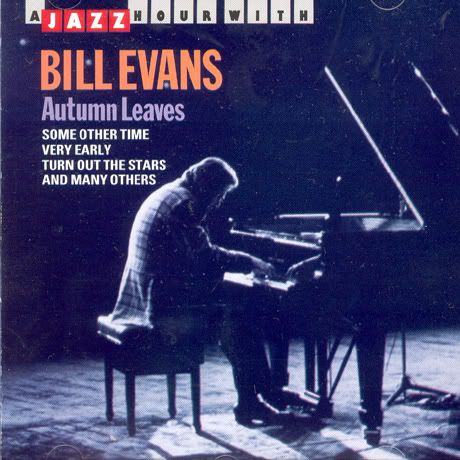
Bill Evans recorded the song many times, with his trio (and occasionally a quartet). From 1959 to 1969 he almost played it every year and re-recorded it for various albums. Again, at the end of 1970s, and in his last years, he began playing the tune. Even a compilation album of his was named Autumn Leaves.

I heard a beautiful take on the song, from Mary Lou Williams in a compilation LP, The First Lady of the Piano. Dizzy and Bobby Hackett accompanied her.
Zoot Sims played it in his Either Way (1961) LP. I strongly believe he has created a very strong, and like anything else he has recorded, deeply emotional recreation. Check him here, in the 1980s, returning to the song for a trio:
In 1974 Chet Baker recorded a version (She Was Too Good To Me, CTI 6050 S1) with a improvisational solo which has acknowledged as one of the best examples of Chet's fluency and harmonic genius. Ironically, Chet recorded it in concert F minor and adds a six bar tag of F minor at the end of every chorus.
Probably the most surprising Autumn Leaves belongs to Duke Ellington. During a dance date in California, 1958. When for a break, he asks singer Ozzie Bailey and Ray Nance (on Violin) to play three tender choruses on Autumn leaves. Bailey even sings the first on French! Stanley Dance remembers when Duke did it with French lyrics in France, audience didn't approve of Bailey's singing. The version below is not the same, but carries many virtues of the mentioned date.

Russell Procope, Bill Graham, Jimmy Hamilton, Paul Gonsalves, Harry Carney, Clark Terry,Rary Nance, Quintin Jackson, Britt Woodman, John Sanders, Duke, Jimmy Woode, Sam Woodyard, Ozzie Bailey, March 4th, 1958, Travis air force base, California.

My favorite among all ? Ahmad Jamal! A 12 minutes long masterpiece, live in Olympia, Paris, with George Coleman on tenor saxophone. Ahmad starts it with an uptempo introduction that takes a minute or two to even French audience recognize the tune. Coleman creeps in slyly from off-mic and then they takes off and you should hear the rest yourself! The version presented here is very close to what I heard on Olympia date, but slightly different and I'd say lighter.
Thursday, May 27, 2010

William Gottlieb's Jazz Photos, Part 4

Bebop and swing cats gather at Mary Lou Williams's apartment and digging new records; from left: Dizzy Gillespie, Mary Lou, Tadd Dameron, Hank Jones, unknown man and woman, Jack Teagarden.
Mary Lou's spacious Harlem apartment was a “salon” where, especially in the 1940’s, many prominent jazz people hung out, especially—though not exclusively—those musicians whose style was at the cutting edge.


Duke Ellington

Dave Tough (1907 – 1948), a great drummer associated with both Dixieland and swing jazz in the 1930s and 1940s. He has been described as "the most important of the drummers of the Chicago circle"

Bunk Johnson and his wife.

Bunk Johnson (left) and Leadbelly (right)

Sunday, May 23, 2010

Hank Jones and His Secret After-hours Classics


Hank Jones’s touch, taste, harmonic wisdom, professionalism, and versatility as a soloist, and accompanist or ensemble player was clear to anyone. In his music all emphasis was on "beauty,” and for instance not on dexterity (which is of course one of the very first elements of a pianist like Jones, especially when you hear him as a sideman), nor on emotional eruptions like his younger brother Elvin, the great drummer of John Coltrane’s classic quartet. Hank’s exquisite sensitivity, and the refinement of his musical thinking, placed him high on everyone's list of favorite pianists from 1950s till very recently. I am one of them.

His light, harplike touch, as though he were plucking the piano's strings instead of striking its keys, and his gracefully restrained single-note style are a reformulation of their aesthetic in modern jazz terms. He was a pianist of great flexibility. He could not only "fit in" with other cats, but inspire and stimulate them, and we are talking about a wide range of jazzmen, from Artie Shaw to Jackie McLean, as well as singers of every variety, from Andy Williams to Ella Fitzgerald. One of the best examples of this stimulation could be found in his duo with Red Mitchell (issued by Timeless label, 283), recommended by my jazz uncle, Ali-Reza Poodat, a beautifully executed record with Hank at his most lyrical touch.

This afternoon I started with his quartet/quintet(s) from a 1955 Columbia session, with Donald Byrd, Matty Dice (at least to me, an unknown trumpeter), Eddie Jones on bass and Kenny Clarke. The thing that stroked me most was Hank’s modesty and generosity in giving his combo a lot of time and space for extended solos, even when the session is under his own leadership, and commercially appeared with his name on sleeve. In these sessions I love his heavily romantic interpretations of standards, and his classical way (in European sense of the word) in translating American pop tunes into a relaxing, dynamics and imaginative eccentricities. As a matter of fact I’ve always loved pianist of a gentler and more lyrical approach to the instrument. Those cats, somewhere between the aggressiveness of bebop and bluesy feeling of hard bop; cats like Hank Jones, Barry Harris, Wynton Kelly, Kenny Baron and Tommy Flanagan. While Hank Jones speaks respectfully of pianists as varied as Fats Waller, Art Tatum, Bud Powell, and Al Haig, his playing derives more from the Teddy Wilson and Nat Cole. I can hear these influences in the works of Kelly, Harris or Red Garland, too.

A day later, I had a delightful time with another Hank’s record from the Savoy label. Hank was virtually Savoy Records' "house pianist" in the middle of 1950s. What I heard was his first trio record, after a solo recording, for the label, simply called The Trio (with bassist Wendell Marshall and Kenny Clarke). Here, Jones achieves one of the most deeply relaxed grooves in jazz history. He provides a model of alert yet unintrusive accompaniment, while his solos combine ascending and descending runs of carefully modulated dynamics, deft funky touches, and a flexible rhythmic sense that constantly pushes and pulls at the beat. “This is one of jazz's secret after-hours classics” says David Rosenthal (in his study of Hard Bop) about the session, and continues “Marshall's velvety bass and Clarke's perfect wrist control on brushes lay down a cushion of sound as they mesh with Jones's dancing, skipping lines on medium tempos and his lushly strummed chords and bell-like octaves on ballads.”

What can I add to this, except listening to Hank with these certain qualities in his music, will never make me tired. There are always lot to hear, lot to groove and lot to be mesmerized. That’s what I call, in my very limited vocabulary of jazz, a PERFECT musician. God rest his soul.

--Ehsan Khoshbakht