Thursday, November 25, 2010

Good Morning Blues#3: Autumn Leaves


I've been assigned to write an article about Yves Montand for an Iranian film journal. Naturally the main focus is on Montand's career as an actor rather than his immense popularity and controversy as a singer and left activist. (for that other persona, how about revisiting Chris Marker's The Lonliness of the Long-distance Singer, made in 1974?)

No portrait of Montand is complete without pointing to the historical moment in French popular culture in which he sang Les feuilles mortes in his second acting experience in Marcel Carne's Les Portes de la Nuit, of course with persuasions of his then lover, Edith Piaf. In this 1946 and rather late entry to the Poetic realist cinema, Montand performed the harmonies and melodies written by Joseph Kosma and lyrics of the renowned poet Jacques Prévert.

Montand's lover and mentor made it a huge hit later:

Edith Piaf version

Later, in 1947, songwriter Johnny Mercer wrote English lyrics and Jo Stafford was among the first to perform the English version. Soon the Autumn Leaves became a jazz standard, and only in my personal catalog I own nearly 200 different interpretations of the song by artists such as Jack Teagarden/Earl Hines, Johnny Smith, Jimmy Smith, Zoot Sims, Artie Shaw, Coleman Hawkins/Roy Eldridge, Gene Ammons/Sonny Stitt, Arnette Cobb/Joe Henderson, Stan Kenton, Wynton Kelly, Bill Evans, Chet Baker, Art Pepper, Jimmy Forest, Toots Thielmans/Joe Pass, Charlie Rouse/Julius Watkins, Stan Getz, Dizzy Gillespie, Chick Corea, Jack McDuff, Erroll Garner, George Shearing, Ben Webster, Buddy De Franco, Sonny Stitt/Hank Jones, Joe Diorio, Booker Ervin/Larry Young, James Moody, Oscar Peterson. Even very recently Eric Clapton did a pop version of it for his new album of standard. And there are still more takes:

Of course, one of the most famous interpretations comes from Cannonball Adderley, Miles Davis and Hank Jones in Blue Note 1595.
Miles Davis (t), Cannonball Adderley (as), Hank Jones (p), Sam Jones (b), Art Blakey (d), 1958
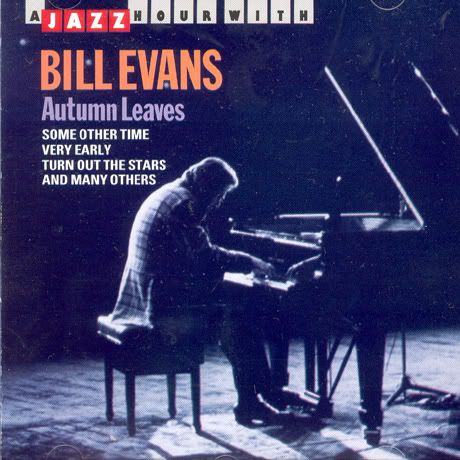
Bill Evans recorded the song many times, with his trio (and occasionally a quartet). From 1959 to 1969 he almost played it every year and re-recorded it for various albums. Again, at the end of 1970s, and in his last years, he began playing the tune. Even a compilation album of his was named Autumn Leaves.

I heard a beautiful take on the song, from Mary Lou Williams in a compilation LP, The First Lady of the Piano. Dizzy and Bobby Hackett accompanied her.
Zoot Sims played it in his Either Way (1961) LP. I strongly believe he has created a very strong, and like anything else he has recorded, deeply emotional recreation. Check him here, in the 1980s, returning to the song for a trio:
In 1974 Chet Baker recorded a version (She Was Too Good To Me, CTI 6050 S1) with a improvisational solo which has acknowledged as one of the best examples of Chet's fluency and harmonic genius. Ironically, Chet recorded it in concert F minor and adds a six bar tag of F minor at the end of every chorus.
Probably the most surprising Autumn Leaves belongs to Duke Ellington. During a dance date in California, 1958. When for a break, he asks singer Ozzie Bailey and Ray Nance (on Violin) to play three tender choruses on Autumn leaves. Bailey even sings the first on French! Stanley Dance remembers when Duke did it with French lyrics in France, audience didn't approve of Bailey's singing. The version below is not the same, but carries many virtues of the mentioned date.

Russell Procope, Bill Graham, Jimmy Hamilton, Paul Gonsalves, Harry Carney, Clark Terry,Rary Nance, Quintin Jackson, Britt Woodman, John Sanders, Duke, Jimmy Woode, Sam Woodyard, Ozzie Bailey, March 4th, 1958, Travis air force base, California.

My favorite among all ? Ahmad Jamal! A 12 minutes long masterpiece, live in Olympia, Paris, with George Coleman on tenor saxophone. Ahmad starts it with an uptempo introduction that takes a minute or two to even French audience recognize the tune. Coleman creeps in slyly from off-mic and then they takes off and you should hear the rest yourself! The version presented here is very close to what I heard on Olympia date, but slightly different and I'd say lighter.

Tuesday, November 23, 2010

Bird Conference

From Norman Granz Jam Sessions, 1952, LA.
photography by Esther Bubley (1921-98)

Esther Bubley happened to be in LA on assignment for The Ladies' Home Journal. It was then that her friend, illustrator David Stone Martin, who had made a name as a jazz album cover artwork designer, invited Esther to come along to a meeting with Charlie Parker and friends, where Esther took this amazing photograph.


Sunday, November 21, 2010

Coleman Hawkins 106th Birthday

"Almost all of the recordings Coleman Hawkins made throughout a 45-year period were outstanding examples of improvisation, but among them were masterpieces by which all tenor saxophone solos will forever be judged."
-- John Chilton, Song of the Hawk


Today's Coleman Hawkins 106th birthday. It's quite a while that I'm working on possibly the biggest piece of my blog, studying Coleman Hawkins recordings with Fletcher Henderson orchestra. I hoped that I could finish it for a day like today, but it didn't happen and I need more time. So enjoy the day with an update of an old post, an audio clip, and I'm sure everybody has many thing to listen and many thing to read about Coleman Hawkins.


Coleman Hawkins All Stars
I Love You
Coleman Hawkins (ts), Hank Jones (p), Chuck Wayne (g), Jack Lesberg (b), Max Roach (d)
New York City, December 11, 1947, RCA Records.


Comments on a Phoenix called Hawk: An update of an article I' posted almost a year ago. Two audio clips and some new comments have been added.

By the way, to see Hawk's shadow over all tenor players after him, I got a great story which can't stop laughing whenever I remember it:

"It wasn't for me. They were whispering on me, everytime I played. I can't make that. I couldn't take that. . . . Fletcher Henderson's wife, she took me down to the basement and played one of those old wind-up record players, and she'd say, "Lester, can't you play like this?" Coleman Hawkins records. But I mean, "Can't you hear this? Can't you get with that?" You dig? I split! Every morning that chick would wake me up at nine o'clock to teach me to play like Coleman Hawkins. And she played trumpet herself—circus trumpet! I'm gone!"

Wednesday, November 17, 2010

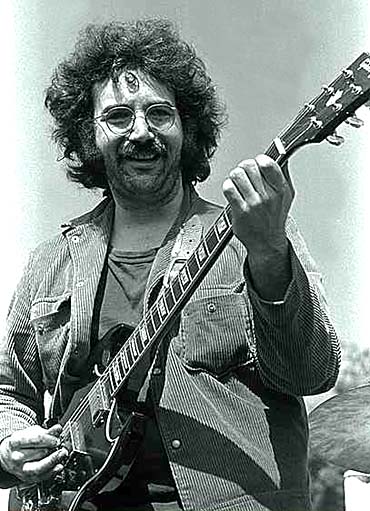
Psychedelicatessen: In Memory of Jerry Garcia

Psychedelicatessen
a Celebration of Jerry Garcia's Music

"There’s no way to measure Jerry Garcia's greatness or magnitude as a person or as a player. I don’t think any eulogizing will do him justice.He was that great,much more than a superb musician, with an uncanny ear and dexterity. He’s the very spirit personified of whatever is Muddy River country at its core and screams up into the spheres. He really had no equal. To me he wasn’t only a musician and friend, he was more like a big brother who taught and showed me more than he’ll ever know.There’s a lot of spaces and advances between The Carter Family, Buddy Holly and, say, Ornette Coleman, a lot of universes, but he filled them all without being a member of any school. His playing was moody, awesome, sophisticated, hypnotic and subtle.There’s no way to convey the loss. It just digs down really deep." - Bob Dylan


  • A Radio Broadcast from Connecticut
0) Tears of Rage, Warfield Theater, San Francisco in the spring of 1990
1) An Odd Little Place & The Wheel, From Garcia's The Wheel LP
2) Pig In A Pen, From Garcia's Old And In The Way LP
3) Tore Up Over You,Warfield Theater, San Francisco in the spring of 1990
4) Sugaree, 12/21/79, Keystone, Palo Alto, CA
5) Let It Rock & Rubin And Cherise, 11/ 17 /91, Hartford Civic Center
6) Eep Hour & To Lay Me Down, From Garcia's The Wheel LP
7) Dirty Business (with New Riders of the Purple Sage), 1971, from NRPS LP
8) He Ain't Give You None, 11/ 17 /91, Hartford Civic Center
9) Struggling Man, 11/ 17 /91, Hartford Civic Center
10) Leave Your Hat On (with Legion Of Mary), 10/31/74 University of San Fransisco Memorial Gym
11) Midnight Moonlight, 7/31/84, The Stone , San Francisco,CA
12) I Shall Be Released, 11/ 17 /91, Hartford Civic Center

Tuesday, November 16, 2010

Is Charlie Parker Arrogant?


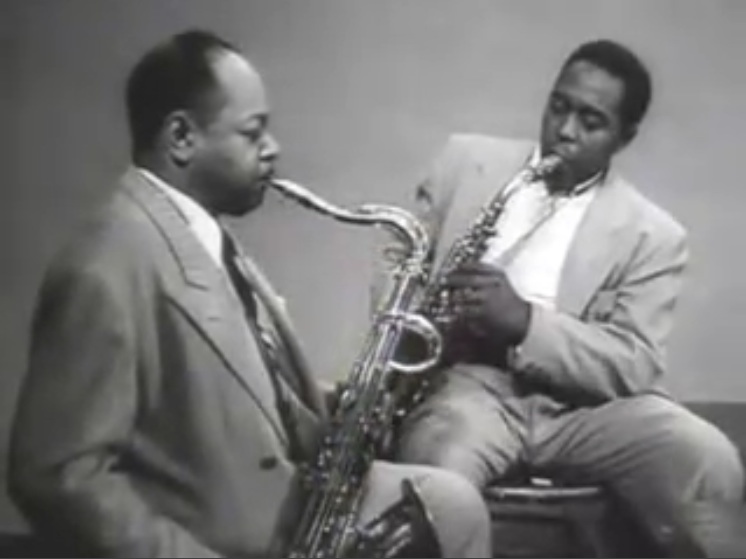
ليندا، يكي از دوستان جازي من، يكي دو روز پيش شكوه‌كنان به من نوشت كه ويدئوي كولمن هاوكينز و چارلي پاركر را ببين كه پاركر چه بي‌ادبانه سولوي هاوك را قطع مي‌كند و جان مادرت سعي نكن اين گستاخي آشكار را ماله‌كشي كني كه هيچ‌ جوري نمي‌شود توجيهش كرد. من ويدئو را دوباره ديدم. و حالا...

نه ليندا جان آن‌طور كه به نظر شما آمده نيست. اين فيلم بخشي از كارهاي سينمايي كوتاه نورمن گرنز درباره جاز بود. اولين بار با Jammin’ the Blues كه حتي نامزد اسكار شد طعم موفقيت را چشيدند تا اين كه تصميم گرفتند دوباره در استوديو و با نگاهي كاملاً سينمايي (به تدوين درخشان فيلم نگاه كن) چند موزيسين بزرگ را دور هم جمع كنند. وقتي بِرد با آن نت تند، ناگهان سولوي هاوك را قطع مي‌كند، انگار كسي از پشت دوربين به او فرمان داده. در اين فيلم‌ها «تايمينگ» دقيق است و به همين خاطر دست و بال نوازنده را مي‌بندد. كاري نمي‌شود كرد، اين ذات اجراي زنده جاز، براي دوربين و نه تماشاگر، است. تا جايي كه من مي‌دانم رابطه هاوك و بِرد دوستانه بوده و اگر به نگاه ايمان داري، فقط ببين وقتي هاوك مي‌زند برد چه كيفي مي‌كند و وقتي برد شروع مي‌كند هاوك را چه سويينگي برمي‌دارد. چارلي پاركر مرد هزار صورتي است و زندگي‌اش بيشتر معماست تا پاسخ‌هاي سرراست، اما يادم نمي‌آيد كه تا به‌حال كسي از نخوت او ياد كرده يا اين‌كه او را متهم به بي‌حرمتي به بزرگان و پدران اين موسيقي كرده باشد؛ من كه اصلاً به خاطر نمي‌آورم. با آن‌كه بي‌باپ هميشه در ذاتش آن تهاجم و گستاخي را داشته، اما غول‌هاي باپ (از پاركر تا گيلسپي، از مانك تا پاول) همه آدم‌هايي شريف‌تر و نجيب‌تر از آدم‌هايي‌اند كه من ديده‌ام يا درباره‌شان شنيده‌ام. پاركر هاوك را دوست دارد. اين فقط يك سوء تفاهم كوچك است.

Jazz and Haiku


Last April I did a post of Jack Kerouac and his love for jazz. The main attraction was Sam Charters long lecture on his friend, Kerouac, and tracing the influence of jazz improvisation on his poetry. Now, let's roam around his haikus and see how they are bound to the world of jazz.

Kerouac developed a new definition for American haiku in his journal Some of the Dharma which are short three-line confessional poems that served to enlighten. Kerouac explains the difference between Japanese Haiku and American Haiku, as quoted by Nervous Musings, this way:
"The Japanese Haiku is strictly disciplined to seventeen syllables but since the language structure is different I don’t think American Haikus should worry about syllables because American speech is something again…bursting to pop. Above all, a Haiku must be very simple and free of all poetic trickery and make a little picture and yet be as airy and graceful as a Vivaldi Pastorella."

In 1958 Kerouac wound up in a recording studio with two of his jazz idols, Al Cohn and Zoot Sims. The trio laid down American Haikus and then another five tune/poetry for an album called Blues and Haikus (Hanover, 1959). Next year,it followed by Poetry of the Beat Generation (Hanover, 1959), largely consisted of Kerouac reading novel extracts over a jazz backing, "this record attempted to connect the words directly with the music; Jack riffing quick bursts of bop-prose followed by skirmishing from Cohn and Sims," says Sid Smith.


It's a great case of painting with sound, and poetry of jazz (not "poetry and jazz" - I mean listen to the musical words of Al & Zoot). And see how musician can overtake the poet, how advance looking these musicians were and how they are historically ignored as far as a pure art form is concerned. For instance, how many people, or even how many jazz people, today remember the swing brothers, Al Cohn and Zoot Sims?

Here is Zoot with his natural sense of swing, and shimmering, mellow warmth on tenor, and Al with his more darkened sound, his top-notch rhythmic pattern and his unique structure of musical ideas. These two cats can turn any Haiku into a ballad.

American Haikus, 1958, Jack Kerouac, with Al Cohn (tenor sax ) and Zoot Sims (tenor sax), produced by Bob Theile


In my medicine cabinet,
the winter fly
has died of old age.


Well here I am
2 pm.
what day is it?


The tree
looks like a dog,
barking at heaven.


Prayer beads
on the holy book,
my knees are cold.


In the morning frost
the cats step,
slowly.


No telegram today,
only more leaves
fell.


The castle of the Gandharvas,
is full of
aging young couples.


Early morning yellow flowers,
thinking about
the drunkards of Mexico.


The national scene,
late afternoon sun
in those trees.


Nightfall.
boy smashing dandelions
with a stick.


Holding up my purring cat
to the moon,
I sighed.


August moon.
Oh!
I got a boil on my thigh.


Drunk as a hoot owl,
writing letters
by thunderstorm.


All day long,
wearing a hat
that wasn’t on my head.


Beautiful young girls
running up the library stairs,
with their shorts on.


Crossing the football field,
coming home from work,
the lonely businessman.


Useless! useless!
heavy rain,
driving into the sea.


After the shower,
among the drenched leaves,
the bird thrashing in the bath.


The little worm,
lowers itself from the roof,
by a self shat thread.


Snap your finger.
stop the world.
rain falls harder.


Nightfall.
too dark to read the page,
too cold.


In my medicine cabinet,
the winter fly
has died of old age.


Following each other
my cats stop,
when it thunders.


Spring evening,
the two
eighteen year old sisters.


The postman is late.
the toilet window
is shining.


Wash,
hung out by moonlight,
friday night in may.


Empty baseball field,
a robin,
hops along the bench.


Black bird.
no! blue bird!
branch still jumping.


My rumpled couch,
the lady’s voice
next door.


The bottom of my shoes
are clean,
from walking in the rain.


Bee!
why are you staring at me
I am not a flower.


The barn,
swimming in a sea
of windblown leaves.


Glow-worm
sleeping on the flower,
your lights’ on.


Spring night.
the leaf
falling from the chimney.

 transcribed by Miray Nair

Wednesday, November 3, 2010

Good Morning Blues#2: With Chet in the Mornings


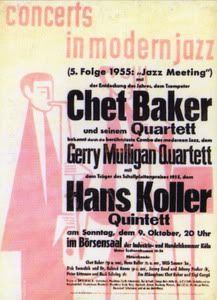
I began this rather cold morning with a butter sandwich, Chet Baker Quartet, a cup of tea, and an inescapable mournful empathy for pianist Dick Twardzik. Before begining the day's task, which is writing a 1800-word piece on cities and movies for 24 Monthly, I ran into this very atmospheric Köln concert of Chet Baker Quartet. Butter and tea were finished after the first tune, and I left alone with Chet's interpretation of Imagination.

The Köln gig was a part of 1955 European tour of the newly formed Chet Baker Quartet. Chet's recording career had started just three years before and now he was a big name in jazz. Musically, he became widely known thanks to the discs he had made with baritone saxophonist Gerry Mulligan as part of a provocative and unusual pianoless quartet (trumpet, baritone sax, bass and drums). Half an hour later, I went for a second cup of tea and found this interview with Chet, from Jazz Podium magazine, 1978. Interviewer is Gudrun Endress:


When did all of these troubles start, in the '60s or in the '50s?
  • No, in 1957. I was 27 years old. And all the musicians that I thought were the greatest musicians were into that, you know. And I never messed with it for a long lime. All the time I was with Gerry Mulligan, I was clean, but people thought I was doing something.
I always thought it happened alter the death of Dick Twardzik.
  • It did. That's when it happened, in 1957, when I went back to New York after he died. That 's when I started it and I kept that pretty strong for about 13 years and then a judge in Califonia was very kind to me. He could have given me five years like poor Art Pepper, who got sent twice to San Quentin or some crazy place like that, but the judge sent me to a sort of guidance-center where they test you, psychological and every way possible, to decide what to do with you. And when I went back to court with the results of the testing, he let me go. He put me back on the street again.
Is that the only way that you can cure yourself?
  • That's the only way. And I did. I got on the methadone program. I was on it 7 years. I started out at 8 milligrams, and little by little I had to take the dosage down and down until I came to Europe with just enough for two months and I made it last for four and a half months. And I just tapered out to nothing and stopped.
That means you are thinking a lot about why you use this. Is it because you can't bear the environment around you, all the bullshit?
  • Yes, the people I had to deal with were a drag, the stuff that I got was never any good. You know, you put all of that energy into the wrong direction. So I decided almost too late to cut it loose. Just to see if I could make it again after everything. Kind of a challenge in a way, because after so much bad publicity it's hard to get people to believe you.
But the bad publicity is publicity, don't forget that.
  • Yes, I know, but everybody reads that and you'd be surprised how many people believe it - what they read. Not people like you, people with some sophistication.
But all these people who are judges or judge these persons, they are maybe drinking a lot of schnapps or beer everyday and they don' t think about that.
  • Oh, but that 's all right. Drugs are something out of the norm, that is really to be feared, I guess. And there are a lot of people, friends of mine, that didn't make it, who couldn't handle it and it killed them. So it comes to a point where you really have to say, do you want to live or do you want to die and then you make that choice and that's it.
And what's the reason why you want to live, to play music?
  • That's about the only thing I'm good for, I guess.
***
Chet looking at Dick Twardzik

But who was Dick Twardzik? Born in Danvers, Boston, on April 3D, 1931, the gifted Twardzik studied classical music before discovering jazz. He began playing clubs in 1946 and by 1954 he was clearly one of the most promising young musicians in Boston. In 1955, when pianist Russ Freeman decided not to travel to Europe with Chet's quartet, the trumpeter found in Dick Twardzik a natural choice. But just like Chet and Littman, Dick was addicted to heroin. Freeman remembered many years later: "Chet was addicted , his drummer was addicted, and there is always a division between musicians who are clean and those who are using. Addicts hang with other addicts."

Chet and Dick's musical relationship would be one of the most interesting albeit tragic experiences in the history of jazz. Beginning the tour in Holland in September 1955, the Chet Baker Quartet played many concerts in Europe and on October 9 they performed at the Köln Börsensaal , in Germany. That tour was his first and his last, because he died from a heroin overdose in his Paris hotel room on October 2 1, 1955. He was only 24 years old.

Now let's go back to another cold day, 55 years ago, in October 9, 1955, only twelve days before Dick Twardzik's death. The setting is Köln Börsensaal. I have it on a CD called The Lost 1955 Concert (RLP Records 88618). The tune is Imagination, with Chet Baker (trumpet), Dick Twardzik (piano), Jimmy Bond (bass), Peter Littman (drums).


Monday, November 1, 2010

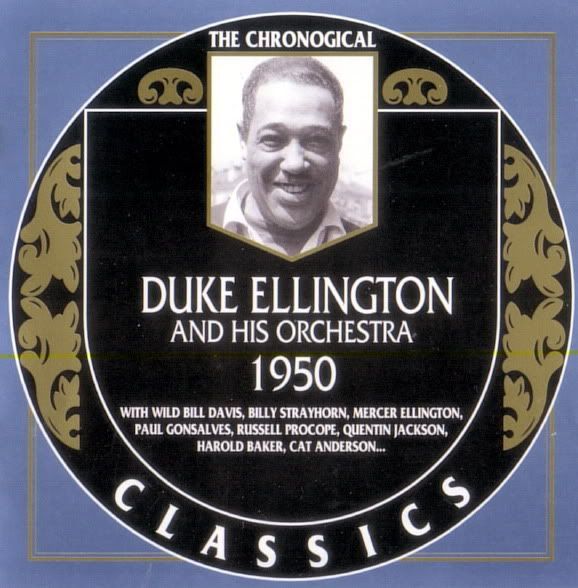
Classics 1217: Duke Ellington 1950


Classics 1217
Duke Ellington and His Orchestra
1950
Release Date: 2002


Other notable musicians in this CD: Wild Bill Davis, Billy Strayhorn, Mercer Ellington and other usual Ellington gang members.
Label(s): Mercer, Columbia
Number of sessions: 6
Unissued materials: None
Track Highlights: a 12 minutes The Tattooed Bride, a 15 minutes Mood Indigo


About the period: Undeniably the early fifties were difficult years for Duke Ellington. Despite having a contract with Columbia the band was rather infrequently recorded. In addition, the peaks of Ellington's creativity have always paralleled the degree of public acceptance of his compositions and general appreciation of his band. Never since the early twenties. had the wider public cared less for big bands than around 1950. In spite of his economical problems Ellington continued to record music of very high quality.

The Album: Opens with ten tracks for Mercer. Eight of these suffered a strange fate, Originally conceived as 78 singles, they were made at a time when the industry was gradually switching to LPs and were thus issued on a very obscure 10-inch LP, which had limited distribution as Mercer left business soon after. This music was next re-issued in 1964 on Riverside just before this label also stopped issuing records. This same LP was finally again on the market in the mid-eighties - when CDs came along. No wonder these outstanding piano-duo shave attained near mythical reputation. Two additional tracks were issued under Wild Bill Davis' name with the Duke sitting in on Things Ain't What They Used To Be. The three next performances for Columbia are not very well known either. Love You Madly features a vocal by Yvonne Lanauze and a fine tenor solo by Paul Gonsalves.

Paul Gonsalves

November 1950 session must be one of the first (if not the first) Gonsalves appearance with Duke on record. Ellington, who had been having trouble with the tenor saxophone chair, finally stabilized it for the next two decades with the addition of Gonsalves. He easily filled the gap that followed Webster’s departure. Gonsalves had a breathy, rich tone that identified him as a Coleman Hawkins disciple, and had put in tours of duty with Count Basie and Dizzy Gillespie. “When he came in the band, he knew every Webster solo by heart,” later said Harry Carney. Gonsalves himself once stated, “If I die tomorrow, I’ll consider I’ve been successful, because when I began to study it was with the idea of being with that band.”


Flamingo, Ellington& Strayhorn on piano, Wendell Marshall on bass, N. Y. C., October 3, 1950.


Other Major Replacements

Gonsalves was one of so many replacement in Ellington's orchestra, from 1949 to 1950. The course of the orchestra during this period is hard to plot, the changes within the band being so numerous. The situation can be summarized briefly: Fred Guy left and was not replaced, Ellington having subsequently kept his rhythm section down to three pieces. Ben Webster left and Paul Gonsalves came. The trumpets wavered between four and five pieces, sometimes
the band having to carry two lead men owing to Al Killian's lip trouble. Quentin Jackson came to the trombone section in place of Claude Jones, but Tyree Glenn ceased to be a regular member of the band. For the European tour of 1950 (with the full band this time, but omitting England from the itinerary owing to the union ban) Ellington was without Tyree Glenn and he brought two drummers with him, Greer and Butch Ballard. The tenor sax chair was vacant so he signed up ex-Basie tenor man Don Byas, who was resident in Europe, for the duration of the tour. Oscar Pettiford had left and been replaced by Wendell Marshall, cousin of the late Jimmy Blanton into whose old chair he now moved. This was a bad period for big bands and both
Count Basie and Woody Herman, Duke's keenest rivals since the mid-forties, had been forced to disband their groups. In February, 1950, he was presented with an award from the magazine Downbeat, in addition to which he was presented with a parchment scroll commemorating the fact that Ms was the only leading band from the magazine's 1949 poll still in existence!

Sessions:
  • BILLY STRAYHORN TRIO:
Duke Ellington (p), Billy Strayhorn (p), Wendell Marshall (b).
New York, October 3, 1950.

Cotton Tail 5710
C Jam Blues 5711
Flamingo 5712
Bang-Up Blues 5713


  • WILD BILL DAVIS AND HIS REAL GONE ORGAN:
Duke Ellington (p), Wild Bill Davis (org),Johnny Collins (g), Jo Jones (d).
New York, late October, 1950.

Things Ain't What They Used To Be M-4023

  • WILD BILL DAVIS AND HIS REAL GONE ORGAN:
Wild Bill Davis (org),Johnny Collins (g), Jo Jones (d).
New York, late October, 1950.

Make No Mistake M-4024


  • BILLY STRAYHORN TRIO:
Duke Ellington(p), Billy Strayhorn (p), Joe Shulman (b).
New York, November 1950.

Tonk M-2479
Johnny Come lately M-2480
In A Blue Summer Garden M-2481
Great Times M-2482


  • DUKE ELLINGTON AND HIS ORCHESTRA:
trumpet section: Harold Baker, Nelson Williams, Cat Anderson, Andres Merenguito and Ray
Nance (also Vln)
Trombone: Lawrence Brown, Quentin Jackson.
Jimmy Hamilton (cl,ts), Johnny Hodges (as), Russell Procope (cl, as), Paul Gonsalves (ts), Harry Carney (cl, barsax), Duke Ellington (p), Wendell Marshall (b), Sonny Greer (d), AI Hibbler (voc), Yvonne Lanauze (voc).
New York, November 20, 1950.

Build That Railroad CO-44662-1
Love You Madly CO-44663-1
Great Times CO-44664-1

  • DUKE ELLINGTON AND HIS ORCHESTRA:
Mercer Ellington (flugel horn),Tyree Glenn (tb), Billy Strayhorn (p).
New York, December 18, 1950.

The Tattooed Bride CO-44749-1
Mood Indigo CO-44750-1


Total Time: 66 mins. (approximately)

Thursday, October 28, 2010

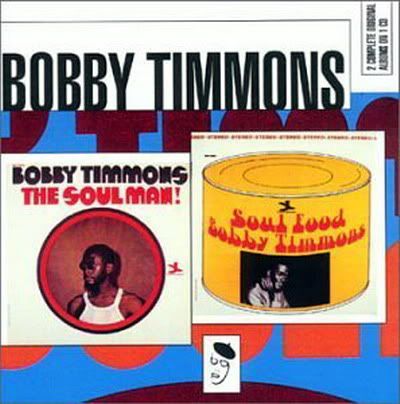
Soul Food (Bobby Timmons, 1966)


Bobby Timmons is one of my favorite gospelly jazz pianists. A master of rhythmic innovations and superb interpreter of standards, especially in live dates. As far as the funky piano style is concerned, among all pianists from Horace Silver and Junior Mance to Les McCann, Timmons is is the one that I really have the utmost groove with.He was Art Blakey's Jazz Messenger's pianist and the one who wrote Moanin', a Blakey anthem tune for many years and one of the most played items in the whole history of jazz.

Here, Soul Food is a rare Prestige recording in trio format from 1966, which is usually paired with another LP, Soul Man! in reissues. It is not a great example of Timmon's artistry or his harmonic sophistication - in that case I recommend This Here Is Bobby Timmons, 1960, or In Person, 1961, both from Prestige catalog - but it's a good demonstration of his sheer energy when he really wants to groove.

He is accompanied with Lee Otis on bass and Billy Higgins on drums. First four tracks (Giblets, Turkey Wings, Angel Eyes, Cracklin' Bread) are from a September 30 date and others (Stolen Sweets, Make Someone Happy, Sauce Meat) from October 14, 1966. Now eat your Soul Food!

.