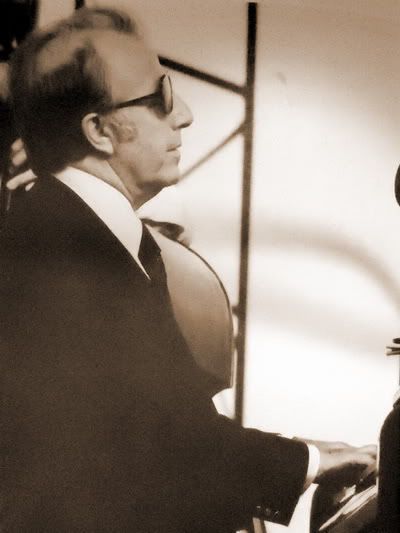
His legacy is complex, yet universal. His passion for the jazz past of Ellington and Jelly Roll Morton prefigured the revivalism of today, even though he might have sneered at it; his insistence on instrumental excellence is reflected in the high standards of execution that have become the norm among young players. His berating of inattentive audiences anticipates a time when jazz is respected as art music, yet the noisy, turbulent feel of all his bands invites listeners to participate in a communal, unstuffy exhilaration. He is Charles Mingus, as described by Richard Cook in his prominent Jazz Encyclopedia.
This interview must be from 1963, as it discusses the “recent release” of Charles Mingus Plays Piano.
Three notes on Guildhall School's seminar, discussing the relationship between jazz musicians and their audience, and also a performance with Guildhall jazz students featuring Tim Garland.
Jazz in Academia
If there is a passion about jazz, inside you, there is no 52nd street anymore, to go there and blow the horn or hit the keys. There is no enough time to put the 78 rpm on, and imitate the sound for weeks and months to became next Horace Silver. There is not that much live gig opportunities to transform a person from an enthusiast listener, with a horn hidden under his coat and hungry for being invited on stage, to the next Jackie McLean. There is no funeral or wedding job with live jazz, to makes a couple of bucks, and in the meantime, gives the pleasure of being heard for the very first time. That's the time jazz education enters the picture. As Jon Faddis makes it clear, "the scene has changed, and jazz education is a very important part of the jazz scene."
Nat Hentoff discuss the subject of jazz education, extensively, in his last book, At The Jazz Band Ball: Sixty Years On The Jazz Scene, and Guildhall College of music and drama in London tries to find practical ways for what have been told and discussed before to educate the young cats.
Nobody would deny the necessity of jazz education, but its economy has still lot of unbeknown corners. One of the neglected aspects of educating jazz is its benefits for elder musicians who can not work in that pace that makes a living possible. Securing a vital future for this music only fulfills when we pay attention, simultaneously, to its economic and its aesthetics. Education a good and young jazz musician is meaningful, only when there is live gig for him or her, or a radio broadcast and record opportunity for him, otherwise it would be like teaching people to became blacksmiths. But who needs a blacksmith now? "A university should reflect the needs of society. Too many lawyers is a drag, but they always get a gig, but too many tenor players is uncontainable," would say mister Phil Woods about jazz in universities and colleges.
Tim Garland
Tim Garland's Saxopiano Playing
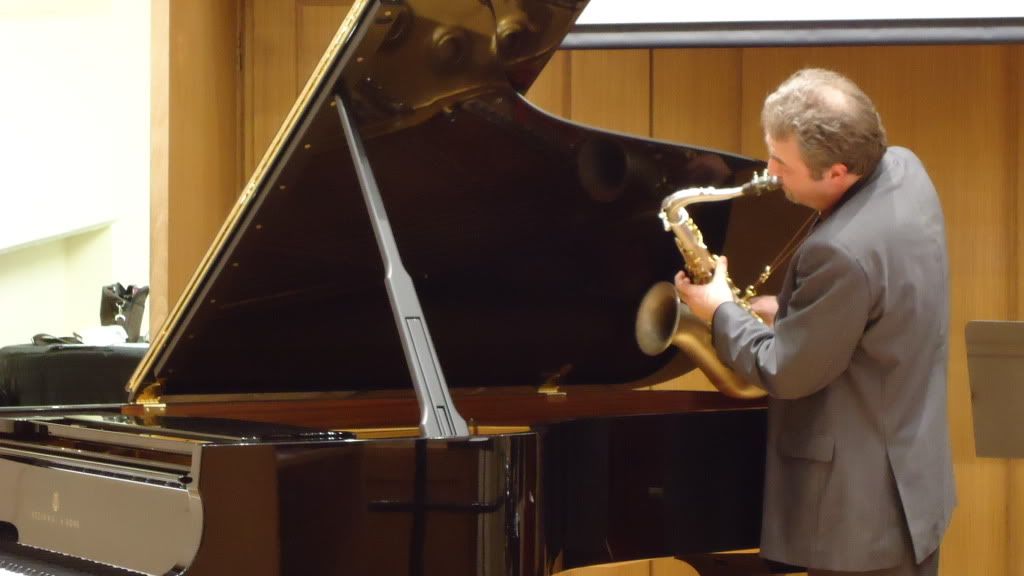
Tim Garland, born in 1966, was a graduate of Guildhall himself. He cut his first album when he was 22, and he is also a product of academic jazz. The highlight of this gig, beside some very well executed post bop materials of his own (which I found them more effective than his treatments of standards like Round Midnight or Body and Soul), was his playing into piano box! Yes, he was blowing his saxophone inside the open box of a Steinway, and he created most moving sounds from there without touching the strings. Strings were producing the magical sound, only by the waves of air that Garland saxophone was making. Very beautiful and unforgettable!
Robert Brockway
We'll Hear More of Him
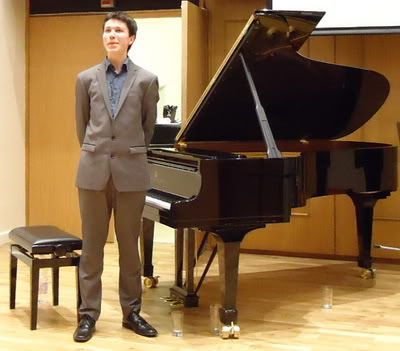
Among the trio that was accompanying Garland in that evening (including Robert Brockway on piano, Andy Robb on double bass, and Joe Sweeney on drums), the great discovery was Brockway, a very young gentleman who plays very interesting solos, with a confidence only seen and heard in men, a generation older than him.
He demonstrates the benefits of that advanced jazz educational programs. He has something to say, though he still needs time and space to find the ways of expressing them. At this point, the best school of music for any young musician is listening to the rich heritage of recorded jazz, on and on. As far as I am concerned, I was born in the wrong place, and in the wrong time, and I hadn't this chance to enter an academic environment to study jazz, but despite the fact of not being a musician myself, most of the time I was lucky enough to be a student of universal jazz school which exists eternally on records. In this case the words of a great teacher, Clark Terry, always rings in my ears:
''Don’t spend it all in one place. It’s just as basic as that: Spread it out. Don’t try to say everything you know how to say in one chorus, you know. Use the space and time is something we were fortunate enough to have learned from Basie, but Duke and Strayhorn, they knew how to put things together. For instance, they would put minor seconds together, and that was something kind of unheard of, as far as jazz was concerned. And they put it together and made notes; it made you learn how to listen and say, “Oh, he’s out of tune . . . oh, no, he’s not!” If you listen closely, you’ll find he’s very much in tune. But they knew how to do that, and they knew how to supply themselves with people who were aware and knew how to do it so it was a marvelous thing. They were both very, very instrumental in the perpetuation of jazz and the colorations of sound and so forth.''
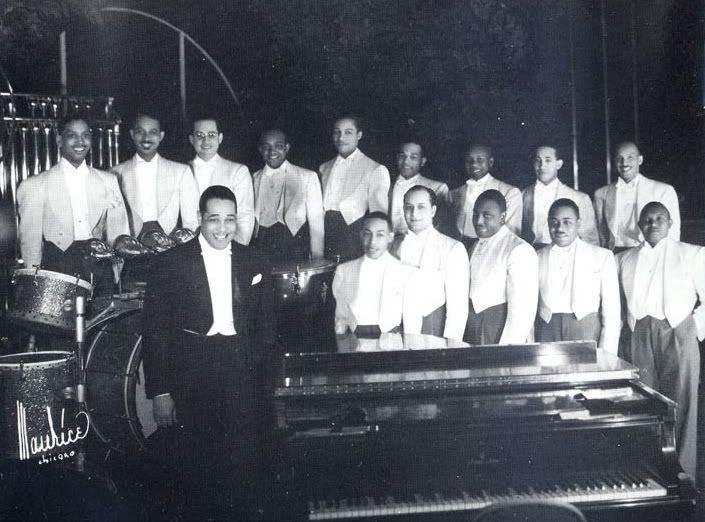
The Complete 1932-1940 Brunswick, Columbia, and Master Recordings of Duke Ellington and His Famous Orchestra
This "invaluably illuminating" boxed set of Duke is available here
"During the summer of 1929, the orchestra appeared in Florenz Ziegfeld's revue "Showgirl." Its performance roused that legendary producer to call the orchestra "the finest exponent of syncopated music in existence. . . . Some of the best exponents of modern music who have heard them during rehearsal almost jumped out of their seats over their extraordinary harmonies and exciting rhythms."
Now, thanks to Mosaic, I have almost jumped out of my seat because the sound engineering by Mr. Lasker and Andreas Meyer [producers of this boxed set] brings these Ellington orchestras swinging right into the room. As Billy Strayhorn (eventually Ellington's associate arranger) put it in Down Beat in 1952: "Ellington plays the piano, but his real instrument is the band. Each member of the band is to him a distinctive tone color and set of emotions, which he mixes with others equally distinctive to produce a third thing, which I call the Ellington Effect." That characteristic sound is as present in these recordings as it would later be in the 1940s and beyond." ~ Nat Hentoff, Wall Street Journal
English Soul (2010),a new documentary about rocker Steve Winwood, portrays his musical journey as a quest for meaning and beauty in the countryside of England, so it has more to do with Winwood's childhood house in Gloucestershire, than his deep fondness for Ray Charles, or his countless influences from American blues. Since it's nearly clear to everybody that lawns, sheep, and barn don't create blues or rock 'n' roll, and this type of music is more related to whiskey, drugs and wimmen', as well as big dirty cities, we can forget about this unconvincing approach and enjoy a panorama of British Psychedelic-Pop and Blues-Rock, from Spencer Davis Group days to Traffic and Blind Faith.
English Soul is meticulously directed by Paul Bernays, who has made another musical portrait for Emmylou Harris (From a Deeper Well, 2007). There are interviews with ex-members of Traffic, where great Dave Mason talks about his frustration of being kicked off the band, while Traffic's best selling hit singles were still Mason's compositions like Feelin' Alright. Eric Clapton, the eternal wise man of rock 'n' roll court, gives his comments about forming Blind Faith, and his sudden break up with this newly born super band. Now it makes sense when Clapton describes his recent reunions with Winwood, and playing almost all Blind Faith songs in Madison Square Garden, as a finishing an unfinished job; delivering the sound that they really wanted to give, back in 1969.
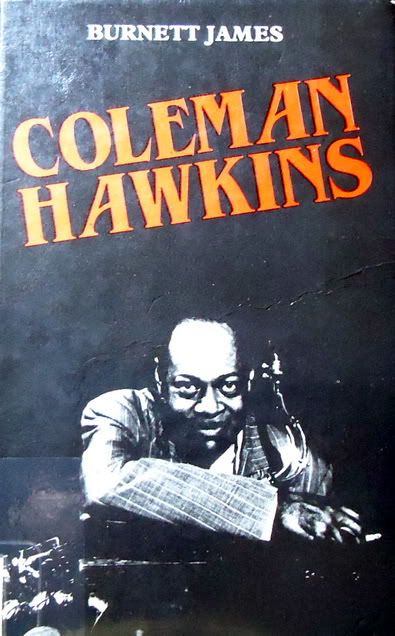
Burnett James, who is the writer of Coleman Hawkins entry in Encyclopedia Britannica, has a small and out of print book on Hawkins, published in 1984, en many Hawk recordings were out of public reach in pre-digital age. And in this book, in the tradition of best British jazz writers, he has a very good, and positivist introduction to the man and his music that worth repeating here:
"If, as the late Roland Kirk put it, jazz is 'black classical music', some interesting consequences follow. For one thing, it requires not only classic performances but also classic performers; performances, that is, which stand the test of time (and not simply the test of passing fashion), and performers who make a genuine advance in both styles and technique. Without such figures and such performances, no art form can develop and therefore no classic art can emerge.
In jazz there are few records that perpetuate unquestioned classic performances. One is Louis Armstrong's West End Blues; another is Coleman Hawkins's 1939 Body & Soul. There are others, but rather less that may at first be suspected. The classic artist is a rare phenomenon; the artist who both creates the conditions for the emergence of the classic and then proceeds to produce it himself (or herself) is rarer still. Armstrong, Hawkins, Charlie Parker certainly come into this category, Sidney Bechet and Lester Young probably, and of course Duke Ellington although in a slightly different sense and context.
Coleman Hawkins did not of course invent the saxophone in jazz. He did not even 'invent' the tenor saxophone. There were other saxophonists around during his youth - each making a contribution, as he himself admitted freely, and even asserted against exaggerated claims made on his own behalf - semi-legendary figures like Stump Evans, Happy Claudwell, Prince Robinson. But he also agreed when pressed that he did evolve a genuinely new style and was already playing in a manner quite different from the others. Exactly what that manner was and how it emerged and matured must be the primary task that any study of him has undertake. He and his work became classics of jazz, his influence stronger and more widespread than any but Louis Armstrong's, at least until the coming of Charlie Parker. As the late Paul Gonsalves, for twenty years Duke Ellington's featured tenor, once said, as quoted by Stanley Dance in the World of Duke Ellington:
Coleman Hawkins was my main influence. There was something in his music that coincided with Duke's that for me donated class. Apart from his musicianship, there was something about him personally - the way he held his horn, the way he dresses. I call him "the Duke Ellington of the saxophone". His style seemed more musical that that of other tenors, a kind of classic way of playing. I admired Lester Young, but Coleman Hawkins was it for me."
To see, or hear, how he was (and still is) the best, listen to three solos in a same piece: Hawk, Gonsalves, and Stan Getz in The Way You Look Tonight (Verve MGV 8225)- see how Hawk chops everybody.
"Being born blind, there was nothing for me to get used to about blindness, because it was there from the start. I didn't know, and still don't, what having sight is like, but from earliest childhood I've also been aware that there isn't such a thing as a blind world. There's a sighted world to which all blind people have to adapt and adjust. In due course, as an adult, I eventually came to the conclusion that even if I were offered the chance of sight, I would refuse it, because it would be so shattering to see everything around me that I had only known as sounds up until that point.
I'd have to go through a whole new process of education, because everything from reading or writing is entirely different. I'm used to hearing cars go by, not to seeing them flash in front of my eyes. There are things I'd love to be able to do, such as to get up from a group of friends and say, "I'll see you guys later on," and mean exactly that.
Maybe we miss a lot, but for the most part that's more than made up for by what we have to replace sight – the ability to conceptualize the world through sound, or our other senses, and the close connection with all those other people who help us get our bearings in unfamiliar surroundings, whatever they may be. Living in a world in which sound plays the most important role has always been a great stimulus to me as a musician." ~ Sir George Shearing
Just a day after my arrival to London, and while I was totally confused by the underground labyrinth of it, came the news of George Shearing's death. It was the third unfortunate occurrence in a row, all happened in less than 24 hours. After overcoming the feeling of being a Cassandra, and after getting acquainted to Tube, and while my discovery of stations and streets was accompanied by Complete Live Capitol Recordings of George Shearing, on my iPod, now I've found myself again, and here is a belated tribute to the man:
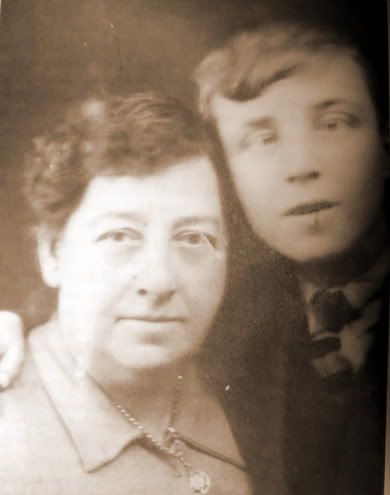
Young George with his alcoholic mother
Londoner George Shearing (born in 1919) was blind from his birth, and was a pianist from early childhood. Coming from a poor family of nine, he attended Linden Lodge School for the Blind [photo on the right] during the early 1930s. His first paid work was at a South London pub, the Mason's Arms, then played in Claude Hampton's National Institute for the Blind Band (1937). Did first solo broadcast in February 1939. Resident at the Nut House, London, from summer of 1939. Briefly in South Wales, then gigged with Stephane Grappelli before playing solo residency at the Starlight Club, London (spring 1940). Joined St Regis Hotel Quintet which was subsequently led by Harry Parry (1940), also worked at Hatchett's Club, London, with Stephane Grappelli and Dennis Moonan. I never forget the story told by Grappelli about how George lead them to their hotel room, during blackouts of night bombings of London in war days. The idea of a blind man, guiding other fellow musicians among the fog and ruins is the to the world of George Shearing music. At this stage Shearing was under the influence of Art Tatum, Fats Waller and Teddy Wilson.
Shearing with George Evans, Harry Parry then joined Ambrose's Octette from July 1941 until April 1942. Toured with Stephane Grappelli Swingtette (1943) and played night clubs, then joined Frank Weir (1944), later (1946) becoming part of Weir's two piano set-up (alongside
Ralph Sharon). Joined Harry Hayes from July to November 1946, then visited the USA for four months. Returned to Britain, again toured with Stephane Grappelli (April 1947).
On piano-accordion and piano with Frank Weir (summer 1947), then emigrated to the USA in November 1947. This geographical change caused a certain change in his music, too: Shearing who always was a swing-style player quickly adopted much of the bebop vocabulary. Though his way of playing bop has a reserved, and gentle touch. "Who needs an English Art Tatum?" says Shearing about adopting his new styles in interview with pianist Billy Taylor. And that's true. Think about hundreds of imitators who has gone with the wind and there is no trace of them anymore, especially when you're not originally an American product. Later, he added a Latin flavor to his music, which this piece could be an example of that:
Cool Mambo
In 1949, Shearing formed a quintet with a suitably soft instrumentation: vibraphone, amplified guitar, piano, bass, and drums (usually restricted to brushes). His quintet arrangements included locked-hands voicings with the vibraphonist doubling the top note and the guitar doubling the bottom. This "Shearing sound" was extraordinarily successful; it is the sound by which many fans identify him even today. “What many people didn't know about George was his courage," remembers John Levy, his bassist and manager, in an interview with Marc Myers, "in 1949, this guy had formed an integrated group with two white guys, two black guys and a white woman on stage together. Today, this might seem like so what. But back then, you just didn't do that, especially in some cities. Many people told George that he’d do better if all of his were white. He didn’t know what they were talking about. He’d get pissed and say, 'I don’t know what color they are. All I know is that they play what I like to hear and I love their intonation.' Only a few people had the nerve to come up to him and say stuff like that."
From this period Lullaby of Birdland and Conception became jazz standards. Even Miles Davis did his version of Conception, although Shearing recently complained that Miles got the bridge wrong!
From 1970s, Shearing abandoned the quintet format, thereafter worked with own trio and in duos with various double bassists as well as being featured with large orchestras. He has recorded many albums with jazz singers, including Nancy Wilson, Mel Torme, Carmen McRae, Dakota Staton, Peggy Lee, and Nat Cole.
With Nancy Wilson - On Green Dolphin Street
We know that how many critics have essential problems with easy-swinging and those pianist who have pure rhythmic/melodic approaches, like George Shearing. In one of the most famous anti-Shearing articles, Martin Williams wrote:
"What Shearing was and is doing is popularizing modern jazz to a widespread success. I am not absolutely sure that musical popularizers are a reviewer's business. They do introduce large numbers of people to a musical style—at least so I am told. But for every listener who moves on, hundreds of others stay with the popularizer; one of the originators of modern jazz, Dizzy Gillespie, had a good audience before Shearing arrived, but Shearing has a larger audience than Gillespie has or probably ever will have. In any case, popularizers always appear and are always going to appear.
However, there are popularizers and popularizers. One of Benny Goodman's functions was to spread a music that Fletcher Henderson had evolved several years before and do the same for some of Count Basic's pieces as well. Goodman contributed more than merely that, to be sure, but his treatment of Henderson's style involved no particular compromise or dilution.
I suppose that if popularizers become a constant preoccupation, a reviewer will be wasting a great deal of time. And at worst he may end up making them the objects of a kind of snobbish abuse. On the other hand, a reviewer probably should discuss
them from time to time to describe what he feels they are up to and to say how much compromise and dilution he hears in their work."
Thanks to Williams himself, who gives us the right words for it, - "snobbish abuse" - one can argue that all rock 'n rollers are popularizers of Robert Johnson, and they are audience-stealers, hence it's a waste of precious time for a critic, to take them seriously. Later he argues:
"As a pianist, Shearing is able and fluent, although as a jazzman he has occasional problems with phrasing and swing. More important, he is capable of a lot more inventiveness than he usually offers. And it seems to me that his basic compromise is to play as if he were not really emotionally involved with what he is doing, even when he allows himself to do something musical."
Well, isn't Basie that way? Looked untouched on the surface, but driving a group like the jet motor, in the moment of take off.
Beside music, Shearing's charm, humbleness and nobility rank him with the best pianists in history of jazz, like Hank Jones. One of the great pleasures of listening to his live recordings comes from his sense of humor. He has a witty introduction for almost every tune. Here is an example:
And finally, from Mosaic out-of-print boxed set, Complete Live Capitol Recordings of George Shearing, give a listen to The Nearness of You with Vibraphonist Emil Richards, guitarist Toots Thielemans, bassist Al McKibbon and drummer Percy Brice. Recorded at Hollywood Sunset Strip , 1959. It's a seminal tune that summarizes his grace, touch, swing and the way he visualized the world through sounds and tones.
The nearness of you
Sources (and Further Reading): Who's who of British jazz /John Chilton.-2nd ed. Jazz changes/ Martin Williams/ pp 279 - 281 Lullaby of Birdland/ George Shearing (written in collaboration with Alyn Shipton)/ This autobiography was published in 2004.
This song is for Cairo, but not the same Cairo we're watching now, live and moving, on our TVs. The Henry Townsend's Cairo is somewhere in Illinois, US. But from my own experience, blues is always the best form of addressing what is happening "now".
The year 2010 was a mournful year, as far as piano and last of the great pianist of golden age of jazz is concerned. First we lost Hank Jones, and now Dr. Bill Taylor.
First time I heard Billy Taylor, I was sneaking through my uncle's jazz collection. He had a personal compilation, kind of favorite traveler's mate, with a dozen track from 1954-55 Taylor/Earl May/Percy Brice sessions. Surely I fell in love with him. At that time I had two convincing reason to really dig him: 1) Practically he could play anything and anybody, from smoky ballads to up-tempo bebop pieces, from Basie-type swing manifestations to Ellington oriented tunes. 2) He reminded me of another unsung hero of jazz piano, Hank Jones. Hank is my yardstick for this instrument. Anything close to him, or feel like close to him, worth listener's attention. And of course, a sheer musical joy is always guaranteed.
Later, I returned to his early works (I wrote about it today, just before this post. Read it here) And then my expedition moved me forward to 1960s. At that point one of the best moments I had with Billy's music came with his gospely I Wish I Knew How It Would Feel To Be Free (1967), accompanied with bassist Ben Tucker and drummer Grady Tate.
Marc Myers in his obituary on Jazzwax defines Billy as "the jazz-musician stereotypes found in pulp fiction and film of the 1950s. He was gregarious and courtly, well-spoken and approachable—and oddly devoid of the simmering anger, anti-social behavior, bad habits and hipster persona that made the jazz life at once alluring and dangerous." Read the rest of his splendid piece, here.
Check this old post of a 1958 video of Billy Taylor, performing his own composition Early Bird with Tony Scott on clarinet, Doc Seversen on trumpet, Mundel Lowe on guitar, Jimmy Cleveland on trombone, Earl May on bass, and Ed Thigpen on drums. More videos are available here.
Classics 1137 Billy Taylor1945-1949Release Date: 2000
Other notable musicians in this CD: Doc Cheatham, Denzil Best, Milton Hinton, Shadow Wilson. Label(s): Savoy, Prestige, H.R.S, Swing 234 Number of sessions: 6
About this period: "When I first really embraced bop, it was—I had, of course, become aware of Parker and Gillespie, prior to coming to New York, but I was very much into Tatum and that kind of thing. I used to have some knock-down, drag-out arguments with Bud Powell, because I'd run into him frequently at Minton's and other places. This was in '44. I came here in '44, and when I got here I worked with Ben Webster at the Deuces, and the whole transition was really being formalized then because this was just prior to Dizzy Gillespie opening at the Onyx with the first bop band downtown." - Billy Taylor
The Album: A good example of what Billy Taylor calls pre-bop, a period of jazz which is not really swing, nor is bebop, but it had all of the ingredients that formalized by people like Clyde Hart, Sid Catlett, Jo Jones, and others. Of course, there are more swing oriented tracks (5 to 8, for instance), or more bop playing stuff (like Paris date), but the main concept is playing a variety of sounds with a great dexterity. - E. K.
Monk’s Mood(see below for details)
Details: Billy Taylor Trio Billy Taylor (p), Al Hall (b), Jimmy Crawford (d)
New York, March 20, 1945, Savoy
S-5792 Monk’s Mood S-5793 Solace S-5794 Night And Day S-5795 Alexander’s Ragtime Band
Walter Thomas Orchestra: Doc Cheatham (t), Eddie Barefield/Hilton Jefferson (cl,as), Walter ‘Toots’ Thomas/Teddy McRae (ts), Buddy Saffer (barsax), Billy Taylor (p), Milton Hinton (b), Specs Powell (d).
New York, June 27, 1945, Prestige
8131 -B Black Maria’s Blues 8132-B Bird Brain 8131-A Dee-Tees 8132-A Back Talk Billy Taylor: Billy Taylor (p), Ted Sturgis (b), Buford Oliver(d).
Paris, December 4, 1946, Swing 234
OSW-435-1 The Very Thought Of You OSW-436-1 Stridin’ Down Champs-Elysées (sic)
Billy Taylor Quartet: Billy Taylor (p), John Collins (g), J0hn Levy (b), Denzil Best (d).
New York, June 1947, H.R.S
1068-2 Well Taylor-ed 1069-2 I Don't Ask Questions, I just Have Fun 1070-3 So You Think You’re Cute 1071 -2 Twinkle Toes
Billy Taylor Quartet: Billy Taylor (p), Herman Mitchell (g), J0hn Levy (b), Denzil Best (d).
New York, September 26 1947, H.R.S
1084-2 Restricted 1085-3 Stridin’ Down Champs-Elysées 1086-2 Mitch’s Pitch 1087-2 Mr. B. Bops
Billy Taylor Quintet: John Hardee (ts), Milt Page (org), Billy Taylor (p), John Simmons (b), Shadow Wilson (d).
New York, November 20 1949, Savoy
SBT-4450 Misty Moming Blues SBT-4451 The Bug SBT-4452 Prelude To A Kiss SBT-4453 Take The “A” Train