Three Suicides and an Album
By Ehsan Khoshbakht
Synopsis:
At the height of his fame, tragedy strikes when jazz pianist Bill Evans loses his bassist, Scott LaFaro, in a car accident. Already battered by drug addiction, the devastated Evans seeks refuge with his family, struggling to piece both his life and himself back together.
Review:
I had just moved into a new, unfurnished flat when I got hold of Bill Evans's LP Sunday at the Village Vanguard. Playing it for weeks on end, I also moved into a new musical subterrane. I delayed furnishing the flat, fearing the furniture would absorb the sound and ruin the clarity of the bass, played on the album by Scott LaFaro who had died in a car accident only 11 days after the recording.
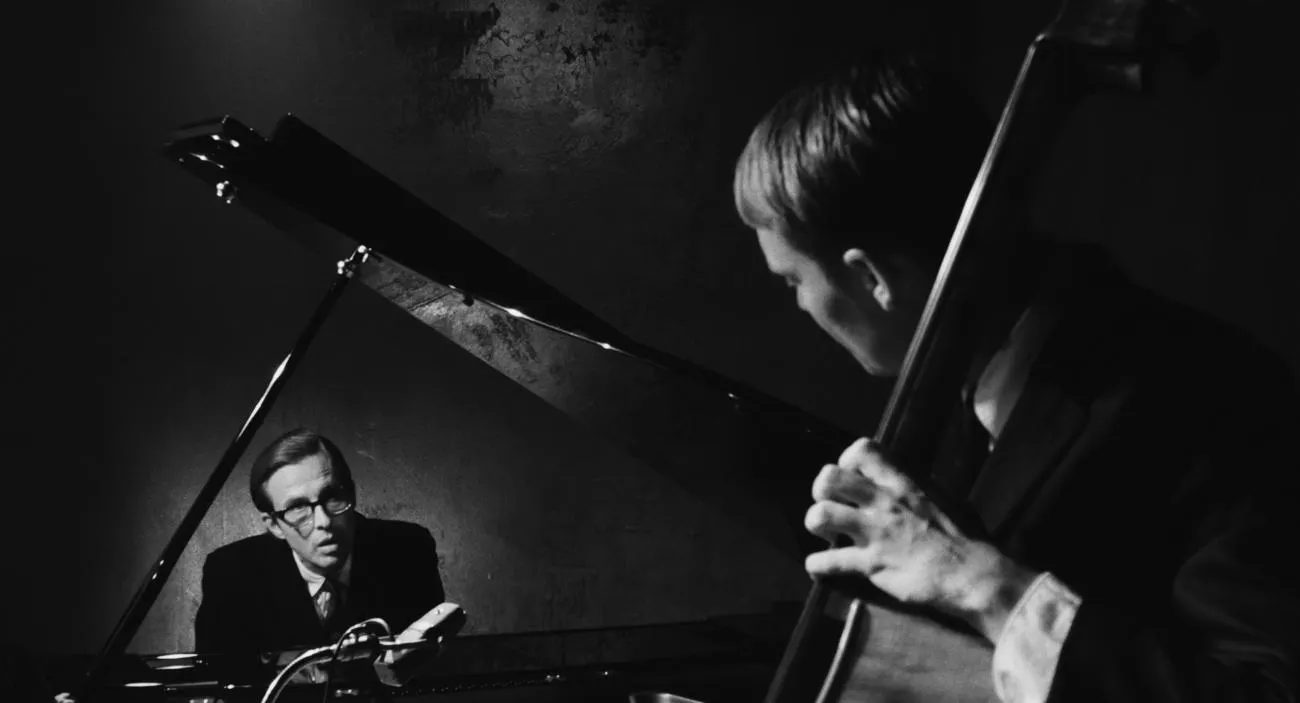
Everybody Digs Bill Evans – named after another equally renowned LP by the jazz pianist – is about what happens between the recording of that live album on 25 June 1961 and its release in October of the same year. In between, it's about a pianist grieving, not necessarily over a lost friend, but over himself.
Grant Gee's reticent film, however, is not about jazz, nor is it about Bill Evans the pianist. It's more of a family story – of failed, troubled sons and fathers. Yet, to some degree, the film still leans on the dark side of jazz lore – the needle-and-spoon side. It's a tale of dependency: on drugs and on people who were like heroin to Evans, such as LaFaro, who "understood" his music, and his girlfriend Elaine, who mothered him.
Actor and musician Anders Danielsen Lie has imported some of his Scandinavian spleen from Oslo, August 31st to the role and has avoided falling into the pitfalls of Evansian mannerism, which any actor with slicked-back hair, brow line eyeglasses, and a back so bent that his nose can touch the keys could imitate. Yet Evans's tragic handsomeness is not there – a presence so immersed in music that his physique seemed to diminish after each performance. Gee has left Evans's music out and has modernised his ennui. The film's focus is on when the music has stopped and life has entered an interregnum of eerily stage-like houses and a world of austere interiority. Absent are the pavements and the urban grime to which Evans responds by letting his music drift away into the serenity of his inner landscape. (This is, no doubt, due to the fact that the film was entirely shot in Ireland.) And the only time the film tries to compensate for the lack of exteriority, it makes its biggest mistake by mutilating one of the fundamental jazz films, using D.A. Pennebaker's colour Daybreak Express (1953) as black-and-white stock footage with its Duke Ellington score removed.
Based on the novel Intermission by Owen Martell – which I have not read – I can't tell whether the film's cleverly devised three-act structure comes from the book or is the screenwriter Mark O'Halloran's invention. After a brief prologue in the Village Vanguard and the infamous car accident, Evans is placed in three environments, interacting with people close to him. First, his brother Harry – gentle, firm, and the artistically failed version of his younger sibling – takes him under his arm; then Evans visits his parents in Florida, the most potent segment of the film, mapping Bill's relationship with his quietly troubled father and protective mother. This therapeutic middle section is followed by a return to New York, to his girlfriend and needle mate Elaine, for the final act. Each act features a poignant scene of Evans reluctantly or undecidedly doodling one of his signature tunes on the piano.
In between these defining acts, there are jumps forward in time, marked by the use of colour in an otherwise excellently shot black-and-white film (courtesy of Piers McGrail). These time skips lead to suicides: Harry, fighting depression, shoots himself in 1977; Elaine jumps in front of the New York subway in 1973, and Bill's incorrigible drug abuse – a slow suicide – leads to his demise in 1980, aged 51.
Some years ago, I managed to obtain a unique compilation CD of Evans's recordings as selected by filmmaker Chris Marker. I always wondered what drew Marker to Evans, but I suspect it had something in common with what this film is after. Tracing loss in the passing of time was the magic of Evans for Marker. Some of his finest tunes were about the things and people he had lost. His biggest loss, however, was time itself. Evan’s Time Remembered was one of the tunes Marker picked for his mixtape. Grant Gee seems to be on a similar search and, in the process, has turned the life of the pianist into a gentle sonata of loss.

No comments:
Post a Comment