Monday, October 21, 2013

Dizzy Gillespie at the Village Gate (1977)

© courtesy of Pablo Records.
"A lot of people call Dizzy old fashioned but so is the bible." -- Mickey Roker

Celebrating what would have been John Birks Gillespie's 96th birthday.

WBAI fundraiser "Dizzy Gillespie Day" held at the Village Gate in New York City on August 30, 1977. This recording contains part one of the event, an interview with Dizzy Gillespie's guitarist Rodney Jones and the music of jazz pianist Rio Clemente.


Saturday, October 19, 2013

Earl Hines and Dizzy Gillespie on Duke Ellington


This scene comes from Love You Madly, one of the best Ellington documentaries which was originally made for TV in the west coast. The interviews are conducted by Ralph Gleason.

Thursday, October 17, 2013

Four Trumpet Masters


I'm knee-deep into London Film Festival and an overdose in film has kept me away from this venue and blogging on jazz. For the sake of reassurance, and promsing that I would return to jazz life soon, I'm posting a recent VHS transfer of a fabulous trumpet summit in which the cream of Ellington and Basie trumpet alumni are on stage together: Joe Wilder, Snooky Young, Harry "Sweets" Edison and Clark Terry!

The event was originally presented as the Legendary Trumpet Masters at the Jazzfestival Bern '97 (May 1) in Switzerland. In addition to the trumpets, our favorite Hank Jones is on piano, Jesper Lundgard on bass and Clarence Penn on drums. The whole concert (also featuring Doc Cheatham), including its nine songs, intro and interviews was broadcast on Swiss and German TVs in 1997.

Monday, October 7, 2013

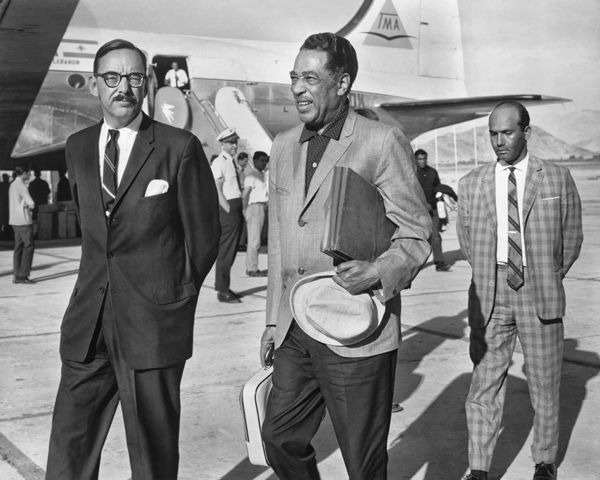
Duke in Dhaka

courtesy of DHAKA TRIBUNE

It has been an auspicious 50th anniversary of the 1963 for Ellington lovers in the Middle East and South Asia. In a series of local and international tributes to the roaring tour of Ellington and the Orchestra, sponsored by the US State Department, this is the latest addition which appeared on Dhaka Tribune, Sunday, October 6, 2013:

"Monday evening, October 28, 1963. Hundreds take their seats at the Race Course in Dhaka, excitement buzzing through the crowd.
On the stage stands an upright bass and a drum set, along with a piano brought over from the Goethe Institute. There is a slight dampness in the air, and a piano tuner has been asked to stand by. After an introduction, more than a dozen musicians from the U.S., mostly black men, take to the stage. The horn section brings along their well-loved trumpets, saxophones, and trombones. The silence of the night is broken by the melody of Billy Strayhorn’s composition, “Take the A Train,” familiar to some because it is the theme of the Voice of America’s Jazz Hour. It will be followed by other tunes like the wistful “Mood Indigo” and the swinging “Things Ain’t What They Used to Be.” For an hour and a half, the Duke Ellington Orchestra, with some of the world’s finest jazz musicians – including Paul Gonsalves and Sam Woodyard – will make the Dhaka air reverberate with the soulful and sizzling sounds of jazz."

The piece continues to give an anecdotal, as well as sociopolitical picture of Duke in Dhaka. The writer of the article is Mahmud Rahman whose knowledge of the Dhaka concert has benefited this blog on the post I did earlier this year. Mahmud is also the author of Killing the Water (Penguin India) and Black Ice (Harper Collins India).

Friday, September 20, 2013

When Duke Ellington Played Kabul


Today, BBC ran an article on the 50th anniversary of Duke Ellington's Kabul concert, a part of the tour of the US State Department which I've already covered here. (As a matter of fact, Monica Whitlock, the author of the BBC article, has put a link to my version of the story on the BBC website.)


Listen to the interview with Mr. Faiz Khairzada here. (click on the image below)


Wednesday, September 18, 2013

Crash Course on Bud Powell


"Bud was totally immersed in music -- his one constant reality. Even when there was no instrument available, he could hear the sounds. Once when a friend visited him in hospital, Bud sketched piano keys on the wall. 'Listen, what do you think of these chords,' he asked while he banged his fingers against the drawing."

This anecdote which is narrated by the deep voice of David W. Niven is the essence of Bud Powell, the subject of this new post. And also this post happens to be the 400th on Take the "A" Train, so in a sense you may call it a celebration too.

The plan is to study Bud Powell though the tapes of archivist David Niven. Please note that a few seconds of silence exists between the end of side A of each tape and the beginning of side B. The side reversal happens automatically for each tape.

I've already posted Bud-related materials here, including a note on a Danish film about the pianist, and a handful of interviews. For completion sake, be aware of the seminal Bud Powell book, Wail: The Life of Bud Powell by Peter Pullman which is described by its author as an "unsentimental biography—not hagiography—of a major jazz artist." Pullman continues: "It’s based as much on an exhaustive look at the public record and press on Powell, as it is on eyewitness accounts of his live performances and on personal opinions of his private life—in addition to subjective assessments of his studio recordings. The book treats all of these accounts as so many pathways to understanding the central paradox of the musically explosive yet emotionally impassive Powell: How could he have played with such rhythmic euphoria (and romantic feeling!) and, yet, seldom if ever have allowed anyone to see the physical and psychic pain that he was often enduring?"

For ordering the paper edition of Bud Powell book, email the author directly at pullman_peter[at]yahoo.com.

This crash course features some 500 minutes of Powell's romantic agony (i.e. music), and as it has been the case with great art, his pain will be your incalculable pleasure.

Tuesday, September 17, 2013

Jazz Mirrors Iran#8: In a Persian Market


The whole color spectrum reflected in tasbihs, hanging from the shop windows. The smell of rosewater perfumes. Carpets and rugs piled inside doorless, windowless shops and a carney-like salesman shouting outside, encouraging curious pedestrians to go in and see the “best.” Kebab shops, sending the smell of rice and meat to the air, next to a fabric shop that no lady can resist stopping by and bargaining with the humorous, assured salesman. This is the daily scene in the bazaar of Mashhad (where I lived most of my life), Grand Bazaar of Tehran, or the dream-like Vakil Bazaar of Shiraz, a Persian market somewhere in Iran where its colors, noises, smells and movements are uniquely inspiring for any poet, musician, filmmaker and anyone interested in turning the sights and sounds of the daily street life into a piece of art. [above photo: ceiling of a bazaar in Iran. Photography by Reza Hakimi.]

Now, the jazz connection, or rather the story of a song: The story begins in England, where the Birmingham born son of an engraver, Albert Ketèlbey (1875-1959) wrote this week’s theme tune, In a Persian Market. In 1920, Ketèlbey, a busy composer in London’s West End music halls, probably without ever being to a Persian market, used his imagination to depict a busy day in a Persian bazaar. His compositions soon became a popular hit, recycled many times, and even found its way to the jazz songbook.

Sunday, September 15, 2013

Earl Hines Documentary (1975)


This English documentary about the father (AKA Fatha) of jazz piano, Earl Hines, came to the online world some months ago. Beautifully shot by two-time Oscar winner DP of The Mission (Robert DeNiro, Jeremy Irons) and The Killing Fields (Sam Waterston), and directed by the Scottish TV documentary maker Charlie Nairn, it was filmed during Hines's rehearsals in the Blues Alley Club, Washington, DC.

Many thanks to the uploader Mark Bunker.


Recommended: Earl Hines with Benny Carter, another rare concert footage here.


Thursday, September 12, 2013

Bud and Buddy: Two Beautiful


If you are a regular visitor, you've probably noticed that recently the sound archives of David W. Niven (no relation to the charming actor, nevertheless a charming collector) and the writings of Whitney Balliett have been the focus of this blog. I hope you're enjoying this feast as much as I do.

This week's edition presents a recording from my favorite format in jazz, "A Meets B", in this case, two ténor extraordinaire meeting gently, passionately and unforgettably: Bud Freeman and Buddy Tate.

This is a live date recorded at the New Orleans Jazzclub, Holland, on March 31, 1976. Released by RIFF and also Circle on vinyl.

The local rhythm section is consisted of pianist Chris Smildiger, bassist Koos van der Sluis and drummer Ted Easton.

Thursday, September 5, 2013

Cootie, Rex and Hawk: Together


The year is 1957, and the session, one of the most enduring in jazz history. If you like cinema, an analogy can be made between this session and a film called RoGoPag, directed by Roberto Rossellini, Jean-Luc Godard and Piere Paolo Passolini. The session is simply called Together, alluding to the mere excitement of putting together the cream of Mainstream musicians under one roof and they blow with such versatility and ease. The Rosellini of the session is Coleman Hawkins, it's Godard, Cootie Williams, and Rex Stewart being its PPP.

For the list of other musicians supporting the Three Musketeers scroll down the page to see a scan of the liner notes, penned by no one but Monsieur André Hodeir (The LP came out in France.)

The audio file's from David W. Niven's vault, accompanied by his commentary (info mostly comes from the liner notes) between the tracks.