Showing posts with label Dizzy Gillespie. Show all posts

Saturday, June 20, 2020

Dizzy Gillespie in Berlin


Dizzy Gillespie Quintet live at the Berlin Philharmonie
November 1980

Dizzy Gillespie (trumpet), James Moody (tenor sax, flute), Ed Cherry (guitar), Michael Howell (electric bass), Tommy Campbell (drums).

Never been released before.

Tracks:
  1. St. Louis Blues
  2. Con Alma
  3. A Night in Tunisia
  4. Unidentified tune
  5. Tanga
  6. Tin Tin Deo
  7. Unidentified tune
Total Time: 1:17:20

Monday, March 5, 2018

A Date with Dizzy (1958)


Aside from being the greatest trumpeter since Louis Armstrong, or being held high as one of the greatest composers in jazz, Dizzy Gillespie was a comedian of sorts. Alluring the audience with weird hats, funky language, and cake-walking, Dizzy was more than a musician, dominating any stage with charisma, an animated performance and a rare sense of ease.

In 1958, a filmmaker tried to capture some of these features on film, though camera's fascination with Dizz can be traced back to the 1940s and his first Soundie films. Directed by the independent American animator John Hubley, A Date With Dizzy presents Dizzy Gillespie Quintet with Sahib Shihab, Wade Legge, Nelson Boyd and Charlie Persip.

Combing comedy with animation and fragments of Dizzy's classic pieces, the story concerns a day in the studio, while in presence of an indecisive director and a nervous company representative, the band is trying to score for a couple of silly cartoon commercials such as Instant Rope Ladder and E-Z Popcorn.

Tuesday, April 12, 2016

Dizzy Gillespie Playing Mouth Harp to It Don't Mean a Thing


So much pleasure in such simple moments: The place is Nice in southeast France, the occasion, a jazz festival. The tap dancer Bunny Briggs appears on a stage where tenormen Eddie Lockjaw Davis and Guy Lafitte (accompanied by Jimmy Rowles, George Duvivier, and Oliver Jackson) are performing, dragging with him on stage Dizzy Gillespie who sits down and plays mouth harp to It Don't Mean a Thing. Briggs responds with his impeccable sense of rhythm. However, it is Dizz who draws his last and gives it a big surprise by doing his tap dance before leaving the stage.

This beautiful, five-minute long video, courtesy of French television, comes from the admirable YouTube channel of Hoffmannjazz whose collection of jazz videos is a must for anyone interested in this music.

In the meantime, don't miss this one:

Sunday, December 13, 2015

Monterey Jazz Festival (1967)


MONTEREY JAZZ FESTIVAL (1967)
Directed by Lane Slate
The event hosted by Jimmy Lyons.


Set list:

Illinois Jacquet
Flyin' Home
Illinois Jacquet (ts), John Lewis (p), Ray Brown (b), Louie Bellson (d)

Ray Nance
Some of These Days
Ray Nance (violin), John Lewis (p), Ray Brown (b), Louie Bellson (d)

Ray Nance, Jean-Luc Ponty, Svend Asmussen
C Jam Blues
Jean-Luc Ponty, Ray Nance, Svend Asmussen (violin), John Lewis (p), Niels-Henning Ørsted Pedersen, Ray Brown (b), Daniel Humair (d)?

The Dizzy Gillespie Quintet
The Gentle Rain
Something In Your Smile
Dizzy Gillespie (t, v), James Moody (f, ts), Mike Longo (p), Russell George (electric b), Candy Finch (d)

The Modern Jazz Quartet & Dizzy Gillespie
Round Midnight
Dizzy Gillespie (t), John Lewis (p), Milt Jackson (vib), Percy Heath (b), Connie Kay (d)

The Don Ellis Big Band
New Horizons
Don Ellis, Glenn Stuart, Alan Weight, Ed Warren, Bob Harmon (t), Ron Myers, Dave Sanchez, Terry Woodson (tb), Ruben Leon, Joe Roccisano, Ira Schulman, Ron Starr, John Magruder (reeds), Mike Lang (p), Ray Neapolitan, Dave Parlato (b), Steve Bohannon (d), Chino Valdes (congas, bongos),
Alan Estes, Mark Stevens (percussion)

Sunday, November 15, 2015

Best Of American Jazz In Paris (Studio Recordings)

Image courtesy of Vogue Records.

25 Greatest Jazz Records by Americans in Paris


The Infinity of Lists, by Umberto Eco, is among the titles on my to-read list, though even before opening the book, and judging from the cover, I can catch the point and apply it to this list of my favorite studio recording of American jazz musicians in Paris.

The relationship between Paris and musicians has been mostly a love affair, started from the early years of jazz and continued to this day, with the post war years as the peak of interest, visits and involvement in Parisian scene. The curiosity about jazz, similar to that of African artwork revival in the early 20th century Paris, was expanding in various directions in the years between early 1950s and late 1960s. Jazz appeared in or influenced French literature and cinema, while I'm sure, the connection between this American art and France goes beyond these two primary examples.

With a long history of hosting American jazz musicians and giving them the space to play and record, the Paris-recorded albums are too important to remain unlisted. This is one attempt to pay a closer listen to the Parisian jazz records.

These are recordings I have listened to and mostly loved over the years, knowing that there are still hundreds of recordings there, waiting to be rediscovered. Probably you will notice the absence of more contemporary albums on the list, but that can be explained in regard to the current international status of jazz and the blurred concepts of nationality and borders in the 21th century jazz scene. Now, appearing in a Parisian studio or a concert hall is nothing unusual or unique for any internationally recognized artist. But I reckon, back in the 1950s, it must have been a rare experience being present and recording in Paris for someone like Gerald Wiggins. This uniqueness is derived from, among many other things, the status of Afro-Americans in France and the fact that they have been cherished as artists and seen as heroes of the Existentialist and Anti-colonial movements of the post war period. Many of these notions remained a romantic and flawed reading of jazz history, but the recorded documents tell of a joy and sense of exploration which was bestowed to the musicians because of the place of recording.

This list was initiated as a part of my short-lived jazz program, targeted for Iranian listeners, which ran between 2011 and early 2012. The episodes 22 to 24 were titled Jazz In Paris, and during three sessions I played many tracks from the albums I've listed here. They are available here, here and here.

Monday, October 21, 2013

Dizzy Gillespie at the Village Gate (1977)

© courtesy of Pablo Records.
"A lot of people call Dizzy old fashioned but so is the bible." -- Mickey Roker

Celebrating what would have been John Birks Gillespie's 96th birthday.

WBAI fundraiser "Dizzy Gillespie Day" held at the Village Gate in New York City on August 30, 1977. This recording contains part one of the event, an interview with Dizzy Gillespie's guitarist Rodney Jones and the music of jazz pianist Rio Clemente.


Saturday, October 19, 2013

Earl Hines and Dizzy Gillespie on Duke Ellington


This scene comes from Love You Madly, one of the best Ellington documentaries which was originally made for TV in the west coast. The interviews are conducted by Ralph Gleason.

Monday, April 8, 2013

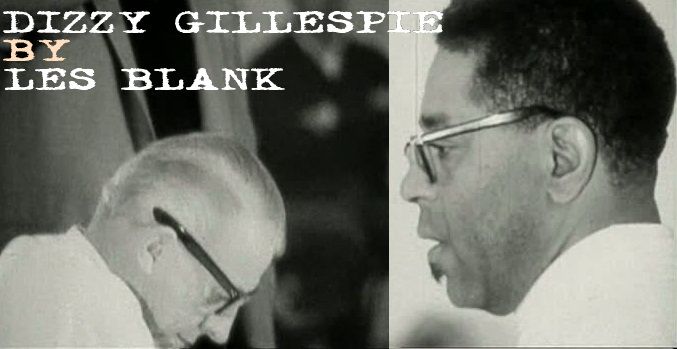
Dizzy Gillespie '65 by Les Blank


Les Blank, a fascinating individual and director of some remarkably personal documentaries passed away yesterday. I hardly have anything to say about him, at least worthy of his long and adventurous career, since I knew his ouvre only sporadically. However, I hope the stream of obituaries following his death would serve the purpose of shedding light on the career of  the man "whose sly, sensuous and lyrical documentaries about regional music and a host of other idiosyncratic subjects, including Mardi Gras, gaptoothed women, garlic and the filmmaker Werner Herzog, were widely admired by critics and other filmmakers if not widely known by moviegoers."

Here, I'll draw your attention to one of Blank's very early films, which happens to be one of the best jazz films produced under the umbrella of independent, ciné-vérité movement of the 1960s. Les Blank made many films about music, including The Blues Accordin' to Lightnin' Hopkins (1968), of course if one doesn't mention incorporating jazz and blues music in his non-musical films. During five tireless decades of film-making, the portrait of Dizzy Gillespie stands out as probably one of Blank's most accomplished cinematographic discovery of music and musical ideas.

Friday, January 25, 2013

Rollin' Around the Horn: Hawk, Dizz, Getz, Mex


Rollin' Around the Horn
Nat Hentoff's Liner Notes for
Sittin' In (Verve/Clef)

About 6 a.m., a few days before the July 4, 1957 weekend, three tenors, a trumpet and a rhythm section convened in a New York recording studio. They left about five hours later - and this is the result. It marks the first time that Coleman Hawkins, Paul Consalves, and Stan Getz have ever recorded together. It's also a reunion between Dizzy and Hawk. They were responsible for an historic date in 1944 at which sessions titles like Woody n' You and Disorder at the Border were recorded. It was musically an important early modern jazz event but also was a rare graphic indication for that warring time that the “bop" movement was not a break with the jazz tradition; for after all, Coleman Hawkins had Dizzy on his date.

“I never worry about styles noway,” Coleman said recently. “I like to get fellows together that play.” Coleman approves of both his reed colleagues on this session, and adds: “You know Paul’s been playing a long time and deserves a lot more credit than he’s gotten."

“Paul,” Stan Getz commented on the session, “plays a ballad that's just beautiful. His ballad playing on the date gassed us all. I've always loved the way Coleman plays; he’s always had his own style, his own way. His work has lucidity and freedom. He seems to just roll around the horn and his sound is so full.”

Sunday, January 29, 2012

Radio Hawkins#23: Americans in Paris II

 راديو هاوكينز: جاز براي ايران
اپيزود 23
آمريكايي ها در پاريس
بخش دوم

اين جا بشنويد


فهرست قطعات

All recorded in Paris, France, unless noted.


Sidney Bechet and His Orchestra
On the Sunny Side of the Street
Gérard Bayol (tp), Benny Vasseur (tb), Sidney Bechet (ss), Eddie Bernard (p), Jean-Pierre Sasson (g), Guy De Fatto (b), André Jourdan (dm)
16 May 1949

Oscar Peterson-Stephane Grappelli Quartet
Autumn Leaves
Stephane Grappelli (vln) Oscar Peterson (p) Niels-Henning Orsted Pedersen (b) Kenny Clarke (d)
22 or 23 February 1973

Bud Powell
Idaho
Johnny Griffin (ts), Bud Powell (p)
14 February 1960

Stan Getz Quartet
Manha de Carnaval (Morning of the Carnival)
Stan Getz (ts), Gary Burton (vib), Steve Swallow (b), Roy Haynes (d)
13 November 1966

Marlene Dietrich & Freddy Johnson
Wo Ist der Mann?
Arthur Briggs (t), Peter Duconge (cl), Freddy Johnson (p), Huan Fernandez (b), Billy Taylor (d), Peter Kreuder (arr, ldr), Marlene Dietrich (voc)
8 July 1933

Blossom Dearie
April in Paris
Blossom Dearie (p), Herman Garst (b), Bernard Planchenault (d)
1955

Dizzy Gillespie Quartet And The Double Six Of Paris
Con Alma
Dizzy Gillespie (tp), Bud Powell (p), Pierre Michelot (b), Kenny Clarke (d), Claudine Barge, Jean-Claude Briodin, Christiane Legrand, Eddy Louiss, Mimi Perrin, Robert Smart, Ward Swingle (vo)
8 July 1963

Lucky Thompson
Lucky Strikes
Lucky Thompson (ts), Jean-Pierre Sasson (g), Paul Rovére (b), Gérard 'Dave' Pochonet (d)
27 March 1956

Duke Ellington & His Orchestra
Paris Stairs
Ray Nance, c; Bill Berry, Roy Burrowes, Eddie Mullens, t; Lawrence Brown, Leon Cox, tb; Chuck Connors, btb; Jimmy Hamilton, cl, ts; Johnny Hodges, as; Russell Procope, as, cl; Paul Gonsalves, ts; Harry Carney, bs; Duke Ellington, p; Aaron Bell, b; Sonny Greer, d.
New York City, 29 March 1962

Lester Young
Back Home Again in Idiana
Lester Young (ts), Rene Urtreger (p), Jimmy Gourley (g), Jamil Nasser (b), Kenny Clarke (d)
4 March 1959

Joe Albany
Lush Life
Joe Albany (p, cov)
1977

Louis Armstrong with Sy Oliver Orchestra
La Vie en Rose
Cy Oliver (arr), Louis Armstrong (t, voc), Melvin Solomon (t), Bernie Parivin (t), Paul Webster (t), Morton Bullman (tb), Hymie Schertzer (as), Milt Yaner (as), Art Drelinger (ts), Bill Holcomb (ts), Earl Hines (p), Everett Barksdale (g), George Duvivier (b), Johnny Blowers (d)
New York City, 26 June 1950

Charles Mingus
Sophisticated Lady
Jaki Byard (p), Charles Mingus (b)
18 April 1964

Bill Coleman
Afromotive in Blue
Bill Coleman (tp), Quentin Jackson (tr), Budd Johnson (tsax), Les Spann (g), Patti Bown (p), Buddy Catlett (b), Joe Harris (d)21 or 22 January 1960

Al Haig
Round About Midnight
Al Haig (p), Pierre Michelot (b)
23 September 1977

Sunday, January 15, 2012

Radio Hawkins#22: Americans in Paris I

راديو هاوكينز: جاز براي ايران
اپيزود 22
آمريكايي ها در پاريس
بخش اول

اين جا بشنويد


فهرست قطعات

All recorded in Paris, with exception of the first track, recorded in New York City.

Coleman Hawkins & Manny Albam Orchestra
I Love Paris
Chauncey Welsch (tr), Romeo Penque (t), Ray Beckienstein (f, sax), Al Epstein (f, sax), Coleman Hawkins (ts), Marty Wilson (vibe), Barry Galbraith (g), Hank Jones (p), Arnold Fishkin (b), Osie Johnson (d)
July 9, 1956

Sonny Criss
Don't Get Around Much Anymore
Sonny Criss (alto sax), Georges Arvanitas (org), Rene Thomas (g), Pierre Michelot (b), Philippe Combelle (d)
April 22 or 25, 1963

Dizzy Gillespie
Serenity
Dizzy Gillespie (tp), Kenny Drew (p) Niels-Henning Orsted Pedersen (b) Kenny Clarke (d)
April 13, 1973

Ben Webster
Johnny Come Lately
Ben Webster (ts), Georges Arvanitas (p), Jacky Samson (b) , Charles Saudrais (d)
June 5, 1972

Dexter Gordon
Broadway
Dexter Gordon (t), Bud Powell (p), Pierre Michelot (b), Kenny Clarke (d)
May 23, 1963

Chet Baker
Oh You Crazy Moon
Chet Baker (t), Phil Markowitz (p), Jean-Francois Jenny Clark (b), Jeff Brillinger (d)
Dec 28, 1978

Cannonball Adderley Quintet
Walk Tall
Nat Adderley (t), Cannonball Adderley (alto sax), Joe Zawinul (p), Sam Jones (b), Louis Hayes (d)
March 27, 1969

Joe Newman Quintet
Lover Man
Joe Newman (t), Frank Wess (ts), Maurice Vander (p), Eddie Jones (b), Sonny Payne (d)
October 8, 1956

Cootie Williams
Mood Indigo
Cootie Williams (t), George Clarke (ts), Arnold Jarvis (org), Larry Dale (g), Lester Jenkins (d)
January 31, 1959

Bill Evans Trio
What are you doing the rest of your life?
Bill Evans (p), Eddie Gomez (b), Marty Morrell (d)
February 6, 1972

Ahmad Jamal
Bellows
Ahmad Jamal (p), Joe Kennedy Jr. (violin), Calvin Keys (g), Jeff Chambers (b), Yoron Israel (d), Manolo Badrena (percussion)
October 26, 1996

Wednesday, December 14, 2011

Dizzy Gillespie's Bebop Reunion


Dizzy Gillespie's Bebop Reunion
Chicago, IL @ PBS Soundstage 1976 
Dizzy Gillespie - trumpet
James Moody - sax
Milt Jackson - vibes
Al Haig - piano
Ray Brown - bass
Kenny Clarke - drums

Original broadcast is 58 minute long, with singers Joseph Carroll and Sarah Vaughan.

Saturday, November 12, 2011

Radio Hawkins#13: On the Road with Kerouac

 برنامۀ سيزدهم
جك كرواك و موسيقي جاز
مجموعه قطعاتي از موزيسين هاي محبوب جك، كاري كه به اسم خود او نوشته و اجرا شده. اشعار او با صداي خودش و با صداي آلن گينزبورگ و مروري بر موسيقي بي باپ كه جك شاهد عيني تولد و اوج گرفتن آن بود
همراه با
لستر يانگ، برو مور، كانت بيسي، جرج شيرينگ، ساني استيت، فليپ فليپس، چارلي پاركر، ديزي گيلسپي، تلانيوس مانك

به برنامه سيزدهم در اين جا گوش كنيد


با كيفيت متوسط و متناسب با سرعت اينترنت ايران در اين جا

Monday, June 6, 2011

Swinging Persia


Jazz in Iran? Yes, and no! Once upon a time, before the 1979 revolution, when oil's money was overflowing, a Queen and some of her advisers had the idea of making the country more sophisticated, more prestigious. Thus, among so many decisions they made, one was inviting the jazz acts to the country. Of course, long before this plan that long before Harry 'Sweets' Edison, Pearl Bailey and Louie Bellson appear in Tehran's biggest amphitheater by that invitation, Duke Ellington and his Orchestra showed up in Isfahan, a place so amazingly beautiful that inspired Duke and Billy Strayhorn to embed all that beauty in one of the most majestic alto solos in history of jazz, Isfahan, as played later by Johnny Hodges.

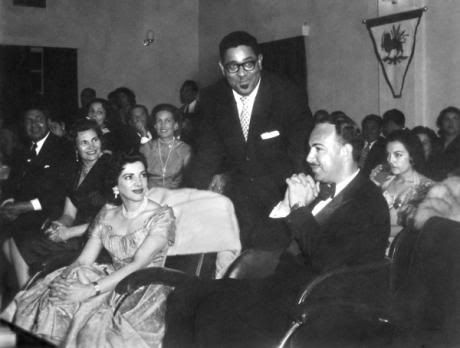
Dizzy Gillespie during the 1956 State Department jazz tour, at a reception with Princess Shams Pahlavi, elder sister of the Shah of Iran, and her husband Mehrdad Pahlbod (Later Minster of Culture and the Arts) at the capital of oil in Iran, Abadan. Also I've seen some very rare photos of Dizz with Shah's generals in a port in southwest of Iran, which a friend discovered in an antique shop in Florida.

Everybody was coming to Iran, from Frank Sinatra to Karlheinz Stockhausen! Money was flowing and even if Frank Sinatra's concert in Jamshidieh Stadium in Tehran was a flop, it didn't stop musicians from visiting lavish, old, and rich Persia. Falling in love with the country was so easy, as William Wyler's host in Iran told me, "he came for a week long festival, and ended up staying for a month on the shores of Caspian sea and eating best Caviar in the world." Magic carpet was ready to give a free ride to everyone whose name was big enough to give credit to the country that was longing for that.

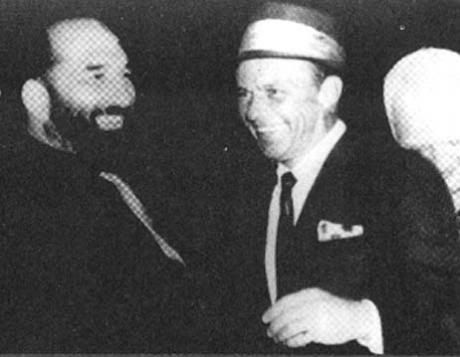
What Frankie is doing with Shabaan the Brainless? Shabaan the Brainless was a notorious thug who had a direct role in American Coup d'état of 1953 that led to overthrow of Iranian first and last democratic government. According to the CIA's declassified documents and records, some of the most feared mobsters in Tehran were hired by the CIA to stage pro-Shah riots. In 2000, Madeleine Albright, ex-U.S. Secretary of State, confessed that intervention by the U.S. in the internal affairs of Iran was a setback for democratic government, but it was too late.
So Dizzy Gillespie and his big band was visiting oil cities, like a treasury minister, and Willis Conover's voice was in the air, as Hollywood films had their premiere in Tehran cinemas. Sundays, Jack Teagarden in a striped suite played good old jazz in national TV. The country was like a story from 1001 nights, a modern fairy land, where at days you had Peter Brook to perform in Shiraz, enjoying the best grapes in the world, and at nights John Cage was on stage, an artist whose musical ideas was even too much for the Western ears.

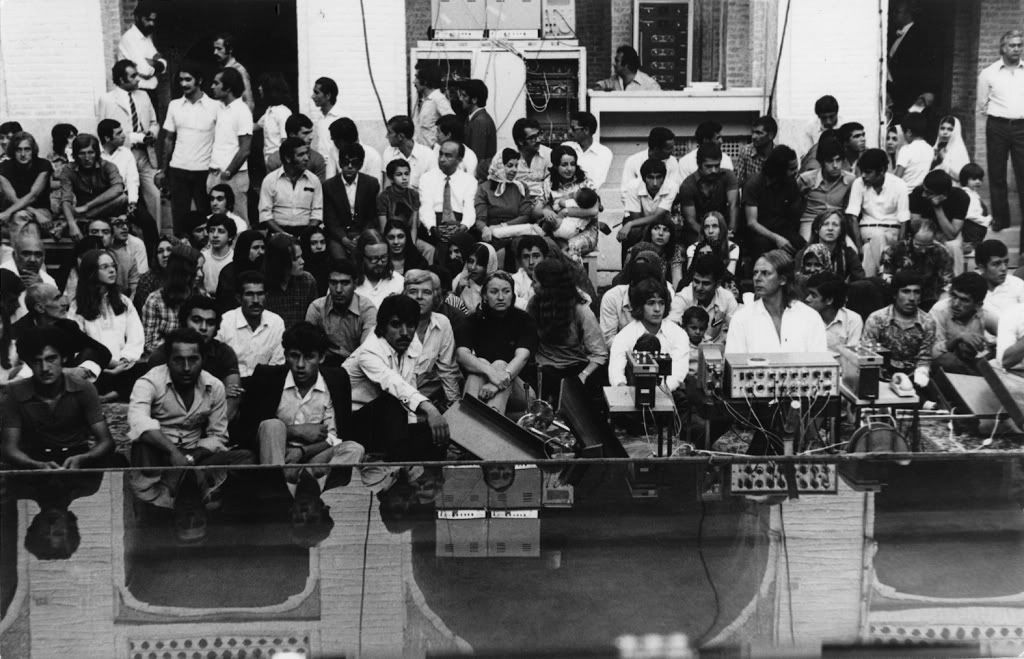
Karlheinz Stockhausen (front right) at the Shiraz Arts Festival, Iran, 2 September 1972. How many of these people understand what's happening, musically?
Aloys and Alfons Kontrarsky, 2.9.1972, Shiraz.

Among those who landed in Iran, there was a young American jazzman who had something else in mind.


...to be continued.

Part 2 here.

Thursday, May 27, 2010

William Gottlieb's Jazz Photos, Part 4

Bebop and swing cats gather at Mary Lou Williams's apartment and digging new records; from left: Dizzy Gillespie, Mary Lou, Tadd Dameron, Hank Jones, unknown man and woman, Jack Teagarden.
Mary Lou's spacious Harlem apartment was a “salon” where, especially in the 1940’s, many prominent jazz people hung out, especially—though not exclusively—those musicians whose style was at the cutting edge.


Duke Ellington

Dave Tough (1907 – 1948), a great drummer associated with both Dixieland and swing jazz in the 1930s and 1940s. He has been described as "the most important of the drummers of the Chicago circle"

Bunk Johnson and his wife.

Bunk Johnson (left) and Leadbelly (right)

Thursday, April 15, 2010

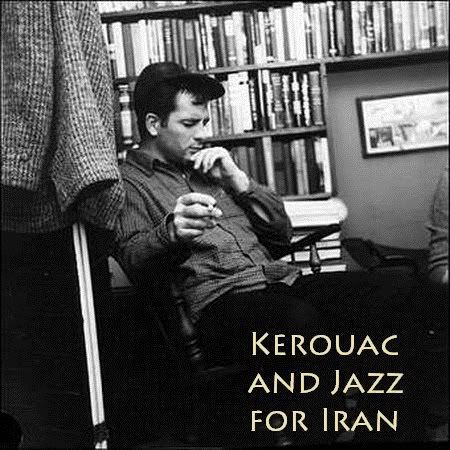
Jack Kerouac and Jazz


Jack Kerouac loved the people, the things of life, the rivers, his mother, and, he also loved jazz. He loved jazz with such intensity that most of us can’t even imagine. He tried to create what we say a jazz writing style, a bop writing style that is evident in his very fine poetry book, Mexico City Blues (1959).

Here, in July, 1982, Sam Charters (born 1929) a novelist, blues and jazz historian, poet and the writer of Studies in Underground Poetry Since 1945, published in 1971 - and a groundbreaking work in the study of the Beats - remembers Jack Kerouac and his passion for jazz, while examining the influence of this music and certain jazz musician on his writings.

According to Allen Ginsberg in an interview originally published in Composed on the Tongue (1980), Jack Kerouac “learned his line” listening to early bebop. He was a regular visitor at Minton’s club, the house of bebop and modern jazz. And it was Lester Young who gave Jack Kerouac his first Marijuana! Dizzy Gillespie’s improvisational style and innovative harmonies had a profound influence on him. Charlie Parker, a rhythmically complex, improvisational idiom influenced Kerouac’s spontaneous approach to prose writing. Jack Kerouac honors Charlie Parker in the final three choruses of Mexico City Blues, praising Parker’s musical genius, recognizing his human position, and appealing to Parker for prayer on behalf of Kerouac. Thelonious Monk undoubtedly had his most profound influence on Kerouac, who emulated the rhythmic and harmonic intricacies of bebop in his spontaneous prosody. Kerouac even organized a collaborative jazz-poetry performance on East 10th Street in Manhattan in early October 1957, and called it “First Poetry-Jazz Concert.” Originally the performance was intended for the Museum of Modern Art.

This audio file includes personal comments and observations from Charters, poetry reading and reading passages from Kerouac books, plus playing some hot jazz and Kerouac’s own voice re-telling his history of Bebop. 84 minutes.

*Sound drops at 00:50:00 for a couple of seconds.
**Thanks to very generous David, from Isfahan, for sending the link.

Listen to On the road: The Jack Kerouac conference, Sam Charters lecture, Jack and jazz, July, 1982.


Thursday, February 4, 2010

Duke Ellington & Dizzy Gillespie

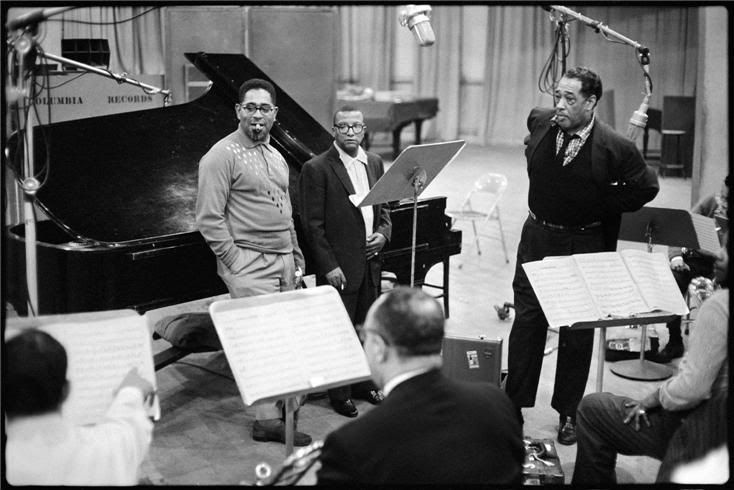
Left to right: Dizzy Gillespie, Billy Strayhorn and Duke Ellington


In February 1959, Duke Ellington assembled a cavalcade of jazz heavyweights and superstars for the swinging "Jazz Party" album. Jazz great Dizzy Gillespie was one of the guests for Duke's party album and the legendary trumpeter's solo on "U.M.M.G. (Upper Manhattan Medical Group)" is still awe-inspiring.

Photographed by: Don Hunstein
© Sony Music Entertainment