Monday, June 6, 2011

Swinging Persia


Jazz in Iran? Yes, and no! Once upon a time, before the 1979 revolution, when oil's money was overflowing, a Queen and some of her advisers had the idea of making the country more sophisticated, more prestigious. Thus, among so many decisions they made, one was inviting the jazz acts to the country. Of course, long before this plan that long before Harry 'Sweets' Edison, Pearl Bailey and Louie Bellson appear in Tehran's biggest amphitheater by that invitation, Duke Ellington and his Orchestra showed up in Isfahan, a place so amazingly beautiful that inspired Duke and Billy Strayhorn to embed all that beauty in one of the most majestic alto solos in history of jazz, Isfahan, as played later by Johnny Hodges.
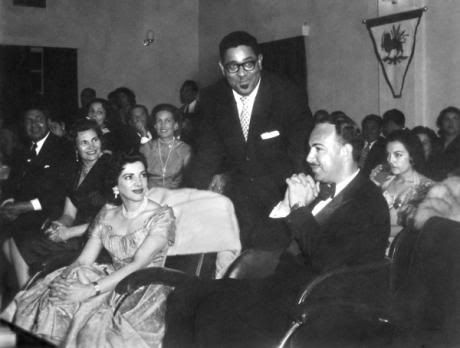
Dizzy Gillespie during the 1956 State Department jazz tour, at a reception with Princess Shams Pahlavi, elder sister of the Shah of Iran, and her husband Mehrdad Pahlbod (Later Minster of Culture and the Arts) at the capital of oil in Iran, Abadan. Also I've seen some very rare photos of Dizz with Shah's generals in a port in southwest of Iran, which a friend discovered in an antique shop in Florida.

Everybody was coming to Iran, from Frank Sinatra to Karlheinz Stockhausen! Money was flowing and even if Frank Sinatra's concert in Jamshidieh Stadium in Tehran was a flop, it didn't stop musicians from visiting lavish, old, and rich Persia. Falling in love with the country was so easy, as William Wyler's host in Iran told me, "he came for a week long festival, and ended up staying for a month on the shores of Caspian sea and eating best Caviar in the world." Magic carpet was ready to give a free ride to everyone whose name was big enough to give credit to the country that was longing for that.
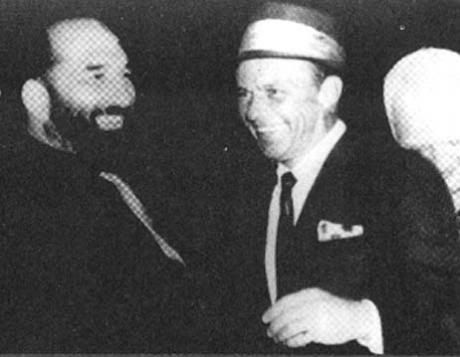
What Frankie is doing with Shabaan the Brainless? Shabaan the Brainless was a notorious thug who had a direct role in American Coup d'état of 1953 that led to overthrow of Iranian first and last democratic government. According to the CIA's declassified documents and records, some of the most feared mobsters in Tehran were hired by the CIA to stage pro-Shah riots. In 2000, Madeleine Albright, ex-U.S. Secretary of State, confessed that intervention by the U.S. in the internal affairs of Iran was a setback for democratic government, but it was too late.
So Dizzy Gillespie and his big band was visiting oil cities, like a treasury minister, and Willis Conover's voice was in the air, as Hollywood films had their premiere in Tehran cinemas. Sundays, Jack Teagarden in a striped suite played good old jazz in national TV. The country was like a story from 1001 nights, a modern fairy land, where at days you had Peter Brook to perform in Shiraz, enjoying the best grapes in the world, and at nights John Cage was on stage, an artist whose musical ideas was even too much for the Western ears.
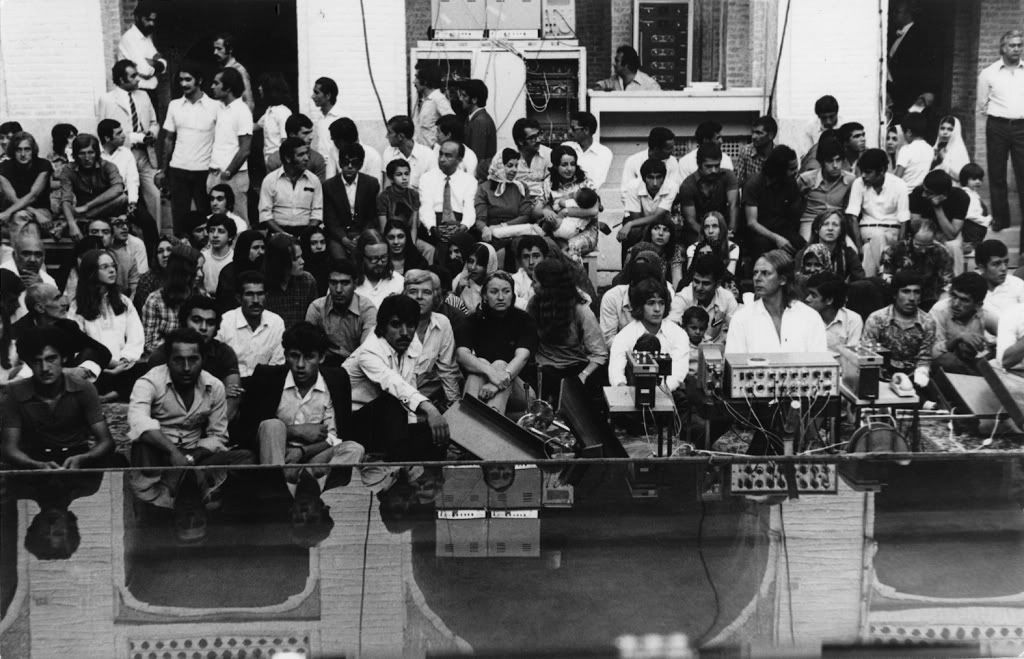
Karlheinz Stockhausen (front right) at the Shiraz Arts Festival, Iran, 2 September 1972. How many of these people understand what's happening, musically?
Aloys and Alfons Kontrarsky, 2.9.1972, Shiraz.

Among those who landed in Iran, there was a young American jazzman who had something else in mind.


...to be continued.

Part 2 here.

Friday, June 3, 2011

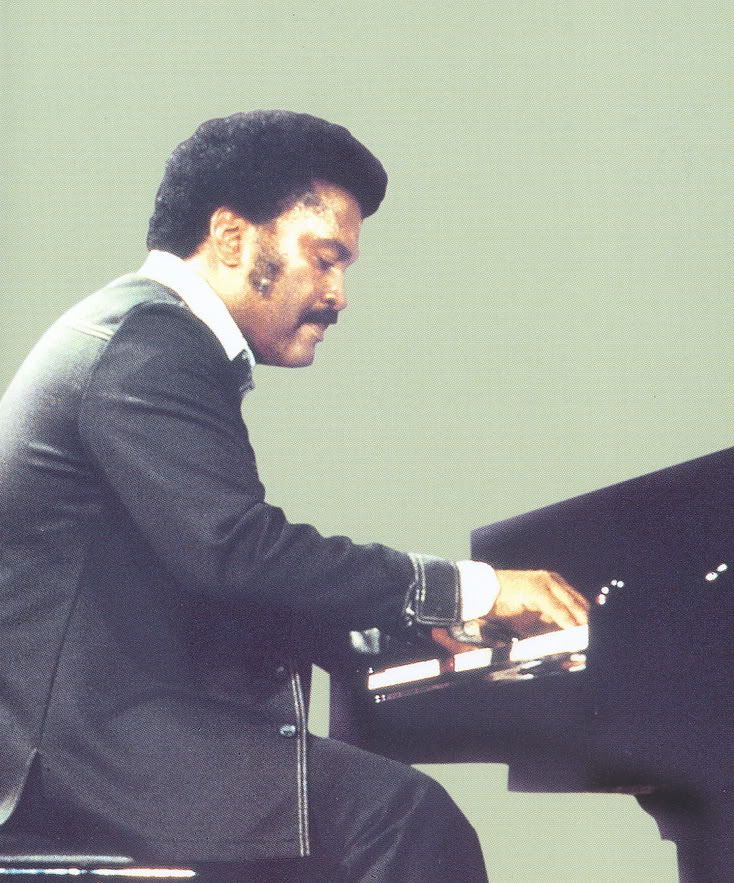
Ray Bryant (1931-2011) R.I.P


Ray Bryant died at 80; the news is always as simple as this. But we all know that behind these numbers that sadly reflect the passing of time, years and years of music, joy of pure humanity and deep belief in art is hidden. The ending is always so sad for me, but let's not forget about the "sound" and the "joy" that always has existed, and is here to stay!

with Ike Isaac (b) Specs Wright (d). April 5, 1957. Prestige  
Blues Changes (composed by Bryant) from the album, Ray Bryant Trio  
 

He was a hard-bopper, in the same category with Sonny Clark, Kenny Drew, Tommy Flanagan, Elmo Hope, Wynton Kelly, or Randy Weston. But he had a delicate touch, like Red Garland and Jimmy Rowles. He was doing magic in small groups (mostly trios - listen to Good Morning Heartache here), and even when he was all alone (dig Alone With The Blues LP!). But also he could accompany the giants in the best way one can imagine. [listen to La Rosita here]

with Charlie Shavers (tp) Coleman Hawkins (ts) Tiny Grimes (g) George Duvivier (b) Osie Johnson (d). April 3, 1959. Prestige.  
La Rosita from Hawk Eyes   
 

Mr Richard Cook summarizes his long career:
Many premier musicians have come out of Philadelphia and Ray Bryant might head the list. He was the regular piano man at the city’s Blue Note club from 1953, where he accompanied all the visiting giants and later in the 50s he performed a similar role at Prestige, taking the piano seat on such sessions as Worktime (Sonny Rollins) and several in the great sequence of discs which Colman Hawkins recorded there. In 1959, though, he settled in New York, establishing his own trio although he never shied away from playing on his own and – unlike such contemporaries as Red Garland – he has set down a distinctive body of solo work on record. He recorded prolifically for Cadet and Colombia in the 60s (although the latter label wasted his time with pop material) and for Pablo in the 70s but he saved many of his finest hours for an outstanding sequence of records for Emarcy in the late 80s and early 90s, which have been too quickly deleted and are too little appreciated. Outgoing and capacious in his style, with a great feel for gospel currents and a gracious touch with blues, Ray is perhaps only fully appreciated in Japan, where he has always had a large and loyal following. His brother Tommy (1930-82) was a bassist.  
with George Duvivier (b), Grady Tate (d). January 10 or 12, 1976. Pablo 
Good Morning Heartache from Here's Ray Bryant


I don't remember any pianist using this much of two hands, and use it so beautifully. R.I.P Ray!
.

Sunday, May 29, 2011

A Guide to Best Jazz Scores for Cinema#2

 20
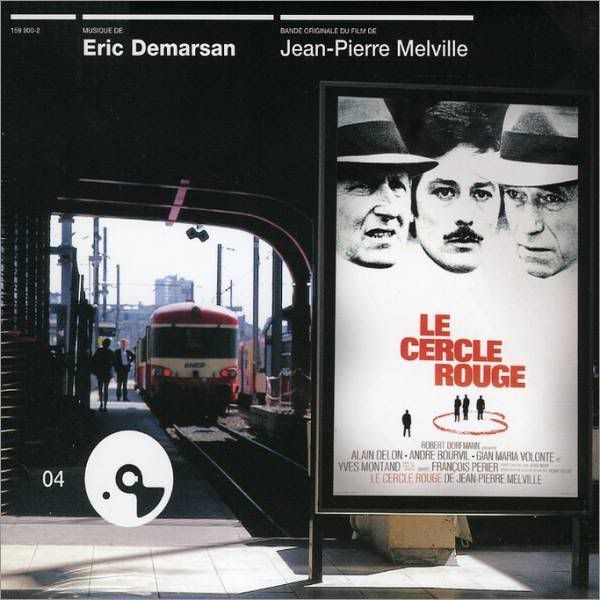
 Eric Demarsan
 Le Cercle Rouge
1971
Jean-Pierre Melville

Musicians: Raymond Guiot, flute; Georges Arvanitas, piano; Joss Baselli, accordion; Bernard Lubat, vibraphone; Guy Pedersen, acoustic double bass; Daniel Humair, drums. Recorded at Studio Davout, Paris, October 1970. Score originally started by Michel Legrand who was replaced during production.

listen to the "main theme"


19
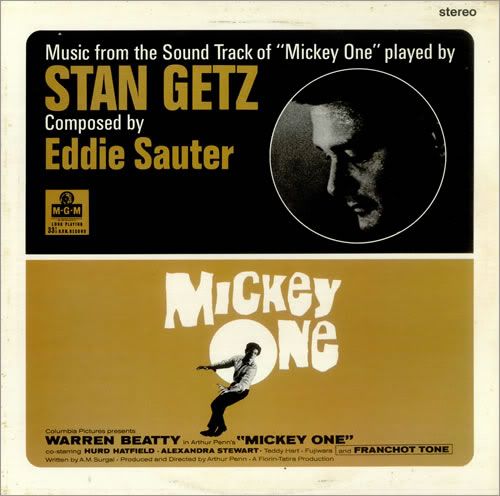
Stan Getz/Eddie Sauter
Mickey One
1965
Arthur Penn

Music by: Eddie Sauter; Music Directed/Conducted by: Jack Shaindlin; Music Supervisor: Jack Shaindlin; Music Arranged by: Eddie Sauter; Improvisations: Stan Getz; Musicians: Bob Abernathy, Ray Alonge, Richard Berg, Jimmy Buffington, Earl Chapin, French horn; Al DeRisi, Ernie DiFalco, Joe Ferrante, Bobby Nichols, trumpet; Clark Terry, trumpet, fluegel horn; Eddie Bert, John Messner, Ephie Resnick, Sonny Russo, trombone; Tommy Mitchell, b trombone; Harvey Phillips, tuba; Harvey Estrin, alto sax, clarinet, flute, alto flute, piccolo; Al Block, tenor sax, clarinet, flute, piccolo; Ray Shiner, tenor sax, clarinet, oboe, cor anglais; Wally Kane, bass sax, clarinet, bassoon; Eli Carmen, bassoon; Don Ashworth, Charlie Russo, reeds; + vlns, violas, celli, harps; Roger Kellaway, piano; Barry Galbraith, guitar; Richard Davis, acoustic double bass; Mel Lewis, drums; + percussion.

Listen to "I Put My Life in Your Hands/A Girl Named Jenny"


18
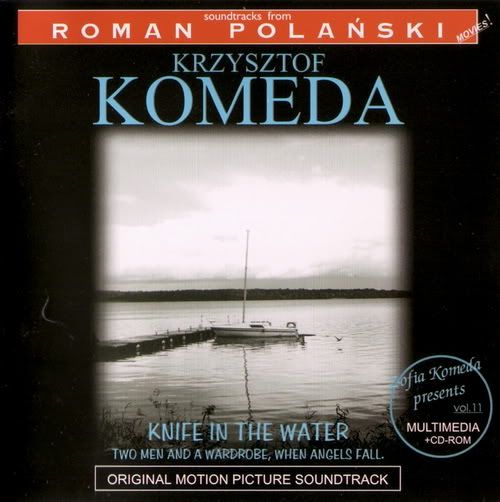
Krzysztof Komeda
Knife in the Water
1962
Roman Polanski

Musicians: Bernt Rosengren, tenor sax; Krzysztof Komeda, piano; Roman Dylag, acoustic double bass; Lech Dudziak, drums.

Listen to a segment of Komeda work for The Knife

17
Martial Solal
À bout de souffle
1959
Jean-Luc Godard

Musicians: Roger Guérin, trumpet; Pierre Gossez, alto sax; Martial Solal, piano; Michel Hausser, vibraphone; Paul Rovère, acoustic double bass; Daniel Humair, drums.

Listen to "L'Amour, la mort"


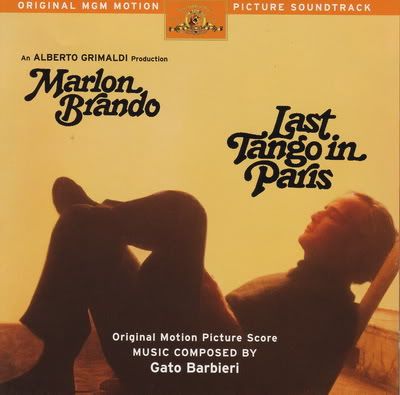
16
Gato Barbieri
The Last Tango In Paris
1972
Bernardo Bertolucci

Conducted & Arranged by: Oliver Nelson; Musicians: Gato Barbieri and his Orchestra, including Gato Barbieri, tenor sax; Joachim Kühn, piano; Charlie Haden, acoustic double bass; Daniel Humair, drums.


Listen to two parts of Last Tango suite


Return to part 1                                                   Go to part 3

Wednesday, May 11, 2011

Snooky Young (1919-2011)


Snooky Young who passed away today, was a man of the best bands of swing and post-swing era, including orchestras by Jimmie Lunceford, Count Basie, Lionel Hampton and Gerald Wilson. Richard Cook describes him as "an impeccable lead-man for the duration of his long career, able to play the most demanding of parts, and as a result his skilful solos, often given a rascally, high-wire treatment, have been largely undervalued." 

Interestingly, I discover him for the first time, in a live rock album by The Band, called Rock of Ages, and later, watching his magisterial solo on Stella By Starlight (Count Basie Orchestra, Sweden 1963, from Jazz Icons series DVD), entered his name to my personal pantheon of greatest trumpet players of all times.

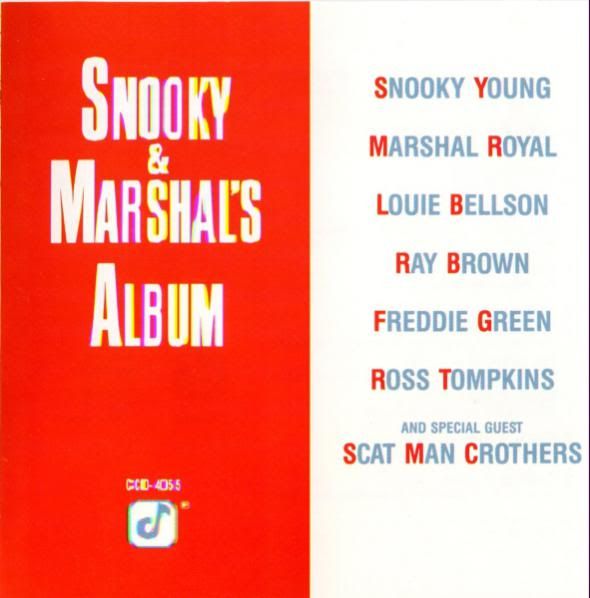
We remember him by listening to his album with Marshal Royal from 1978:


 Snooky & Marshal's Album

This album is Snooky Young's second session as a leader (from three sessions throughout his life), and this one with altoist Marshall Royal. Backed by a great rhythm section and guest vocalist Scatman Crothers who sings his own composition, Mean Dog Blues.

Snooky Young (Flugelhorn, Trumpet), Marshall Royal (alto sax), Ross Tompkins (piano), Freddie Green (guitar), Ray Brown (bass), Louie Bellson (drums), Scatman Crothers (vocals)
Hollywood, CA, 1978, Concord Jazz CJ55 - Total Time 42:28 - Transferred from Vinyl

Side A:
1) I Let a Song Go Out of My Heart (Ellington, Mills, Nemo, Redmond)
2) Mean Dog Blues (Scatman Crothers)
3) Cederay (Ray Brown)
4) Limehouse Blues (Braham, Furber)


Side B:
1) Cherry (Corgan, Gilbert, Mogg, Redman, Way)
2) Medley: You've Changed/I'm Confessin'/Come Sunday (Carey, Fischer/Dougherty, Reynolds, Neiburg/Ellington)
3) Catch a Star (Tom Peterson)
4) Should I? (Brown, Freed)


Tuesday, May 10, 2011

A Guide to Best Jazz Scores for Cinema#1

25
Duke Ellington
Anatomy of a Murder
Otto Preminger
1959
Music Directed/Conducted by: Gerald Wilson - Musicians: Clark Terry, Cat Anderson, Harold Baker, Gerald Wilson, trumpet; Ray Nance, trumpet, violin; Johnny Hodges, alto sax; Russell Procope, clarinet, alto sax; Paul Gonsalves, tenor sax; Harry Carney, clarinet, baritone sax, bass-clar; Jimmy Hamilton, clarinet, tenor sax; Britt Woodman, Quentin Jackson, John Sanders, trombone; Duke Ellington, piano; Billy Strayhorn, celeste; Jimmy Woode, acoustic double bass; James Johnson, drums.

Listen to theme for the main title

 24
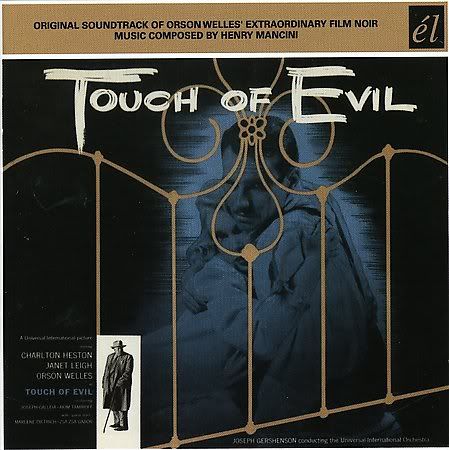
Henry Mancini
Touch of Evil
Orson Welles
1958

Musicians: Ray Linn, Conrad Gozzo, Pete Candoli, trumpet; Plas Johnson, tenor sax; Dave Pell, baritone sax; Ray Sherman, piano; Barney Kessel, guitar; Red Norvo, vibraphone; Rollie Bundock, acoustic double
bass; Shelly Manne, drums; Jack Costanzo, bongos; Mike Pacheco, congas.

Listen to Reflection from Touch of Evil


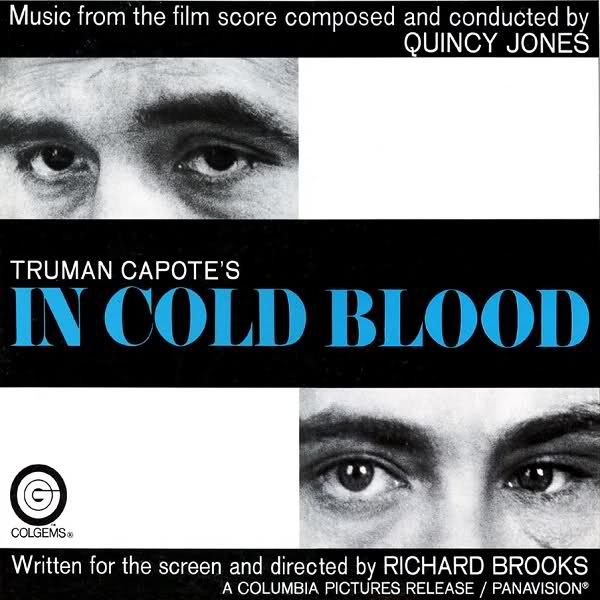
23
Quincy Jones
In Cold Blood
Richard Brooks
1967
Musicians: Buddy Childers, trumpet; Frank Rosolino, trombone; Dave Grusin, clavinet; Gene Cipriano, Bud Shank, William Green, woodwinds; Howard Roberts, guitar; Ray Brown, Andy Simpkins, b soloists;
Carol Kaye, acoustic double bass; Shelly Manne, Earl Palmer, drums; Don Elliott, Emil Richards, percussion.

Hanging Paper from the soundtrack


22 
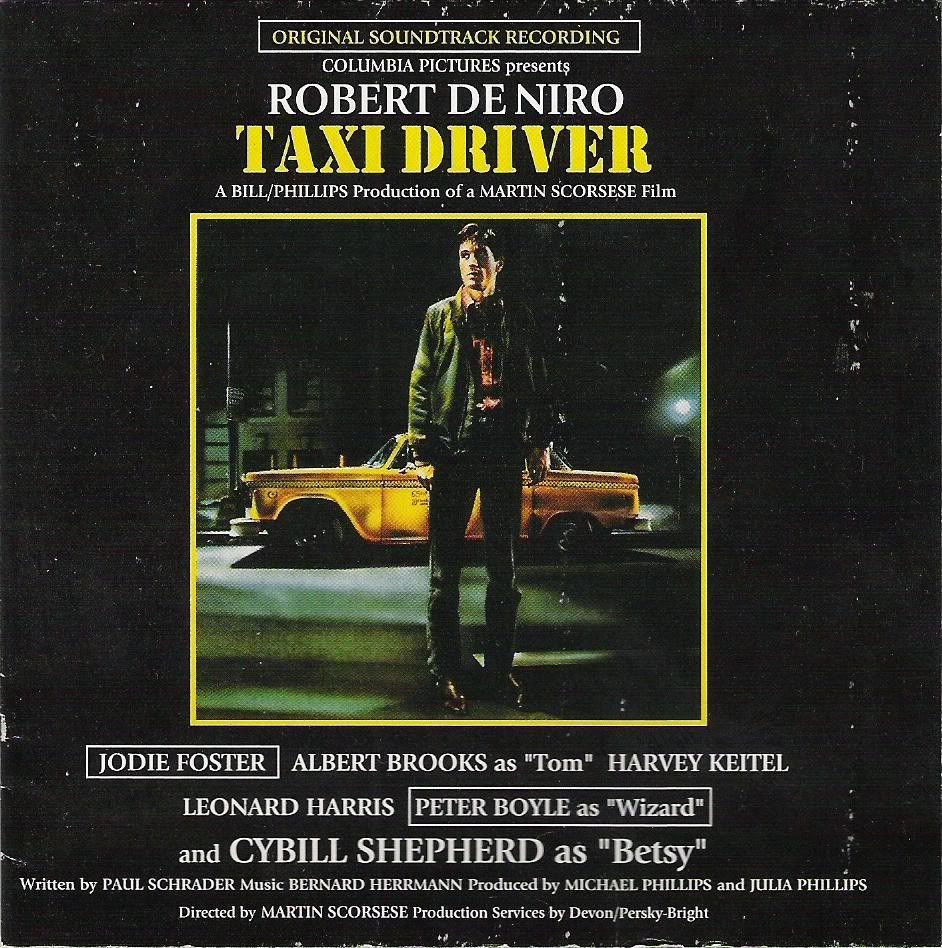
Bernard Herrmann
Taxi Driver
Martin Scorsese
1976
Musicians: Malcolm McNab, trumpet; Tommy Johnson, Jim Self, tuba; Ronnie Lang, alto sax solos; Emil Richards, percussion.

Main Title


21
Elmer Bernstein/Chico Hamilton
Sweet Smell of Success
Alexander Mackendrick
1957

Musicians: The Chico Hamilton Quintet (Paul Horn, reeds; John Pisano, guitar; Fred Katz, cello; Carson Smith, acoustic double bass; Chico Hamilton, drums), Pete Candoli, trumpet; Frank Rosolino, trombone; Curtis Counce, acoustic double bass.

Goodbye Baby, from Sweet Smell, by Chico Hamilton

Friday, April 29, 2011

Duke's 112th Birthday: The Sound Is Still Going Somewhere


112 years after his birth, and now physically gone from the face of the earth for 37 years, he is still hard to define. He avoided being categorized intentionally. "Never get caught up in categories,” he told Nat Hentoff. “It’s individuals who make the difference." So his music remained inspiring generations of musicians from different categories and backgrounds and ordinary people from all around the world. He led that "A" train the way like nobody can going to stop it, even in his death bed in Columbia-Presbyterian hospital in New York. And nobody could! Now it has became more the matter of understanding life, art, and beauty than understanding jazz itself. Again it was him who mentioned "I don’t want people listening to how my music is made. I want them to open themselves as they hear it."

Gramophone Record Shop Encyclopedia of Recorded Music (1936) praised Ellington’s "incomparable powers of rhapsodic invention, instinct for tonal nuance, and orchestral ingenuities equal to the most brilliant flights of Rimsky-Korsakov’s or Richard Strauss’ imagination. Ellington’s compositions are uniquely significant for their poly-timbres, their complex textures, the spontaneous and rhapsodic flow of the melodies, the homogeneity of style, and—above all—for their sensitive and poignant revelation of pure feeling in tone." But it doesn’t seem enough to explain the reasons for endless joy while one is listening to him, and endless influence on music when he is heard in countless number of sounds and recordings and styles which emerged after him. Clark Terry, cleverly, pointed that "He wants life and music to be always in a state of becoming. He doesn’t even like definitive song endings to a piece. He’d often ask us to come up with the ideas for closings, but when he’d settled on one of them, he’d keep fooling with it. He always likes to make the end of a song sound as if it’s still going somewhere."

Today, the song is still going somewhere. It’s true that every great musician is always playing himself, or his inner feelings, but Duke was playing Life, as reflected in his gentle, restless soul.

* * *

I choose this tune because I love to remember the one who "loved us all madly," in one of his most intimate moods. All alone, singing for us and playing a lullaby-like melody on celeste: Moon Maiden (from 1969, August 29th, NYC)


Saturday, March 12, 2011

Charles Mingus Interviewed by Nesuhi Ertegun


His legacy is complex, yet universal. His passion for the jazz past of Ellington and Jelly Roll Morton prefigured the revivalism of today, even though he might have sneered at it; his insistence on instrumental excellence is reflected in the high standards of execution that have become the norm among young players. His berating of inattentive audiences anticipates a time when jazz is respected as art music, yet the noisy, turbulent feel of all his bands invites listeners to participate in a communal, unstuffy exhilaration. He is Charles Mingus, as described by Richard Cook in his prominent Jazz Encyclopedia.

This interview must be from 1963, as it discusses the “recent release” of Charles Mingus Plays Piano.


Wednesday, March 9, 2011

Jazz Goes to College

Three notes on Guildhall School's seminar, discussing the relationship between jazz musicians and their audience, and also a performance with Guildhall jazz students featuring Tim Garland.


Jazz in Academia


If there is a passion about jazz, inside you, there is no 52nd street anymore, to go there and blow the horn or hit the keys. There is no enough time to put the 78 rpm on, and imitate the sound for weeks and months to became next Horace Silver. There is not that much live gig opportunities to transform a person from an enthusiast listener, with a horn hidden under his coat and hungry for being invited on stage, to the next Jackie McLean. There is no funeral or wedding job with live jazz, to makes a couple of bucks, and in the meantime, gives the pleasure of being heard for the very first time. That's the time jazz education enters the picture. As Jon Faddis makes it clear, "the scene has changed, and jazz education is a very important part of the jazz scene."

Nat Hentoff discuss the subject of jazz education, extensively, in his last book, At The Jazz Band Ball: Sixty Years On The Jazz Scene, and Guildhall College of music and drama in London tries to find practical ways for what have been told and discussed before to educate the young cats.

Nobody would deny the necessity of jazz education, but its economy has still lot of unbeknown corners. One of the neglected aspects of educating jazz is its benefits for elder musicians who can not work in that pace that makes a living possible. Securing a vital future for this music only fulfills when we pay attention, simultaneously, to its economic and its aesthetics. Education a good and young jazz musician is meaningful, only when there is live gig for him or her, or a radio broadcast and record opportunity for him, otherwise it would be like teaching people to became blacksmiths. But who needs a blacksmith now? "A university should reflect the needs of society. Too many lawyers is a drag, but they always get a gig, but too many tenor players is uncontainable," would say mister Phil Woods about jazz in universities and colleges.


Tim Garland
Tim Garland's Saxopiano Playing

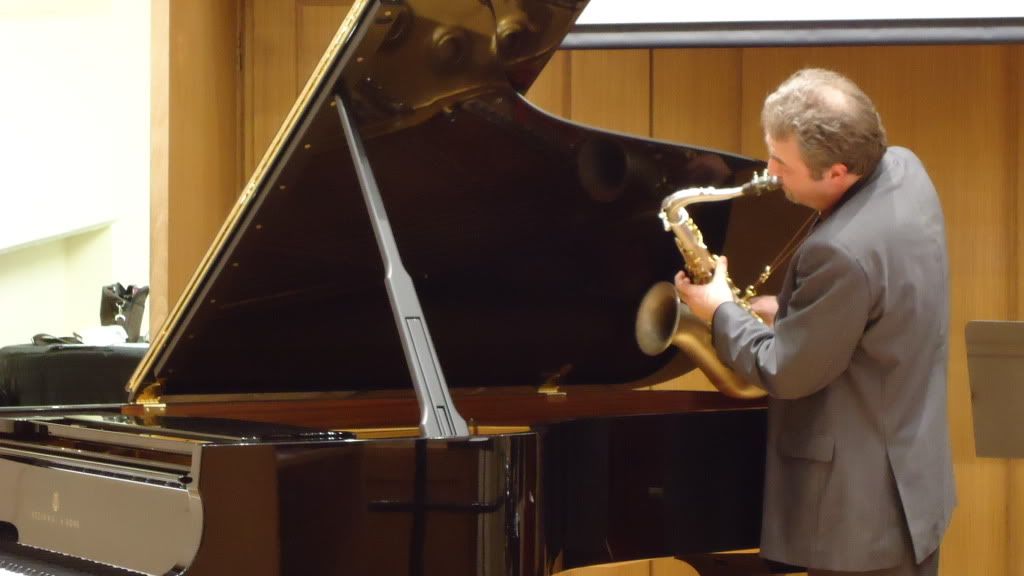
Tim Garland, born in 1966, was a graduate of Guildhall himself. He cut his first album when he was 22, and he is also a product of academic jazz. The highlight of this gig, beside some very well executed post bop materials of his own (which I found them more effective than his treatments of standards like Round Midnight or Body and Soul), was his playing into piano box! Yes, he was blowing his saxophone inside the open box of a Steinway, and he created most moving sounds from there without touching the strings. Strings were producing the magical sound, only by the waves of air that Garland saxophone was making. Very beautiful and unforgettable!


Robert Brockway
We'll Hear More of Him

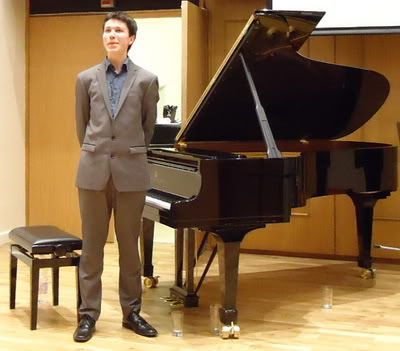
Among the trio that was accompanying Garland in that evening (including Robert Brockway on piano, Andy Robb on double bass, and Joe Sweeney on drums), the great discovery was Brockway, a very young gentleman who plays very interesting solos, with a confidence only seen and heard in men, a generation older than him.


He demonstrates the benefits of that advanced jazz educational programs. He has something to say, though he still needs time and space to find the ways of expressing them. At this point, the best school of music for any young musician is listening to the rich heritage of recorded jazz, on and on. As far as I am concerned, I was born in the wrong place, and in the wrong time, and I hadn't this chance to enter an academic environment to study jazz, but despite the fact of not being a musician myself, most of the time I was lucky enough to be a student of universal jazz school which exists eternally on records. In this case the words of a great teacher, Clark Terry, always rings in my ears:

''Don’t spend it all in one place. It’s just as basic as that: Spread it out. Don’t try to say everything you know how to say in one chorus, you know. Use the space and time is something we were fortunate enough to have learned from Basie, but Duke and Strayhorn, they knew how to put things together. For instance, they would put minor seconds together, and that was something kind of unheard of, as far as jazz was concerned. And they put it together and made notes; it made you learn how to listen and say, “Oh, he’s out of tune . . . oh, no, he’s not!” If you listen closely, you’ll find he’s very much in tune. But they knew how to do that, and they knew how to supply themselves with people who were aware and knew how to do it so it was a marvelous thing. They were both very, very instrumental in the perpetuation of jazz and the colorations of sound and so forth.''

Duke by Mosaic

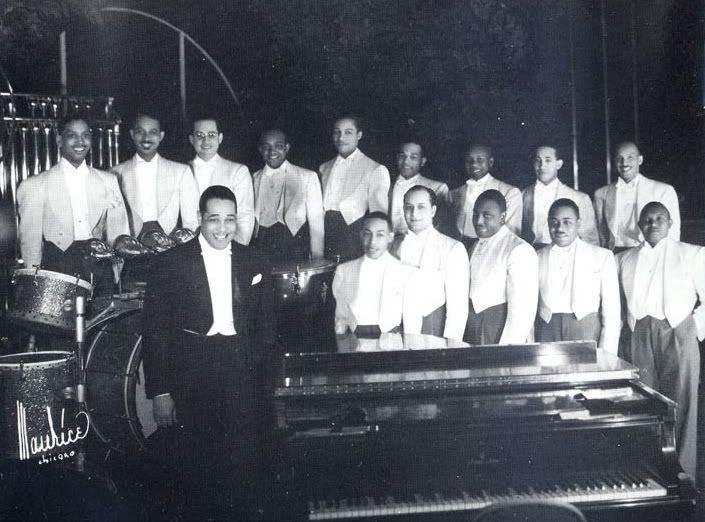
Duke Ellington & His Orchestra, 1936


The Complete 1932-1940 Brunswick, Columbia, and Master Recordings of Duke Ellington and His Famous Orchestra
 
This "invaluably illuminating" boxed set of Duke is available here 


"During the summer of 1929, the orchestra appeared in Florenz Ziegfeld's revue "Showgirl." Its performance roused that legendary producer to call the orchestra "the finest exponent of syncopated music in existence. . . . Some of the best exponents of modern music who have heard them during rehearsal almost jumped out of their seats over their extraordinary harmonies and exciting rhythms."
Now, thanks to Mosaic, I have almost jumped out of my seat because the sound engineering by Mr. Lasker and Andreas Meyer [producers of this boxed set] brings these Ellington orchestras swinging right into the room. As Billy Strayhorn (eventually Ellington's associate arranger) put it in Down Beat in 1952: "Ellington plays the piano, but his real instrument is the band. Each member of the band is to him a distinctive tone color and set of emotions, which he mixes with others equally distinctive to produce a third thing, which I call the Ellington Effect." That characteristic sound is as present in these recordings as it would later be in the 1940s and beyond." ~ Nat Hentoff, Wall Street Journal

Tuesday, March 8, 2011

English Soul of Steve Winwood


English Soul (2010), a new documentary about rocker Steve Winwood, portrays his musical journey as a quest for meaning and beauty in the countryside of England, so it has more to do with Winwood's childhood house in Gloucestershire, than his deep fondness for Ray Charles, or his countless influences from American blues. Since it's nearly clear to everybody that lawns, sheep, and barn don't create blues or rock 'n' roll, and this type of music is more related to whiskey, drugs and wimmen', as well as big dirty cities, we can forget about this unconvincing approach and enjoy a panorama of British Psychedelic-Pop and Blues-Rock, from Spencer Davis Group days to Traffic and Blind Faith.

English Soul is meticulously directed by Paul Bernays, who has made another musical portrait for Emmylou Harris (From a Deeper Well, 2007). There are interviews with ex-members of Traffic, where great Dave Mason talks about his frustration of being kicked off the band, while Traffic's best selling hit singles were still Mason's compositions like Feelin' Alright. Eric Clapton, the eternal wise man of rock 'n' roll court, gives his comments about forming Blind Faith, and his sudden break up with this newly born super band. Now it makes sense when Clapton describes his recent reunions with Winwood, and playing almost all Blind Faith songs in Madison Square Garden, as a finishing an unfinished job; delivering the sound that they really wanted to give, back in 1969.