Thursday, November 21, 2013

The Hawk Talks


Two interviews with Coleman Hawkins, posted on the occasion of his 109th birthday anniversary.

The English Interview:

Coleman Hawkins, in London (circa 1960), talks about tenor saxophone, Fletcher Henderson, Fats Waller (bringing him his 'breakfast' which was a glass full of scotch), Body & Soul (recorded in "just one take...Boom!!") and some other things.


Duke in the USSR

Jam Session in the U.S.S.R. Duke playing balalaika. source
The first time I saw Dr. Harvey G. Cohen was in one of his King’s College London lectures about Duke Ellington's America (politics of race), also the title of his Ellington book. Later, I contacted him about the State Department tour of 1963 which I mused about here and hopefully, I'm going to meet Mr. Cohen again to hear his take on this tour for which I'm making a short film.

However, today I mentioned Mr. Cohen for a slightly different reason, or for a different "trip". I just learned that he's authored a long essay on Ellington's second tour of the East which shares many of the socio-political contexts of the first one. Originally published on the journal of Popular Music as Visions of Freedom: Duke Ellington in the Soviet Union (2011), the essay explains the Ellington's second State Department sponsored tour. Mr. Cohen, in the abstract to the paper, writes:

Tuesday, November 19, 2013

The Style of Duke Ellington


In August 2013, when the Los Angeles Times published Mimi Melnick's obituary, I didn't catch that she was the same Mimi Clar I knew for her jazz writing, especially for her study of Ellington's style which was published in the Jazz Review journal of 1959.

In The Style of Duke Ellington Clar starts her argument by focusing on the problem of defining Ellington's style quoting André Previn who has said: "Stan Kenton can stand in front of a thousand fiddles and a thousand brass and make a dramatic gesture and every studio stranger can nod his head and say, 'Oh, yes, that's done like this, but Duke merely lifts his finger, three horns make a sound, and I don't know what it is!"

Friday, November 15, 2013

The Illinois Jacquet Big Band, Part II


This is the second part of the Illinois Jacquet Big Band video I posted in late October (here). I haven't been able to identify the members of the trombone section yet. In addition to that, the set is still incomplete and one last part which features a fantastic finale is on the way. The pieces performed are listed below with the name of those soloists I was aware of.

00:00  Doggin' Around (soloists: Joey "G-Clef" Cavaseno, Jacquet, James Zollar, Winston Byrd, Tom Olin, Richard Wyands, Cavaseno, Mike Grey?, 2nd trombone?, 3nd trombone?, Fred Hunter)
09:40  The Sunny Side of the Street (sax solo, vocal and dance: Jacquet)
16:46  Flying Home (soloists: Cavaseno, Jacquet)

Monday, November 11, 2013

Jazz Mirrors Iran#9: Persian Village


Postscript January 6, 2016: "Paul Bley, a jazz pianist whose thoughtful but intuitive commitment to advanced improvisation became widely influential, died of natural causes Sunday. He was 83."


What I hear in jazz takes on Persia, aka Iran, is like Montesquieu's Persian Letters in reverse. If Persian Letters was composed of letters exchanged between two imaginary Persian noblemen traveling in Europe, jazz pieces about Persia are like composers' and musicians' mind journeys in Persia. As Montesquieu would say, you might find in jazz compositions about Iran "a sort of romance, without having expected it."

In the Jazz Mirrors Iran series, several different musicians and pieces introduced and they were all connected together by a sort of a chain. The chain was Persia, a dream land where even the traffic can be (pictured) as harmonious. (see Gulda)

Back to Montesquieu's concept of an imaginary encounter between east (Iran) and west (Europe), the author talks about how the travelers (in this case, musicians) were struck with the marvellous and extraordinary, each in his own style. "Reasoning cannot be intermixed with the story," remarks Montesquieu, "because the personages not being brought together to reason." Therefore, Fats Waller's Persian Rug or Lloyd Miller's Pari Ruu are always "connected with a manifestation of surprise, or astonishment, and not with the idea of inquiry, much less with that of criticism." That is the Iran I hear and see in jazz.

Monday, November 4, 2013

Ad-Lib#5: Two Faces of Johnny Griffin

© photograph: Yukio Ichikawa
The line-up on some of the old 78 rpm records are truly amazing. For instance, teaming up Johnny Griffin, Elmo Hope, Percy Heath and Philly Joe Jones on one single record may sound like a fantasy modern group, but in reality it happened in the late 1940s, though the encounter is not as jazzy as one expects.

The name of Joe Morris (1922-58) hardly rings a bell today. However, those familiar with the big bands of Lionel Hampton, Buddy Rich and Dizzy Gillespie will recognize this trumpet player who after some busy years in big bands led his own usually loud combos, playing rhythm and blues charts. It is in one of these small combos that the little giant of tenor sax, Johnny Griffin, is presented at the age of 19.

Did Griffin pick up something from his demanded rough, bluesy, riff-based performance here for his future's distinctive style? It's hard to think he didn't.


Thursday, October 31, 2013

The Illinois Jacquet Big Band, Part I

© photography by William Ellis
Once again, I've used a birthday as the pretext to celebrate one's art. Today's Illinois Jacquet's day and the birthday present is a rare video of his big band in Bern, 1998.

Naturally, the concert in its entirety serves as an overview of his career and inclusion of each song in the repertoire reflects a stage of Illinois' career, starting from the smashing hit Flying Home with the Lionel Hampton Orchestra to the standards of the Count Basie songbook.

As for the man himself and his stimulating sound, he is praised as the primary example of the Texas sound, or as Richard Cook observes, permanently saddled "with the largely meaningless 'Texas tenor' tag," which is basically "big, blues tone, edged with a kind of desperate loneliness that somehow underlines Jacquet's permanent status a guest star." Still, a better definition is given by Brian Priestley:

Wednesday, October 30, 2013

We Remember Clifford


Clifford Brown was three years younger than Lee Konitz, two years Horace Silver's junior and one year Benny Golson's. All the mentioned musicians are alive, some if them still going strong, but it's painfully difficult to accept that one of the best musicians in jazz history has left us for nearly 6 decades.

As they say, The Good Die Young, but it is the time for celebration rather than mourning and lament. Today's Clifford Brown's birthday and Take the "A" Train commemorates the short and once blooming life of Clifford Brown by playing two tapes from David W. Niven's archives. Throughout the tapes, Niven injects personal observations and speculations, anecdotes, history and touching quotes which makes the tapes even more precious.

1

The Memorial Album happened to be one of my first (and due to conditions of life in Iran, one of the very few) acquired jazz CDs. The album contains two early sessions, one a quintet and the other a sextet, led by Brownie. However, Niven's tapes are not exactly track by track replica of the Blue Note release. In order to give a survey of Brownie's recording during the summer of 53, Niven has mixed takes from Brownie Speaks (Applause LP) and Memorial (LP edition).

Monday, October 28, 2013

Shirley Clarke + Teo Macero


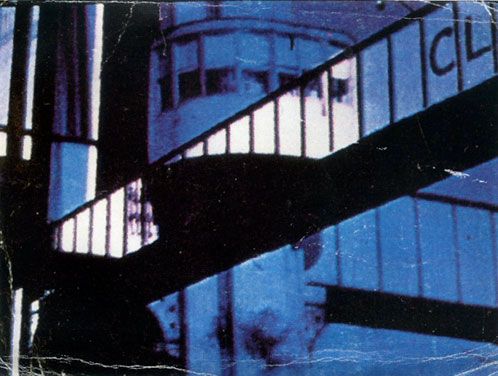
Bridges-Go-Around (1958), made by one of the forerunner Jazz Film artists of all time, Shirley Clarke, is a short film, or more precisely two shorts in one. Composed of a series of shots from New York bridges, the film, in its first half, is edited and synced with the music of Teo Macero. For the second half, the very same images, as the first half, are repeated, but this time they are accompanied by the electronic music of Louis and Bebe Barron. So Bridges-Go-Around is a film which is played twice, but each projection, thanks to specific effects created by each musical genre, gives a distinctive impression and even the meaning of the images change and assiduously contrast/complete/comment on the other half. 

In fact, Bridges-Go-Around wasn't originally designed as a twice-played film with two soundtracks, but it was merely one four-minute-long film with Barrons' music. Clarke used the music of Barrons, but when the copyright issues arose, she asked Columbia records jazz producer and trumpet player Teo Macero to compose a replacement. Later, Clarke who liked the both versions started screening them back to back. Like a jazz musician, Clarke turned the spontaneity of moment into an extension of her art, a prudent experimentation which can be seen as a study of the relation between sound and image.

Thursday, October 24, 2013

Wendell Marshall


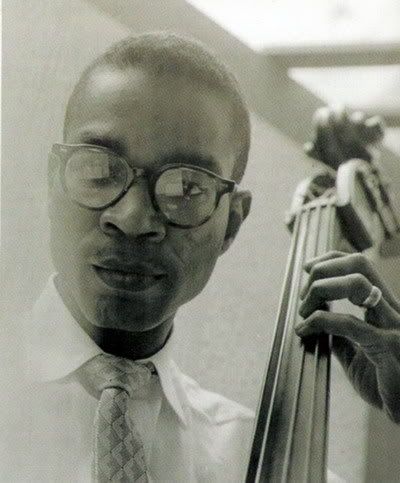
Happy birthday to Wendell Marshall who like his first cousin, the legendary Jimmy Blanton, became the bassist of Duke Ellington Orchestra from September 1948 to January 1955.


Take the "A" Train feat. W. Marshall. Credits here.