Monday, May 20, 2013

Jazz Mirrors Iran#1: Tehran

photo by Reza Hakiminejad

Imagine this: A tenor saxophone and bass mimic in sound the pace of rush hour walkers. A trumpet, sounding like a car horn, pops in and out, pulsating along with the beat of the drummer, whose brushes on the snare create an interplay that brings to life the image of a bustling urban city.
No cobblestone streets or the smell of Parisian bread; no green leaves overhanging narrow passageways or the sound of French in the background. This is not Europe. It’s Iran that is being depicted in cool jazz tones.

Each Monday for the next ten weeks I will feature a jazz tune that reflects a part of Iran, both as an actual place on the map and as a pure creation of art. This is Iran according to American (or non-American) artists in the 20th century. It is the same country that makes daily news headlines, but thanks to the masters of misinformation in the media, the more that is heard, the less that is learned.

                           Teheran- Friedrich Gulda                              

Tehran, sometimes spelled in French or German as Teheran, is a metropolis of 8.5 million people and the capital city of Iran. Witnessing many changes in the past 150 years, it was, and still is, a gigantic mechanism dealing with endless urban issues. Tehranis, sharp and open, and culturally closer to the people of those capital cities of the Eastern Europe, have two simultaneous battles to fight: one, to find a way out of the maddening traffic of the highways and streets of Tehran, and then, to find ways of expressing their social and political dissatisfaction in some creative and subversive ways.

Monday, April 29, 2013

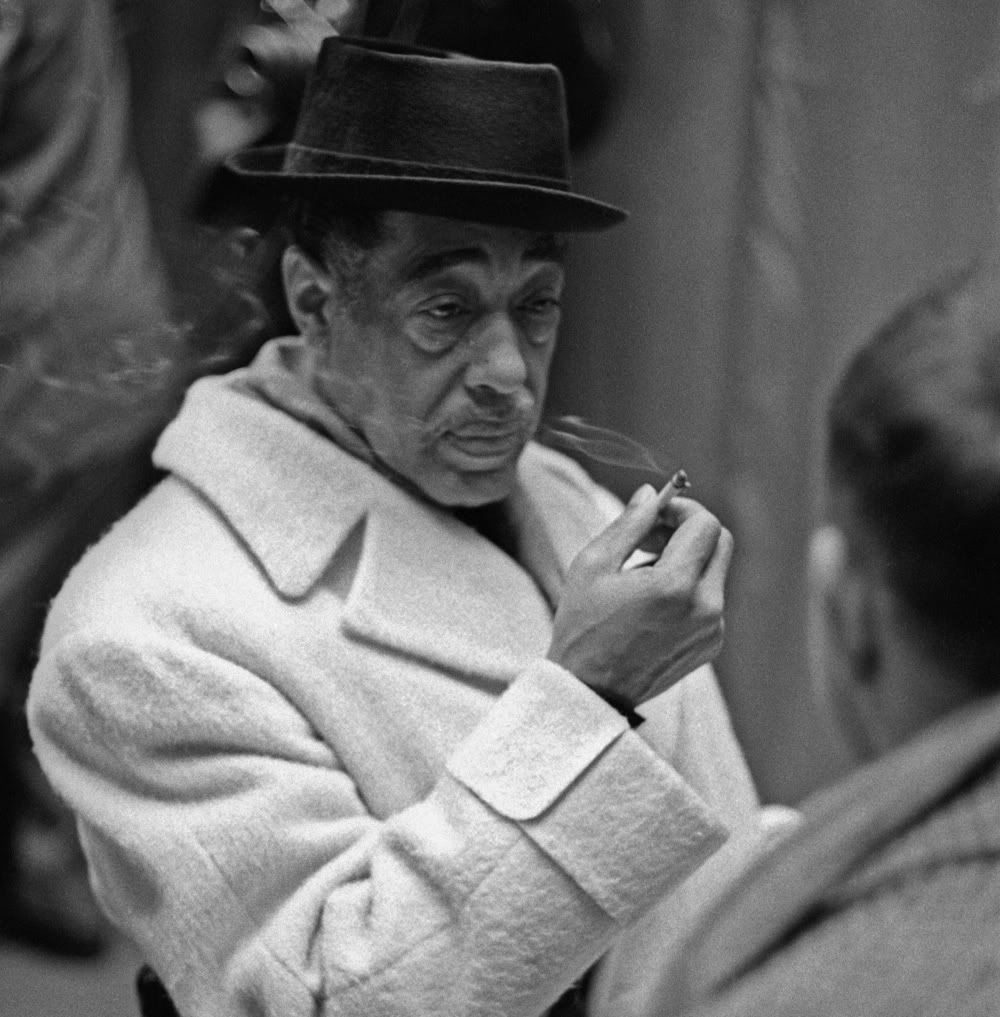
Duke Ellington: Jazz Entre Amigos (1985)


Continuing with our Duke Ellington's 114th birthday celebration, here you can watch probably the most ambitious TV programme ever made about Ellington. Interestingly, this unmissable compilation of many great films of Duke is coming from Spain. (But the Spanish voice-over is not too loquacious to lessen the viewing pleasure, except when they dub Duke!)

This two-part portrait of Duke during six decades of non-stop genuine creativity is from Jazz Entre Amigos, a weekly TV programme on Spanish national television, presented by Juan Claudio Cifuentes (known to his friends as Cifu) which ran between 1984 to 1991. The Ellington entry is particularly ambitious because it's 130-minute long, and features many well-known clips (Black & Tan and other Hollywood appearances), as well as more rare and hard to find footage and backstage films from the 1960s.

Enjoy the last hours of  this 114th birth day with the images of his highness in action:

Saturday, April 20, 2013

Ad-Lib#4: Hepcats, Slums, Moon Maidens


1

"New Orleans jazz may be considered 'mouldy fig' by the diggers of bop, but when it comes to setting a joint jumping, Dixie is still king," reads this funny piece of journalism from the 1950s, furnished with pictures of Willie "The Lion" Smith and Henry "Red" Allen. [source]


2

Ignore the silly cartoons, inserted into the footage and enjoy this highly energetic performance of a Slums and Wheels [aka Slums on Wheels] written by Volker Kriegel and featuring Dave Pike on vibraphone. Resurfaced from German archives (NDR studios), this 1969 TV appearance features Volker Kriegel (g) Dave Pike (vibe), Ingfried Hoffmann (organ), Hans Rettenbacher (bass) and Peter Baumeister (drums).

Wednesday, April 17, 2013

22 Trumpet Players!

click on the image to enlarge
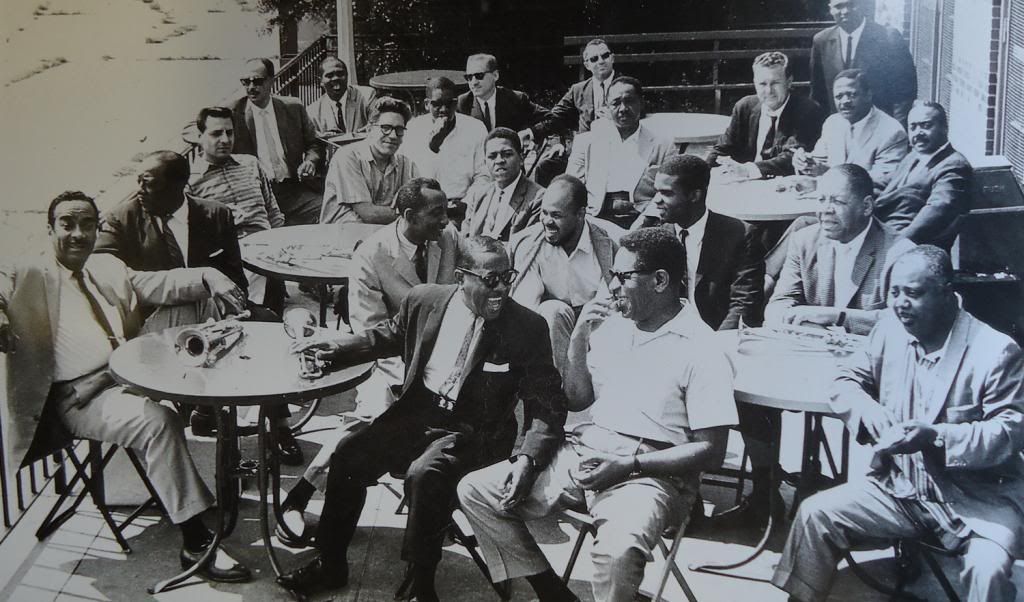
Looks like a dream, but it really happened in the summer of 1961 in Central Park, New York. For this photo session, twenty-two trumpet players from different generations have appeared in front of Herb Snitzer's camera.

From back left to right, the trumpet players are: Johnny Letman, Doc Severinsen, Max Kamisnky, Ted Curson (standing), moving to the next row, Ernie Royal is looking at the left, Booker Little, Joe Thomas, Yank Lawson is sitting next to Clark Terry behind the table. Again, starting from left, Don Ferrera, Nick Travis (with glasses), Bobby Bradford, and on the far right Jimmy Nottingham (sitting near CT). The next row: the very dark gentleman gazing at some out-of-frame point is Herman Autrey. Then moving to right we have Joe Newman, Dizzy Reece, Freddie Hubbard and Henry "Red" Allen, all sitting  tight next to each other. And finally the front row giants are Buck Clayton, Roy Eldridge fooling with Dizzy Gillespie and the beautiful Charlie Shavers.

share on Facebook

Monday, April 8, 2013

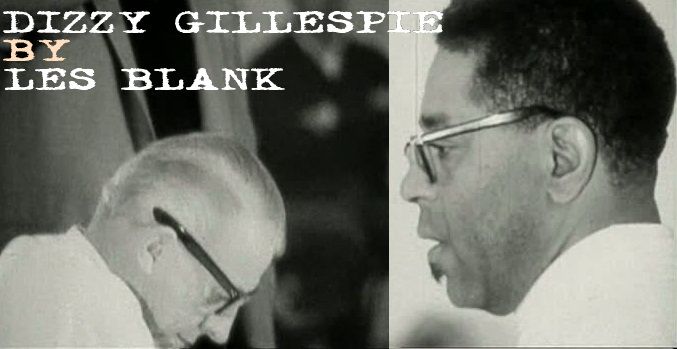
Dizzy Gillespie '65 by Les Blank


Les Blank, a fascinating individual and director of some remarkably personal documentaries passed away yesterday. I hardly have anything to say about him, at least worthy of his long and adventurous career, since I knew his ouvre only sporadically. However, I hope the stream of obituaries following his death would serve the purpose of shedding light on the career of  the man "whose sly, sensuous and lyrical documentaries about regional music and a host of other idiosyncratic subjects, including Mardi Gras, gaptoothed women, garlic and the filmmaker Werner Herzog, were widely admired by critics and other filmmakers if not widely known by moviegoers."

Here, I'll draw your attention to one of Blank's very early films, which happens to be one of the best jazz films produced under the umbrella of independent, ciné-vérité movement of the 1960s. Les Blank made many films about music, including The Blues Accordin' to Lightnin' Hopkins (1968), of course if one doesn't mention incorporating jazz and blues music in his non-musical films. During five tireless decades of film-making, the portrait of Dizzy Gillespie stands out as probably one of Blank's most accomplished cinematographic discovery of music and musical ideas.

Thursday, March 28, 2013

Le Jazz à Paris

Duke Ellington in Paris


‎"America is my country and Paris is my hometown." -- Gertrude Stein

Jazz found its second home in Paris, France. Josephine Baker and Charleston dance paved the way for Sidney Bechet and La Nouvelle-Orléans music. It started in Pigalle and moved to Saint-Germain. Surrealist were fascinated by it, but it was existentialists who cherished it. French films used a good deal of it as their soundtrack, or even their story. Cinéma de papa liked it (Marcel Carné) and the rebellious figures of modern cinema, known as Nouvelle Vague (New Wave), liked it even more: a generation confronted another generation, nevertheless jazz stood there as their only concurrent kick.

The anti-colonialist attitude and a certain tendency toward exotica made Paris of post-WWI the place for American drifters and jazz community. They were free, accepted and treated like kings. "The best of America drifts to Paris," said F. Scott Fitzgerald, "the American in Paris is the best American." So it was when Louis Armstrong, Benny Carter, Lionel Hampton, Kenny Clarke, Miles Davis, Bill Coleman, Don Byas, Bud Powell and many other resided in the city for shorter or longer periods.

Sunday, March 24, 2013

All the Young Persian Cannibals [A Memoir]


The readers of this blog have probably noticed that lately I've been focusing on jazz in Hollywood films. There is no particular reason for this interest, except re-watching some of the films I had seen light years away and becoming slightly nostalgic about some of them, especially the one I'm going to mention today.

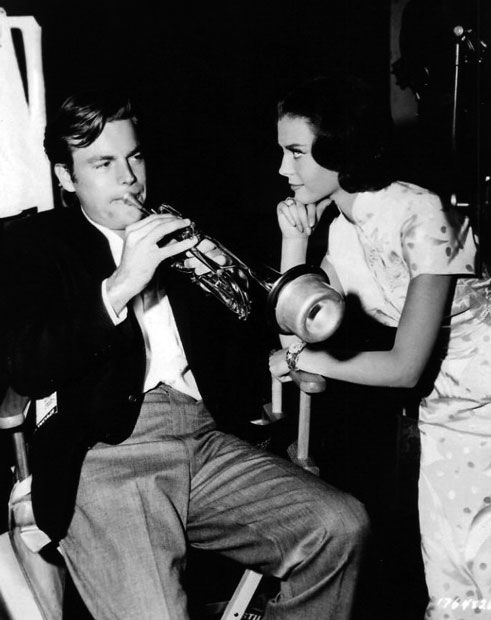
In the late 1990s, me and my two sisters, all of us in our teens, became fascinated by a film called Young Wolves about the life of a good-looking trumpet player and a troubled girl in the Deep South. However, later we discovered that the original name, just altered to Young Wolves in Persian-dubbed version, was All the Fine Young Cannibals. Again, after some years I heard some rumor that the film was loosely based on the life of Chet Baker, which considering the casting of Robert Wagner, one can argue that MGM producers wanted the young Chet and his rebellious life as the role model for the film's protagonist.

Robert Wagner and Natalie Wood

Tuesday, March 19, 2013

Howard Hawks and A Song Is Born


In 1941 one of the most commercially successful and artistically enduring comedies of all time was released: Ball of Fire. The story was set against a mansion in which a bunch of old professors (with exception of one young chap) are collaborating to write an encyclopedia. The problems arise when they reach the "slang entry" of the project, and learn that their knowledge for writing that section is so narrow that a volunteer is needed to leave the secluded mansion and map the changes in the language of the street.

Only seven years passed since the completion of the Ball, producers thought that the very successful idea can be used again, and this time the professors should search for a new word, JAZZ!

The same director who made Ball of Fire, Howard Hawks, was hired again for the job. Unlike ignorant professors of the story, Hawks had a great understanding of American modern popular music and had even incorporated them into his film whenever necessary. (For that matter, see Hoagy Carmichael's glowing presence in To Have and have Not.)

The script, written and rewritten by an army of writers, based on an original idea by Billy Wilder and Thomas Monroe, was considered too messy to be credited to anyone, therefore the whole weight was put on jazz and jazz musicians -- and rightly so.

Aside from principle stars, Danny Kaye and Virginia Mayo, the studio hired Louis Armstrong, Tommy Dorsey, Charlie Barnet, Lionel Hampton, Mel Powell, Louie Bellson and many more to carry on the jazz weight of the film which fell out of balance with rather poorly narrated romantic story and gangster sub-plot.

Hawks' main achievement was tuning to whole ensemble into a celebration of unappreciated art of jazz, as if in the process he was reflecting on his status in Hollywood as a misunderstood director.

Wednesday, March 13, 2013

Hentoff on Donald Byrd

Byrd in Paris with Walter Davis (p), Bobby Jaspar (ts) and Doug Watkins (b).

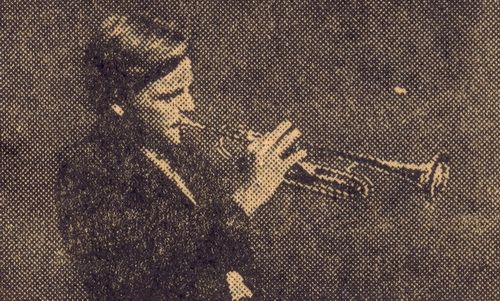
Trumpet player, composer, band leader and jazz educator Donald Byrd passed away last month. He left a prodigious legacy behind which among them his long and abundant tenure with Pepper Adams remains my favorite.

(a fast dissolve to Nat Hentoff)

Nat Hentoff, during his exuberantly active years as the session attendant, liner note author and producer, wrote more liner notes for Donald Byrd than any other trumpet player of the 1960s. What follows is a small part of Hentoff's illustration of Byrd, as well as his attempt to reflect Byrd's views on various issues - from educating jazz to church music and evaluation of his colleagues.


Byrd Emerges

The continuing growth of Donald Byrd as a uniquely melodic improviser with authoritative command of his instrument has not been sufficiently underlined, it seems to me, in the past couple of years. Several critics have, however, been cognizant of Byrd's increasingly substantial achievement. Frank Kofsky, for one, noted in Down Beat that "the history of Byrd's recording career has been one of consistent improvement; and the British critic, Michael James, has observed in the Jazz Review that Byrd's "tone sings loud and clear throughout the range of his horn, and his invention has more that kept pace with his improved technique...There is not a hint of blandness technical confidence will sometimes bring."

Also heartening is the fact that Byrd does not find necessary to pound home the point that he has roots. A blues feeling courses through everything he plays, but he is also able to range through a much wider variety of moods than are several of his more self-consciously "hard" contemporaries. There is in Byrd a linkage to sunny, light-hearted jazz playing as well as to vigorously assertive self-expression.

Monday, March 4, 2013

Pops on Beats


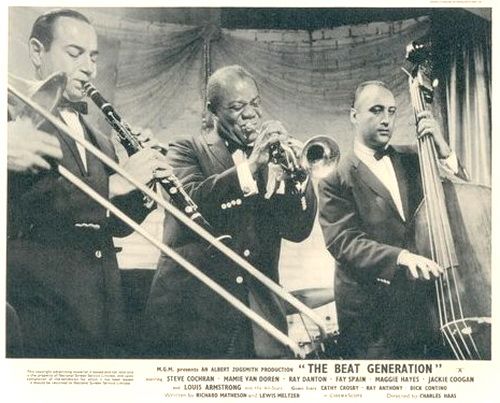
I spent the last week researching and writing about the evolution of Beat cinema and films about the Beat Generation. The occasion was an assignment for writing a 3000-word critique of the new adoptation of On the Road by Walter Salles which is going to be published on Iranian Film Monthly.

My opinion about the film, and the predictable disillusionment I had after watching On the Road, as well as arguments about problems of translating Beat literature to moving images need another place and time to be fully explained. However, the process of writing concurred with discovering new films and revisiting some of the milestones of Beat cinema which many of them would appeal to jazz people. Films such as Pull My Daisy (with Jack Kerouac's scrips and voice-over and a jazz score), Shadows (containing Charlie Mingus's soundtrack), The Connection (the groundbreaking Shirley Clarke film with Freddie Redd and Jackie McLean) and even the mediocre Subterraneans (based on Kerouac's novel) which features Gerry Mulligan's pianoless quartet have their own merits that in many different ways exceed so many limitation of what Salles offers us.