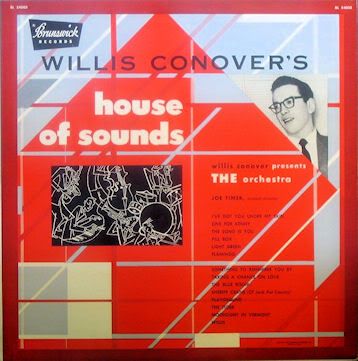
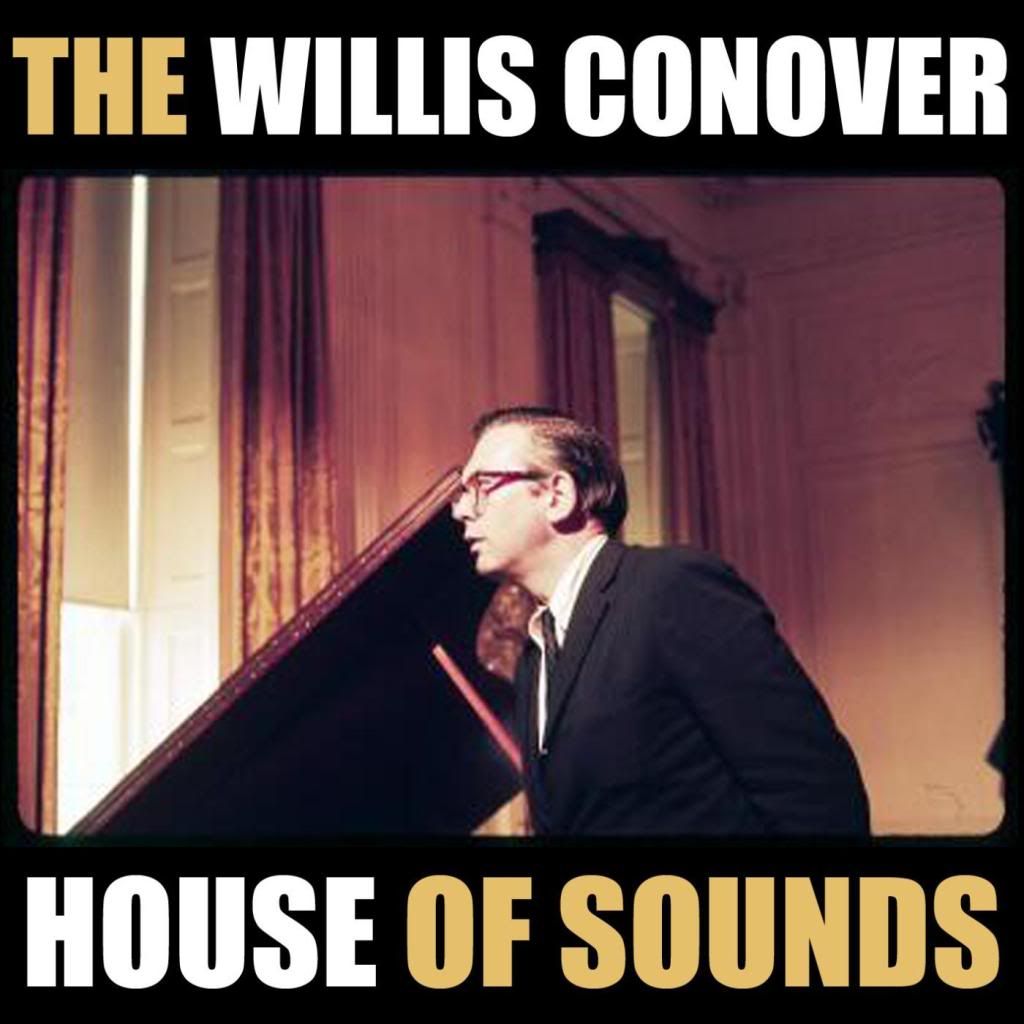
A search under Willis Conover's name to find any official recording with his presence (as a presenter, or with his voice), probably will guide us to this obscure recording from 1953. Actually it has nothing to do with Willis, at least musically. He has just introduced a band that was playing in Washington in the years he was doing his famous radio show. There is only a tune, from total 12 tracks, recorded for this session that is named after Willis Conover, and it is composed/arranged by Bill Potts, another Washingtonian whom later accompanied Lester Young in his legendary Washington sessions.
"Nobody did more for jazz on the radio than Conover," says Richard Cook in his Jazz Encyclopedia. That could be true, not only because in the 1950s he took jazz to the other side of iron curtain, but also because of the musicality and intonation of his voice that was inseparable from the music he was playing. What was the first words I heard about Thelonious Monk? They were Willis Conover's, when he introduces the pianist in the legendary 1958 Jazz on a Summer's Day documentary: "...one of the complete originals of music. A man who lives his music. A man who thinks his music, and it is possible to say that he lives and thinks of little else. We can't describe him exactly as daring because I think he is unconcerned with any opposition to his music. He concerns himself with such elements as quarter tone which he doesn't find in our western scale, so he strikes to adjoining notes, two adjoining keys, on the piano, to imply those missing notes in between. Ladies and gentlemen, Thelonious Monk!" And those words stayed with me.
Like many other recordings that I heard in my teenager years, this House of Sound came from my uncle's collection. This was his note, attached to the record:
"...[This] orchestra was named 'THE Orchestra' and enjoyed limited local reputation, though there were many marvelous instrumentalists like Ed Leddy or Walp or Swope brothers, and great reed players like Nimitz and James Parker in it’s ranks. Most of its members had a long period of play with famous white big bands of those days like those of Gene Krupa, Boyd Raeburn, Woody Herman, Elliot Lawrence and Charlie Barnet amongst others. Here again we have the pleasure of listening to some beautiful trumpets and trombones and a very fine tuned drum work of Joe Timer, who died two years later at the age of 32. Timer was a fine composer and arranger. He was very much in Klook’s tradition. In the present session he leads the orchestra. I enjoyed mostly the trumpet section and especially the lead trumpet of Ed Leddy. There is also the very fine arrangement of The Song Is You by then very young arranger John Mandel, who later enjoyed the fame of being one of the most sought for score writers for movie industry. Markowitz has a beautiful solo on Moonlight..."
I must add one more thing to the history of this interesting, and sadly forgotten orchestra that when Charlie Parker was in Washington, DC, they accompanied him in "Club Kavakos" in February 22, 1953. I hope in one of the last Sundays of the summer, you enjoy listening to this record:
Willis Conover's House of Sounds Presents THE Orchestra
Joe Timer & THE Orchestra (AKA Joe Theimer - see available Charlie Parker discographies from 1953)
Recording date: 1953, (probably Washington D. C.)
Release Date: Aug 21, 1953
Total Time: 46:00
Reissue on Vinyl by Jasmine, JASM 1016 (Jasmine was a London-based label, established in 1982, and apparently still working on the reissue of jazz classics.)
Line-up:
Bob Carey, Ed Leddy, Marky Markowitz, Charlie Walp (tp) Dan Spiker, Earl Swope, Rob Swope (tb) Jim Riley (as) Ben Lary, Jim Parker, Angelo Tompros (ts) Jack Nimitz (bars) Jack Holliday (p) Merton Oliver (b) Joe Theimer (d, cond)
Side A:
1 I've Got You Under My Skin (Composed by Cole Porter; Arranged by Ralph Mutchler)
order of soli: Markowitz; Riley; Holliday.
2 One For Kenny [Clark] (Composed & arr. by Joe Timer)
order of soli: Markowitz; Carey; Leddy; Walp; Holliday.
3 The Song Is You (Composed by J. Kern, O. Hammerstein II; arr. by Johnny Mandel)
order of soli: Earl Swope; Walp.
4 Pill Box (Composed and arr. by Bill Potts)
order of soli: Holliday; Robbie Swope; Earl Swope; Nimitz; Walp.
5 Light Green (Composed and arr. by Bill Potts)
order of soli: Holliday; Oliver; Earl Swope; Walp; Tompros
6 Flamingo (Composed by Ted Grouya, Edmund Anderson; arr. by Joe Timer)
Solo: Walp
Side B:
1 Something to Remember You by/Taking a Change on Love/Blue Room (Composers Schwartz, Dietz/Duke, Fetter, Latouche/Rodgers, Hart; arr. by Joe Timer)
2 Sheriff Crane [AKA Jack Pot County] (Composed & arr. by Jack Holliday)
order of soli: Tompros; Holliday; Walp; Earl Swope; Timer.
3 Playground (Composed and arr. by Bill Potts)
order of soli: Tompros; Robbie Swope; Riley; Walp; Markowitz; Leddy; Holliday
4 Tiger (Composed & arr. by Harvey Leonard)
order of soli: Markowitz; Earl Swope; Tompros; Lary.
5 Moonlight in Vermont (Composed by John Blackburn and Karl Suessdorf; arr. by Jack Holliday)
Solo: Markowitz.
6 Willis [Conover] (Composed and arr. by Bill Potts)
order of soli: Holliday; Earl Swope; Tompros; Markowitz; Nimitz.