Showing posts with label Playlist. Show all posts

Saturday, June 13, 2020

Chris Marker Picks His Favourite Bill Evans Songs

Chris Marker in Telluride, 1987. Courtesy of Tom Luddy.

Until midnight music is a job, until four o’clock it’s a pleasure, and after that it’s a rite.” – Chris Marker

There are only indirect hints as to what Chris Marker liked and did beyond his films. In studying the world of this elusive director, every sign invites us to scrutinize it carefully. Marker appears in small details, such as the mix CD which one day arrived on my doorstep. If the address on the parcel hadn’t confirmed the sender as Tom Luddy, co-director of Telluride Film Festival and a close friend of Marker’s, I could have taken it to be Marker’s personal gift from the beyond.

The CD cover gave little away: Sandwiching a photo of pianist Bill Evans was his name and the words "joue pour Guillaume" [plays for Guillaume], along with an illustrated image of the Markerian animal familiar Guillaume, a wise if mischievous-looking cat, holding sheet music. A lyrical filmmaker, who could also compose and play the piano, had compiled his favorite tunes performed by the lyrical jazz pianist and composer Evans (1929-80). The fascination with compilation is also evident in the films. Marker would often juxtapose material from various sources—news footage, computer games, photographs and songs—to remarkable effect.

Tom Luddy recalls conversations about jazz with the filmmaker, who used to tune in to KJAZ whenever he was in the Bay Area. One of his favorite satellite TV channels was Mezzo, playing classical and jazz around the clock. While the genre didn't feature much in his films, one could argue that jazz for Marker, like cinema, was something both personal and political. His jazz-related writings for Esprit (“Du Jazz considere comme une prophetie”) and Le Journal des Allumés du Jazz seem to bear this out. Marker even made a small contribution to jazz literature by writing the narration for a documentary about Django Reinhardt directed by Paul Paviot, who'd previously produced Marker’s Sunday in Peking.

Wednesday, April 15, 2020

David Meeker's Ten Favourite Jazz Recordings


David Meeker, the author of world's most comprehensive jazz and film encyclopedia (regularly updated and available online at the website of the Library of Congress) and the former Head of Acquisitions in the National Film Archive (now British Film Institute's archive) has shared with me his list of ten favourite jazz recordings which I'm sharing with you here. They are sorted in chronological order.


1
Paul Whiteman and his Orchestra (1928)
There Ain't No Sweet Man That's Worth The Salt Of My Tears by Fred Fisher.


Monday, June 1, 2015

Cinema at 33 1/3 RPM


Ten jazz takes on film music that prove the interconnectedness of the two art forms.
Read/listen here.

Jazz music has long expressed its capacity to borrow from various, sometimes contradictory sources in order to create something which in every sense transcends the original elements. Since the earliest days of jazz as a musical form, it has been inspired by military and funeral marches; has stylishly interpreted popular songs; and even brought the classical intricacies of Wagner into the domain of swinging brasses and reeds. This multiculturalism and eclecticism of jazz likens it to cinema which, in turn, has transformed pop culture motifs into something close to the sublime and mixed ‘high’ and ‘low’ artistic gestures to remarkable effect.

In the history of jazz, the evolution from ragtime or traditional tunes, to discovering the treasure trove of Broadway songs was fast and smooth. The latter influence was shared by cinema, as the history of film production quickly marched on. The emergence of ‘talkies’ in the United States meant rediscovering Broadway, its stars and directors and above all its musicals and their songs. In the 1930s, jazz became the incontestable rival of cinema in extracting tunes from the American theatre and transforming them into immortal standards. Both arts, film and jazz, used popular songs as a structuring framework, around which band leaders, musicians, directors and choreographers could develop more sophisticated and daring ideas.

Just as the emergence of television began to make itself felt at picture houses across the States, where declining attendance figures reflected a shift in the culture, jazz experienced a similar deadlock which contributed to the decline of the big bands. The effects of the war for returning Americans, and the new possibilities for enjoying entertainment in the home gave rise to very different strategies of survival: The film studios began to produce more sumptuous, glossy and costlier motion pictures to overshadow television, while jazz bands were downsized, becoming more intimate – or “indie”, if you like. Instead of big bands, modest outfits of three to six musicians was jazz’s answer to the times. In this respect, one might find the origins of John Cassavetes and 1960s independent cinema not only in Hollywood, but in Coleman Hawkins Quartet.

Cinema, for a very short time, managed to beat the odds with the help of Cinemascope, stereophonic sound, majestic scores and other gimmicks which expanded the affective potential of the big screen. After the invention and popularity of 331/3 rpm discs, releasing film music on LPs became a good source of income too. This market blossomed in the 1960s; in some cases, it was not only music but dialogue from the films that were presented on record (Who's Afraid of Virginia Woolf? and Romeo and Juliette). Jazz labels took note, and saw no reason to deprive themselves of such guaranteed success. Soon the themes from films were added to an expanding repertoire. Bringing film music to jazz wasn’t only a trend in keeping with the change in the public’s taste, but also a challenge for the musicians’ creativity in harmonic innovations and free improvisation – the way it had started two decades before, with Broadway songs.

The ten jazz takes on film music that I have selected here, rather than being a case of one art form riding the coattails of the other, prove the interconnectedness of the two and a motivating force that they both passionately share: creating images.

Wednesday, February 27, 2013

Jonathan Rosenbaum Takes the "A" Train

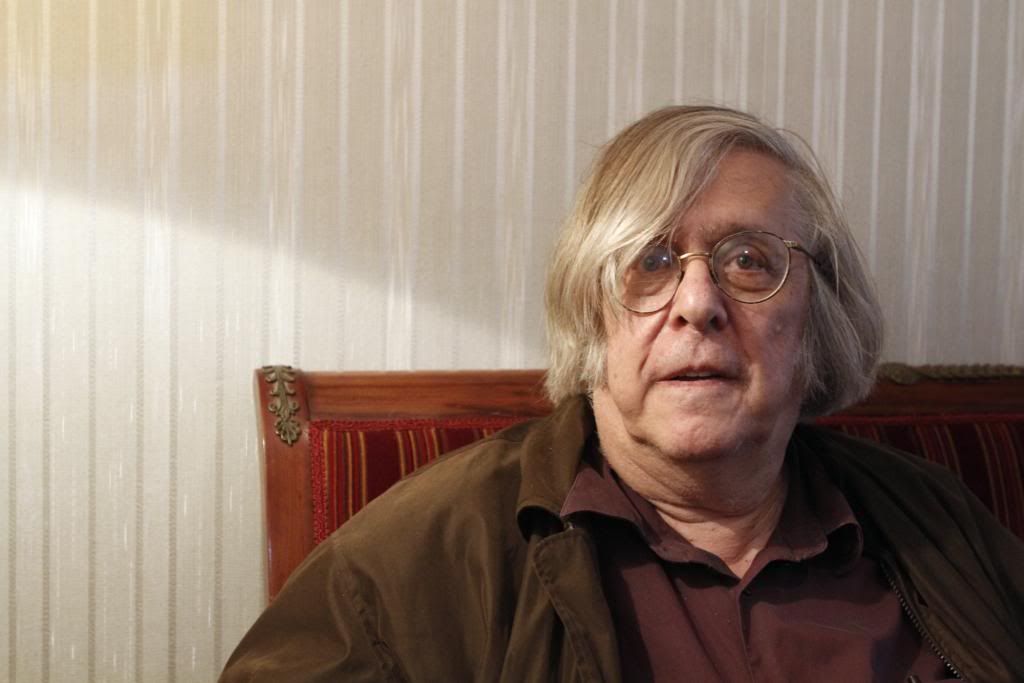
Jonathan Rosenbaum [image courtesy of San Sebastián Film Festival]

As a part of Jonathan Rosenbaum's 70th birthday posts on my jazz and film blogs, I asked him to compile a playlist of his favorite jazz tunes and he kindly provided me with the music that has inspired him, moved him and has stayed with him through the years. (the slideshow includes the cover of the albums used in the playlist) He shares details of his jazz life with us in the interview published on Keyframe. And if you want to catch up with some of his writings on jazz and film, or jazz in general, please visit this index that I posted yesterday.


The discographical information is given below the player. If this particular player isn't compatible with your system, there a simpler one, if you just scroll down the page, where, alternatively, you can download it and listen to it offline.


Even on his birthday, it is Jonathan who gives us presents.