Showing posts with label Johnny Hodges. Show all posts

Wednesday, October 22, 2014

Clark Terry: Further Years at the University of Ellingtonia (1955-56)


"Never think you are too hip, because two hips make an ass." — Clark Terry

Here is my second post on Clark Terry at the University of Ellingtonia, complemented by David W. Niven's audio archive and his selection of Terry's solos played and recorded over the course of two years.

This collection is particularly interesting because of introducing more flugelhorn solos into the Ellington repertoire.

I also quote passages from Clark Terry's autobiography, where he is giving astute descriptions of other members of Ellingtonia. The book, which aside from its invaluable insight into CT's life is a great piece of literature, can be purchased here.

This is how Mr Mumbles introduces his colleagues:

"Harold "Shorty" Baker got his nickname because of his height. Sometimes we'd call him "Shorty Boo," just to mess with him...He had a gorgeous sound on his trumpet and played beautiful and interesting solos."

"We called Ray Nance 'Little Dipper' in honor of Louis Armstrong, whose nickname was 'Big Dipper'. He was the sweetest cat in the world. Never harmed anyone. He smiled most of the time, and there was always a pleasant atmosphere around him. He played elegant trumpet solos and was an accomplished violinist, tap dance, and vocalist as well."

"Willie Cook came over from Dizzy's band. He was playing 'à la Birks,'...Very small but a powerful player with interesting solos. Dark-skinned with nice features—almost like a Native American. He wore a conk all the time."

"We called Johnny Hodges 'Rabbit' because with his long ears and small eyes, that’s what his face resembled. He was a marvelous lead alto player with a very mellow sound. Quiet and unassuming, but he could play his ass off."

"Russell Procope played alto. He was short and more portly than Rabbit. Kinda intellectually talkative at times. He was from the old John Kirby band. He was a dependable reader and had a beautiful sound."

"Jimmy Hamilton was a tenor player who was featured more on the clarinet. His old nickname was “Joe Trump” because he had played trumpet in Philadelphia years before. Everybody loved his playing. He was a little shorter than me, of average complexion and with a little moustache. Sort of slow of speech."

"Harry Carney had been with Duke for a long time—ever since he was seventeen. Ended up staying with Duke for forty-five years. An incredible musician. First cat in the band I saw doing circular breathing...Harry played clarinet, bass clarinet, and baritoneax. He was a big guy with intelligent conversations, and he was Duke’s favorite riding buddy. They rode together often in Harry’s Chrysler while we rode on the bus."

"Juan Tizol played valve trombone beautifully. A Cuban who spoke broken English. Olive complexion, and he wore glasses. He was a hell of a composer, too."

"Britt Woodman was a studio man who played slide trombone. Phenomenal chops, beautiful tone. And he could sight-read like nobody’s business. Such a delightful person to be around. Kinda short, with a light complexion. He was also sedentary, and would go to sleep on you in a New York minute."

"Quentin 'Butter' Jackson was a master with the slide trombone and the plunger. He filled a great void with his incredible plunger techniques after Tricky Sam left the band years before."

Tuesday, October 23, 2012

10 Songs For Duke

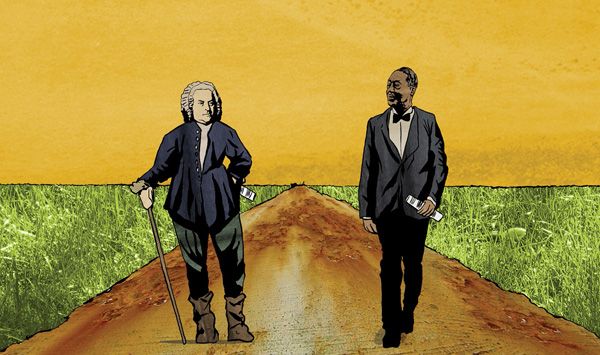
drawing by Naiel Ibarolla

"The worst thing about Duke Ellington's death," lamented Whitney Balliett "was that he, of all people, turned out to be mortal." Now it may sounds a cliche of I state that his music, forty years after his death, continues to live. No, that's somehow too obvious and not so dukish.

Another way of proving that the "profound, ageless, ongoing joyousness and originality of his music" doesn't seem to be retired is listening to the countless number of tribute albums and songs, recreations of his work, and tracing the influence he left on people who came after him and also his contemporaries. (He even awed musicians before him too - listen to what Willie The Lion Smith says, as my fifth choice.)

For that purpose, let's start with a list of ten tribute songs to this "brilliant eccentric," Duke Ellington. The list can expand in every imaginable direction and I hope some of you dear readers name your favorite "for Duke" songs at the end of this post.

Duke loved telling stories, so let's have one for the end. When Ben Webster (one of the guests of this tribute playlist) - who was playing with Teddy Wilson and dreaming to be a part of Duke Ellington Orchestra - received a message from Duke to go and see him, he felt twenty years younger: "I was drunk at the time, but the news sobered me up in a second. I went to see Ellington in the dressing room of the theatre he was playing at the time. He said, ‘Why don’t you come to the rehearsal tomorrow morning?’ Then I realised I had to tell Teddy Wilson that I was leaving him. To be able to do that, I had to get drunk all over again."

This anecdote tells something about Duke's music that can make you emotionally drunk, and then few minutes later, leave you totally sober. This is the feeling evident in the homages I've gathered here: they all alter between ecstasy and calculated movements. Or both are the same? 


Sunday, October 7, 2012

Ad-Lib#2: Beware of Baker and Heywood

1
Beware of Mr. Baker is the title of a new documentary, and exceptionally a good one, about legendary drummer Ginger Baker which is going to be screened at this year's London Film Festival.

The programme booklet of the 56th London Film Festival insists in calling Baker "the world’s greatest drummer" which he obviously is not, as you will see in this accurate portrait of his musical (and geographical) journeys, ambitions and passions, how he is cut by Art Blakey in one of so many drum battles Baker set with the giants he praised. Even in the only scenes in the film that he is not bragging, or insulting people (including himself) he drops a few tears about his only "true friends" and "idols", Phil Seamen, Max Roach, Art Blakey and Elvin Jones. That's exactly the moment one begin to understand the reason for Mr. Baker's contempt for many of his ex-colleagues, among them, unjustly, Jack Bruce of the Cream. Baker talks about Time all the time. That's what he feels as what many rock musicians lack and why they cannot keep up with him and his complex rhythmic fireworks. He wants to be acknowledged in the idiom of jazz, and not became the context of his stardom, rock music.