Showing posts with label Bob Dylan. Show all posts

Friday, April 25, 2025

Bob Dylan and The Band – The 1974 Live Recordings | My Picks

I delved into the 27-CD set between September 2024 and April 2025, and these tracks — roughly amounting to a double LP — are my picks among the 431 tracks. I took the following factors into consideration:

  • Quality of recording (some of the shows had poor sound quality)
  • Newness of the song to Dylan's live repertoire (as in 1974)
  • My love for Planet Waves and my desire to sample some live versions of it — though, as you'll see, not everything made the cut
  • Aiming to highlight tracks that showcase strong features of the Band's accompaniment, particularly Robbie Robertson’s guitar, Rick Danko’s bass, and Garth Hudson’s legendary blanket organ sound
  • Original and daring interpretations of oft-played tunes
  • The energy of the performance, even if it meant picking some tracks that feature the shouting style I know puts some people off
  • Ray Padgett’s remarkably detailed analysis and his sound advice


So, in the order of recording, here is my list:

Date, Venue, Location

Disc number of 27 | Song's name | Duration

Wednesday, December 7, 2011

Open the Door, Basie, Dylan and The Band


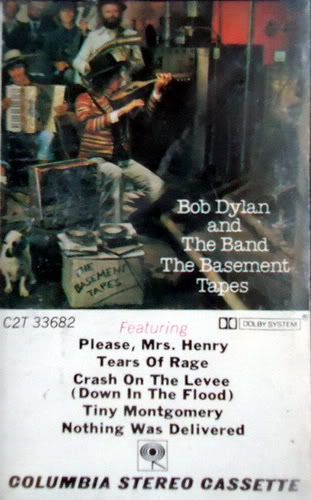
A friend, half-jokingly, called me a polytheist last night, in response to me saying "Joe Albany [another forgotten master/poet of jazz piano] is God!" Well, I can see myself more as an atheist polytheist, and in that case one of the non-jazz guiding sounds of my early teens was Bob Dylan and The Band's The Basement Tapes (released 1975). The cassette that was bought by an Iranian friend in San Francisco, circa 1975-76 was inherited to me in 2000, and I wasn't the same person after that.

I'm not going to talk about the album, but about a surrealist song of that set, among other surrealist takes, called Open the Door, Homer. The problem I had, because of the lack of confidence, knowledge or whatever you call it, I couldn't understand why Homer in English sounded like Richard. It took some times to understand, yes, he is singing Richard, and not Homer. That was the beginning of a rather long story about the song which originally should have been titled Open the Door, Richard!

Dylan is famous for using other people's songs, changing the words, and making it something of his own. In this respect he reminds me of French painter Marcel Duchamp and his idea of "ready-made" objects in art. During The Basement Tapes sessions in Big Pink and other club-houses of Woodstock, New York, he and The Band performed many of other people's songs, and sometimes the choices were really odd.

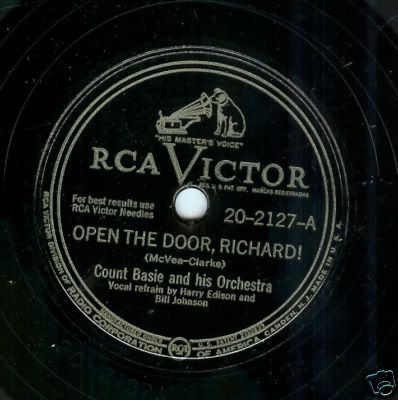
Open the Door, Richard started out in 1919 as a Harlem black vaudeville routine by John Mason. It was first recorded in 1947 on the Black & White Records label by saxophonist Jack McVea and became the number one song on Billboard. The same year Count Basie recorded the song with his orchestra (Lewis, Newman, Berry, Young, Edison, Robinson, Johnson, Matthews, Donnelly, Love, Rutherford, Gonsalves, Tate, Washington, Green, Page, Wilson) and humorous vocal part was done by Harry 'Sweets' Edison and Bill Johnson. It was released by RCA Victor Records and reached the Billboard magazine Best Seller chart on February 7, 1947 and lasted four weeks on the chart, peaking at number one.

After these successful singles, it became a safe bet for many artists through the years, including Louis Jordan. According to Wikipedia, "the phrase 'Open the Door, Richard' passed into African American Vernacular English and became associated with the Civil Rights Movement. When college students marched in 1947 to the state capitol demanding the resignation of segregationist governor Herman Talmadge, some of their banners read 'Open the Door Herman'. The Los Angeles Sentinel used 'Open the Door Richard' as the title of an editorial demanding black representation in city government and a Detroit minister used the title for a sermon on open housing."

Now flash-forward to an unknown day between April to early/mid-May 1967 in Big Pink, when Dylan pays his tribute to Count Basie, the world of vaudeville, drunk songs, André Breton, and Jesus Christ by playing Open the Door Richard, in a slightly different way. Sid Griffin, in his study of the Basement Tapes recordings says "it is a nonsense song based on a nonsense song." Here Dylan plays acoustic 12-string guitar. Rick Danko on bass backs Dylan's vocal, so does Richard Manuel who also plays Piano. Hudson is on organ and Robbie Robertson produces his signature rattling sound on electric guitar. Not many listeners notice that the famous Basement Tapes recordings (especially all the materials from Big Pink) are drum-less and no Levon Helm is ready to kick yet.

And concerning Homer sang Richard, Rick Danko explains that Dylan changed the name of the title to Homer so folks would not think it is reference to Richard Manuel. Obviously one can notice that Richard has changed to Homer, and not John for instance. The vaudevillesque nonsense context of the song has changed to a religious nonsense which I find moving and poetic. 

In The Basement Tapes many references to the Old and New Testament are present. And when Dylan sings “Take care of all your memories/Said my friend, Mick/For you cannot relive them/And remember when you’re out there/Tryin’ to heal the sick/That you must always/First forgive them” Sid Griffin argues that Dylan must have been reading the book of Matthew, chapters four and five which "deals with such deeds as a sign of powerful prophecy and a sign of God's love." (Griffin, P. 212)


Listen to this audio file which starts with Basie, switches to Dylan and The Band, and again returns to Basie for the finale. Also some classic interpretations of the song is complied in this playlist from Spotify.

Monday, December 20, 2010

Minstrel Boys: Dylan & The Band at Isle of Wight


While joyously reading the detailed analysis of Bob Dylan and The Band's Basement Tapes, from the pen of Sid Griffin (Million Dollar Bash, Jawbone press), I found this histrorically important video of Dylan/Band, from their Isle of Wight appearence, on Sunday, August 31, 1969.

According to Google video's note, this amazing footage is all that we have of Dylan’s performance that day, and features the following tracks: The Weight (only The Band), I Threw It All Away, Highway 61 Revisited, One Too Many Mornings, I Pity The Poor Immigrant, Minstrel Boy (only the beginning of the song. Complete take on Self Portrait, 1970). Rumor has it that this black and white footage was shot by a friend of John Lennon’s who sat between him and Yoko at the foot of the stage. Later, Lennon damned with faint praise when asked by the press to defend Dylan’s brief performance (an hour was brief granted that the audience, though not of course John Lennon, had been sitting in the mud for three days to await it). Lennon allegedly told the Daily Express: "He gave a reasonable, albeit slightly flat, performance, but everyone was expecting Godot, a Jesus, to appear."

The video rounds off with remarkable footage of The Band live at the Syria Mosque in Pittsburgh in November 1970, shot in color, bur very amateurishly, for Dutch television. Songs including: Time To Kill, The Weight, This Wheel’s On Fire and Up On Cripple Creek.


By the way, recently, Neil Young under the direction of Garth Hudson made an excellent recording of This Wheel’s On Fire which can be found in the album Canadian Celebration of the Band. This Neil Young interpretation significantly came out just a week after a fire destroyed his garage and he lost many of his beloved things and archival materials.

[December 21 UPDATE]

I noticed that Neil Young's new album, Le Noise is among Rolling Stone's 30 best records of the 2010. Though I didn't really like it, it's a good news. Le Noise is composed of eight new songs and no band. Neil is, accompanying himself on guitars with maximum fuzz and electronics, manipulated by producer Daniel Lanois. Rolling Stone writer, David Fricke, gives this four stars (out of five) and writes:

"The most personal thing about Le Noise is the sense of a restless master caught in the pursuit of ideas, shaping their expression. In Love and War, Young — his creaky whisper and acoustic guitar buoyed by Lanois' watery treatments — confesses an uncertainty hard to believe in one of rock's most driven stars: "When I sing about love and war/I don't really know what I'm saying." But then the conviction comes back. He only has that one way forward, through the music: "I sang in anger, hit another bad chord/But I still try to sing about love and war." Le Noise is, ultimately, an extreme simplicity: the sound of a man who won't give up."

[Second UPDATE, same day]
A funny video. Neil Young reveals that the fashion world never really understood him.


Tuesday, October 26, 2010

Dylan: Witmark Demos 1962-64


Two falls have been passed since the release of Bob Dylan's last Bootleg Series(Volume Eight). Now, bootlegs are back with the 47-track Vol. 9, which will feature studio recordings from 1962-64 known to old bootleggers as the Witmark Demos and Leeds Demos, named after the New York studios where Dylan recorded. Dylan will also reissue his first eight albums (from his 1962 self-titled debut through 1967's John Wesley Harding) in mono format, which have never been issued on CD before. The reissues — reportedly mastered using "first issue copies of the mono LPs" in order to recreate the sound of the original LPs.

The Witmark Demos features 47 Bob Dylan songs recorded by the artist accompanied only by his acoustic guitar, harmonica and occasionally piano on 2 CD or 4 LP 180-gram vinyl. All of these songs were written—and their subsequent demos recorded—before Bob Dylan turned 24 years old. 

Among the many gems are 15 Bob Dylan songs that were recorded by the artist only for these sessions, and which have never been officially released to the public until now. These include the plaintive Ballad For A Friend, the civil rights era-inspired Long Ago, Far Away and The Death Of Emmett Till, and the poignant Guess I'm Doing Fine.

For those who have been busy with hunting Dylan's real bootlegs, many of materials in these CDs are familiar, but certainly not with this clean sound and perfect quality.


Leeds Music Demos/New York City, New York /February 1962

1. Hard Times In New York Town
2. Poor Boy Blues
3. Ballad For A Friend
4. Rambling, Gambling Willie
5. Man On The Street
6. Talking Bear Mountain Picnic Massacre Blues
7. Standing On The Highway

Witmark & Sons Demos/ New York City, New York /December 1962

1. A Hard Rain's A-Gonna Fall
2. Tomorrow Is A Long Time
3.The Death Of Emmett Till
4.Let Me Die In My Footsteps
5. Ballad Of Hollis Brown
6.Quit Your Low Down Ways
7.Baby, I'm In The Mood For You

Witmark Studio/ New York City, New York /Winter 1963

1. Bound To Lose, Bound To Win
2. All Over You
3. I'd Hate To Be You On That Dreadful Day
4. Talking John Birch Paranoid Blues

Witmark Studio/ New York City, New York/ March 1963

1. Long Time Gone
2. Masters Of War
3. Farewell
4. Oxford Town
5. Don't Think Twice, It's All Right
6. Walkin' Down The Line

Witmark Studio /New York City, New York/ April 1963

1. I Shall Be Free
2.Bob Dylan's Blues
3.Bob Dylan's Dream
4. Boots Of Spanish Leather

Witmark Studio /New York City, New York/ May 1963

1. Girl From The North Country
2.Seven Curses
3.Hero Blues

Witmark Studio/ New York City, New York /August 1963

1. Whatcha Gonna Do
2. Gypsy Lou
3. Ain't Gonna Grieve
4.John Brown
5.Only A Hobo
6.When The Ship Comes In

Witmark Studio /New York City, New York /October 1963

1. The Times They Are A-Changin'

Witmark Studio /New York City, New York /December 1963

1. Paths Of Victory

Witmark Studio/ New York City, New York /January 1964

1. Guess I'm Doing Fine
2.Baby Let Me Follow You Down (Eric von Schmidt)

Unidentified Recording Studio/ New York City, New York /Mid to late June 1964

1. Mr. Tambourine Man
2.Mama, You Been On My Mind
3. I'll Keep It With Mine


.

Friday, May 28, 2010

Some Rock 'n' Roll Recommendations

Recent readings and hearings on the web:

[1] Grateful Dead's two Saturday Night Live performances, one from 1978 and the two and last from 1980. Songs including I Need A Miracle, Good Lovin', Alabama Getaway, Saint Of Circumstance.

[2] Keep On Truckin', on blogspot, has provided a superb 1979 Bob Dylan TV appearance, again from SNL, and the starting point of his famous Gospel influenced tour. Three songs are performed and sidemen are best Nashville session musician that I ever known: Spooner Oldham (keyboard) and Tim Drummond (bass), plus Jim Keltner on drums. All this men where Neil Young's buddies in Harvest sessions. Dig it!

[3] Neil Young’s on the road again, alone and ready for solo sets on what he calls Twisted Road tour. There is a back and forth between new songs and old songs, acoustic and electric guitars, standing and sitting stances, two pianos, an organ. Here is the rare appearance of an old song, “The Hitchhiker,” from a solo electric set of the tour:


Update [January 2011]:
Love and War

Wednesday, October 14, 2009

Bob Dylan's Christmas in the Heart


دربارۀ آلبوم تازۀ باب ديلن، كريسمس در قلب.

بيشتر از چند ساعت از انتشار آلبوم تازۀ باب ديلن كه مخصوص كريسمس اجراء شده نمي گذرد. من تا اين لحظه آلبوم را سه يا چهار بار پشت سر هم شنيده ام و تا همين جا بايد بگم كه يكي از قابل چشم پوشي ترين كارهاي ديلن از زمان under the red sky است. درس بزرگ آلبوم اين است كه نيت خير هميشه باعث بوجود آمدن شاهكار نمي شود، به خصوص براي كسي كه چهار آلبوم استوديويي اخير ديلن را بيشتر از هر چيز ديگري در تاريخ بيست سال اخير راك اندرول دوست دارد.

قرار بر اين است كه تمام پول فروش آلبوم و تورهاي متعاقبش خرج گرسنگان و نيازمندان شب كريسمس بشود. هنوز نمي دانم موقعيت آلبوم در چارت بيلبورد چطور خواهد بود، اما يادم نرفته كه دو آلبوم آخر ديلن در چارت شمارۀ يك شدند و ديلن شد "مسن ترين كسي كه رتبۀ اول چارت موسيقي آمريكا رو تسخير كرده،" (و براي تكميل معلومات بي ربط اضافه كنم كه براي همين اسمش وارد كتاب گينس شد!) آن هم براي دو آلبوم پشت سر هم كه بسيار بالاتر از حد درك و سليقۀ مردمي كه اين روزها مي شناسيم، بودند.

اين آلبوم شبيه كارهاي آخر فرانك سيناترا يك مجموعۀ دقيق، استاندارد و شيرين از آهنگ هاي اميدبخش كريسمس است. با اين كه ديلن در آلبوم قبلي (Together through life) ، كه بعد از روي كار آمدن اوباما ضبط شد، نشان داد كه به چيزي خوش بين نيست، اما اين جا مردم را دعوت به آينده اي روشن تر مي كنه، آينده اي كه به شكلي عجيب در گذشته اي گرم و زنده ريشه دارد و اين را حتي از روي جلد آلبوم هم مي شود حدس زد.

نكتۀ آخر اين كه هيچ كدام از 15 آهنگ «تمام كريسمسي» اين آلبوم را خود ديلن ننوشته و همه، كارهاي ديگرانند. خود اين مسأله يكي از دلايل نااميدي آدم هايي مثل من بعد از شنيد آلبوم بود. حتي ديلن وقتي در 1970 و 1973 دو آلبوم بيرون داد كه بعضي از آهنگ هايش كارهاي ديگران (جوني ميچل، گوردون لايت فوت، پل سايمون، كريس كريستوفرسون و بقيه) بود، خيلي ها را مأيوس كرد. خود اين كار يك حركت عجيب و غيرقابل پيش بيني ديگر از ديلن بود، اما پيشنهاد من اين است كه به جاي اين، آلبومي از كارهاي منتشر نشدۀ استيفن استيلز و گروه درجۀ يكش "ماناساس" (حوالي سال هاي 1972 و 1973) رو بشنويد كه قبلاً در همين جا به زبان فرنگي معرفي كرده بودم.

Sunday, October 11, 2009

New Releases from October


Tuesday will be the day of releasing Bob Dyaln’s 47th album, Christmas in the Heart. A bunch of Christmas songs including 'Here Comes Santa Claus', 'Winter Wonderland', 'Have Yourself a Merry Little Christmas' and 12 others. I’m wondering, this time how he is gonna show us the darker side of Santa Claus!

All of Bob Dylan's U.S. current and future royalties from sales of “Christmas In The Heart” will be donated in perpetuity to Feeding America, guaranteeing that more than four million meals will be provided to over 1.4 million people in need in this country during this year's holiday season.


For the first time the complete Joe Cocker performance at Woodstock 1969 has been released on CD. Though some of the tracks are available in other compilations, but most of them are unissued.

Nobody will ever forget Cocker’s superb interpretation of Lennon/McCartney’s “With a little help from my friends”, on the third day of the historic "Three Days of Peace & Love," with his excellent The Grease Band. The singer performed songs mostly from his first two albums (With A Little Help from My Friends and, due 3 months hence, Joe Cocker!).


One of the best releases of the year is a great collection of Stephen Stills & Mannasas’ outtakes and unissued tracks from 1971-73 when they were working on one the rock history’s most valuable treasures, an eponymous double LP, "Manassas" and their second album, “On the road”. The new album is called Pieces, but it’s seems more concise than any other original studio albums that I‘ve heard during past months.

“Pieces” features alternate versions of two songs from “Down the Road”: 'Do You Remember the Americans' and 'Lies' (featuring guitarist Joe Walsh). The collection also includes the legendary group's unreleased performances of 'Sugar Babe' and 'Word Game,' a pair of songs Stills recorded in 1971 for his second solo album. The remaining tracks include 'Like a Fox,' a song recorded with blues guitarist Bonnie Raitt on background vocals and the Latin-tinged 'Tan Sola Y Triste' (Spanish for 'So Alone and Sad').


After almost 30 years after the last LP by the original line-up of New Riders of the Purple, they have recorded a good collection of songs, most of them composed by legendary Robert Hunter (lyricists of Grateful Dead and Bob Dylan’s “Together through life”). It is called Where I Come From.
The album came out after John Dawson -- lead vocal of the classic line-up -- passed away on July 21, 2009 at the age of 64 in Mexico, where he had retired several years ago.

There are two unforgettable songs in the album that I can’t stop listening to. One, the opening track, “Where I come from” and the other, “Down the Middle” (both of them co-written with the band’s guitarist and vocalist, David Nelson). It’s just perfect for these days.