Tuesday, July 2, 2013

In Memory of Paul Smith (1922-2013) + Intensive Care LP

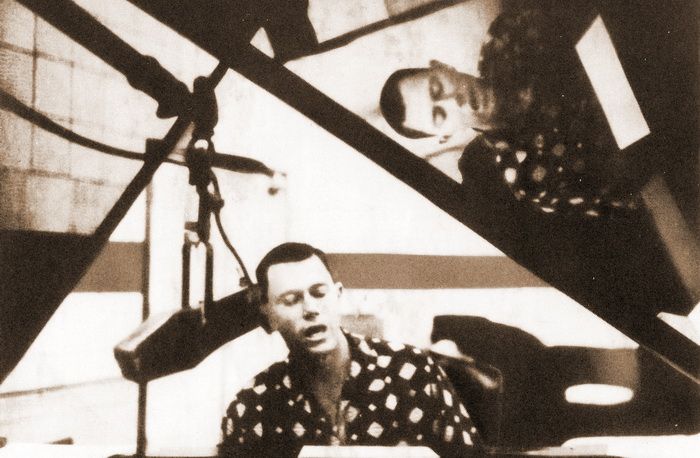
Paul Smith
The jazz pianist Paul Smith, also a versatile composer and arranger and a prolific sideman, died at 91. To be honest, I didn't know he was still alive.

The Los Angeles Times reported his passing and added that the man had worked with "such greats as Bing Crosby, Nat 'King' Cole and Dizzy Gillespie...Smith began studying classical piano when he was 8 and joined a professional band in his teens. Over a long career, he recorded more than five dozen albums with his own groups and accompanied many performers, including Sammy Davis Jr., Ella Fitzgerald, Doris Day and the Andrews Sisters. Smith also arranged and performed TV and movie scores as a studio musician. He spent more than 25 years as pianist and music director for The Steve Allen Comedy Hour."

Nearly 60 years ago, Paul Smith who contrasted his size (six-foot-four, over two hundred pounds) with an "extremely deft and delicate touch at the piano," was introduced in the liner notes of one of his early recordings as "a brilliant young pianist who plays classics, 'pop' tunes, and modern jazz with equal facility, and as a result is one most sought after studio musicians in Hollywood. In past years he's been both performer and arranger with leading dance bands and musical groups throughout the country."

Monday, July 1, 2013

Jazz Mirrors Iran#5: Strictly for the Persians


For my fifth installment in Jazz Mirrors Iran, I'll look at a tune from a third country in which the secretive consociation between the American art form and Persian culture took place: France.


If you were in Paris during the cold winter of 1941, walking by the Seine and watching the German barracks, you could whistle a beautiful tune by Alix Combelle Orchestra, a song ironically called Strictement pour les Persans, or in English, Strictly for the Persians. 

Strictement Pour Les Persans (Strictly for Persians) - Alix Combelle Orchestra

Paris’ underground resistance did not stay paralyzed for too long. To write the French off as cowards or conceding would be dismissive and inaccurate. A Parisian writer at the time was “incapable of surviving for long hiding, he would sell his soul to see his name in print,” silenced essayist Jean Guehenno observed. “He believes that he is French literature and thought and that they will die without him.” Satre himself had stated that artists and writers had a duty to tell the rest of France “not to be ruled by Germans.”

We all know that jazz played a significant role in uniting African-Americans under the oppressive Jim Crow laws. In Paris of 1941, even as a borrowed art form, it still manifested the self-empowerment to create a nationalistic identity at a point where the country was already fractured into rubble. Before the Nazi invasion of France, when news of an eventual war reached Paris, many African-American expatriate musicians left to return to the United States. Their sudden departure left the active French jazz scene on its own, and club owners found themselves without any entertainers or live music to supply the demand of tasteful customers.
Tuesday, June 18, 2013

5 Favorite Jazz Films, Illustrated

Jazz on a Summer's Day
Me and my super-talented friend Naiel Ibarrola have our five favorite jazz films on display on Keyframe in graphic form. Apart from drawing the key characters and musicians related to that particular film, each illustration is devoted to exploring major concept in films about jazz. The colors used allude to how each musician sounds and how those films feel, and frames within the frame, more or less, reflect the filmmaker’s very specific way of handling the compositions or the overall feeling of the film in terms of mise-en-scène and narrative. That’s why Black and Tan (Dudley Murphy, 1929) is made out of one big extensive frame and much abstract and transforming content within it, whereas All Night Long (Basil Dearden, 1962) features eight classically structured frames within the bigger picture, all in accordance with this Shakespearean story told in jazz and its unity of time and space. Some of the concepts regarding jazz and film in these illustrations have been discussed before in my chat to Jonathan Rosenbaum here.

Sunday, June 16, 2013

Jazz Mirrors Iran#4: An American in Tehran

photo by Reza Hakimi
In the fourth installment of my ten-week series exploring Iran through the world of jazz, I've looked at Iranian music through the melodies of one its most dedicated ambassadors: Lloyd Miller.

Lloyd Miller is no typical fan boy. If there’s one thing to know about him, it’s that he doesn’t like mainstream music, likely most of the stuff on your iPod. Groupie he is not, calling most of today’s new hits “jumpy ugly obnoxious rock junk that has permeated the whole world like leprosy destroying everyone’s musical tastes and minds.” You could write him off as an aging music snob, but then you’d be missing out on one of the edgiest pioneers in building the musical bridge between East and West.


                                  Segah – Lloyd Miller                                 

If there’s a more important thing to know about Lloyd Miller, it’s his love of Persian music. Born in 1938 to a ballet dancer and a professional clarinetist, he began learning piano at the age of three. By his early teens, he taught himself banjo, clarinet and cornet. There is scarcely a single instrument today that he hasn’t mastered or at least experimented. In 1957 his father, now a professor at the University of Southern California, was invited to Iran in order to oversee the creation of University of Tehran’s business school. Nineteen-year-old Lloyd, already a staple in the American jazz scene, came along, mostly so that his parents could keep him away from a drug culture that permeated into many music circles. Miller himself looked at the trip as a spiritual quest, searching for a new musical language that he found partially in traditional jazz and the more modern Bop, but still felt incomplete.

Monday, June 3, 2013

Jazz Mirrors Iran#3: Iranic

Vank Cathedral in Iran [photo by Reza Hakiminejad]

Two weeks ago I began a ten-week series (that now I might extend it to 12!) exploring jazz that reflects a part of Iran, both as an actual place on the map and as a pure creation of art. This is Iran according to American and European jazz musicians of the 20th century. In the third installment, I look at the "ironies" shared between a culture and a musical form.

From the Shahs of Sunset to the Mullahs of Qom, Iran stands a Catch-22 waddling to find its way between Bravo and Basij, Marxist and Muslim, youth and establishment, sincerity and tar’ruf. Sound confusing? Welcome to Irani irony, a culture where expectations are implied but never stated, perhaps the only one where you’ll find yourself politely chastised. To navigate in it is an improvisational act of its own, an interplay where actions depend on relational anticipation. This is the game of Persian life.

.                         Iranic by Jimmy Giuffre                        .        

The emergence of free-form jazz in the 1950s, pioneered amongst others by composer and multi-instrumentalist Jimmy Giuffre, was no less a paradox than the musical form's emergence itself, challenging the limitations of established bebop, hard bop and modal, breaking down standards that characterized traditional jazz. Where bebop treated musicians as interpreters, free jazz placed them at the forefront as the tune's dominant voice. Framework from jazz charts gave way to improvisation. Professionals, in their experimentation came off to the naked ear as amateurish, as if they were students doing their best to sound good. Not so confident to play constantly and seamlessly, they pause, wait, look at each other, and think deeply for what they should play for the next chorus.

Monday, May 27, 2013

Jazz Mirrors Iran#2: Persian Rug


Last week, I began a ten-week series exploring jazz that reflects a part of Iran, both as an actual place on the map and as a pure creation of art. This is Iran according to American and European artists of the 20th century. It is also the same country that makes daily headlines in the news, yet it is music that brings it a far greater truth than any pundit on a TV screen. In the second installment of this ten-week series exploring Iran through the world of jazz, let's gaze our eyes down to the magnificent floor coverings that inspired the classic jazz standard tune.

Iran as a country has long been a contested commodity in the modern era, its politics so pervasive, hardly a piece of artwork makes it abroad without some sort of oppositional branding -- the mere fact that it comes from Iran automatically makes it a piece of creative dissidence. The one medium that manages to evade any type of political baggage is not the artwork we hang on our walls, but the adorned canvas we lay out on our floors --Persia’s rugs. Like Iran’s version of Wall Street, these carpets, often called an Iranian’s stock or share, are more than a hypnosis of vivid colors and mesmerizing patterns: they’re a woven record of a country and civilization dating back over 2,500 years, and for most Iranians, a first encounter with the visual blueprints that we come to associate as art.
Three versions of Persian Rug which I'm going to discuss later