 |
| photo by Reza Hakiminejad |
Imagine this: A tenor saxophone and bass mimic in sound the pace of rush hour walkers. A trumpet, sounding like a car horn, pops in and out, pulsating along with the beat of the drummer, whose brushes on the snare create an interplay that brings to life the image of a bustling urban city.
No cobblestone streets or the smell of Parisian bread; no green leaves overhanging narrow passageways or the sound of French in the background. This is not Europe. It’s Iran that is being depicted in cool jazz tones.
Each Monday for the next ten weeks I will feature a jazz tune that reflects a part of Iran, both as an actual place on the map and as a pure creation of art. This is Iran according to American (or non-American) artists in the 20th century. It is the same country that makes daily news headlines, but thanks to the masters of misinformation in the media, the more that is heard, the less that is learned.
Teheran- Friedrich Gulda
Tehran, sometimes spelled in French or German as Teheran, is a metropolis of 8.5 million people and the capital city of Iran. Witnessing many changes in the past 150 years, it was, and still is, a gigantic mechanism dealing with endless urban issues. Tehranis, sharp and open, and culturally closer to the people of those capital cities of the Eastern Europe, have two simultaneous battles to fight: one, to find a way out of the maddening traffic of the highways and streets of Tehran, and then, to find ways of expressing their social and political dissatisfaction in some creative and subversive ways.
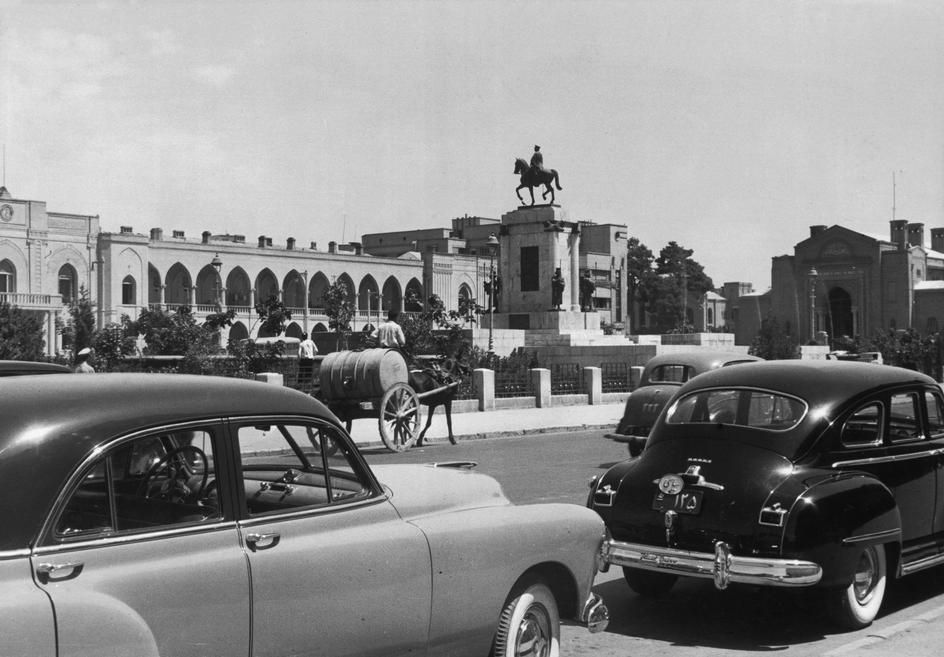
But in spite of millions of dramas in the city, Tehran was never a source of inspiration for composing music as much as it should have been. Art in the 1950s fell short of giving Iran justice. The image of Iran of 1956, three years after an American- and British-led coup overthrew the legitimate, democratic government of Dr. Mohammad Mossadegh, should have been the image of a modernized country, an adequate answer to the imagined Middle East of the West. This only perpetuated the fables of Hollywood.
For years, I thought the jazz world totally overlooked Tehran. My search showed no fascination with the city, while some big names of jazz have been guests of Tehran since 1950s, from Duke Ellington to Harry Sweets Edison. That disappointment ended when I discovered an album from, at least to me, an unknown jazz musician. I wasn’t completely wrong. He wasn’t a jazz musician, but a highly respected Austrian classical pianist: Friedrich Gulda. The Decca album of the live gig at Birdland café in New York City was a showcase for Gulda, in his first officially recorded jazz session in the US. And that’s when I discovered a swinging, vibrant picture of Tehran in a Gulda’s original, Teheran.
 |
| Friedrich Gulda playing flute |
It opens with the alarming notes of Seldon Powell on tenor saxophone, in the form of call-and-response between the tenor and the rest of the horns and reeds. Trombone plays a beautiful bridge and then the whole group starts to swing. Powell proceeds, and then Phil Woods follows him. After Woods, comes the time for Gulda and his energetic solo on piano.
Music pictures a busy day in Tehran. The horn-like sound of the opening bars is like the roar of the cars, rolling into streets of Tehran on a typical and already bustling morning. Movements in the streets, squares, pedestrians hurrying to work, buses overcrowded, and cabs crossing the red lights can be heard in Teheran. Somehow it reminds the listener of Miles Davis’s Move (a Denzel Best composition), from the Birth of the Cool sessions, where the same exuberant feeling is delivered by Miles Davis Nonet.
Teheran is recorded with a relatively small group, but Gulda’s imaginative writing has given the sound of a big band to the music. The powerful textures and the vibratoless tonality of it can be seen as a bridge between the classical roots of Gulda with a Cool sound of the 1950s America.
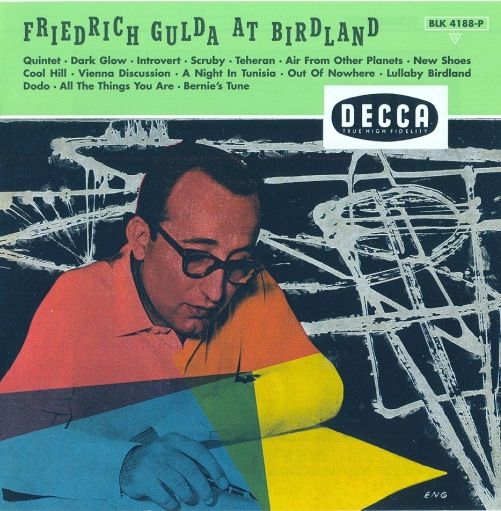
But how did Gulda capture Tehran so vividly in his tune? Did he ever travel to Iran? These questions kept me busy inquiring for a while, till the answer came from Paul Gulda, the son of late Friedrich, who wrote me in February 2012:
"Sadly, as far as your question goes, there is little I can tell you. No, my father has never been to Teheran or any other Iranian city, nor India, or any Arab country. Why he would choose the title Teheran for his composition, one out of twelve he prepared for his ‘true American Jazz debut’ at Birdland, eludes me. As you mention, Isfahan [Ellington/Strayhorn composition], might have had something to do with it, although so different in mood. But there is a slight similarity in the little motive shaped with two 16th-notes and a longer one succeeding it forms the background."
"Also, my father was very fond of Dizzy Gillespie´s tune A night in Tunisia. What I can tell you is that my father had an almost lifelong fascination with the common ground shared by flamenco music, some of baroque music and Arab music, which resulted in him inviting both flamenco musicians and a group from Tunis to his festival in Ossiach, Austria in 1969/1971. This came to a culmination when he got into contact with Oud master Mounir Bashir around 1975, they repeatedly appeared on stage together in the following years and there is a recording of two duets they played at another festival designed by my father, Salzburg World Music Days, 1979."The answer wasn’t what I expected to hear, but it is the truth.
Richard Cook, in his encyclopedia of jazz, writes: “[Gulda] seems like a genuine pioneer, whose music has sometimes been sniffily dismissed on the tedious and fallacious ground of being too European and unswinging.” Listening to Teheran, we know this can’t be true, and further explorations on YouTube will reveal, as Cook says, “his music deserves a full reappraisal.”
.

No comments:
Post a Comment