Saturday, July 31, 2010

Wendell Marshall


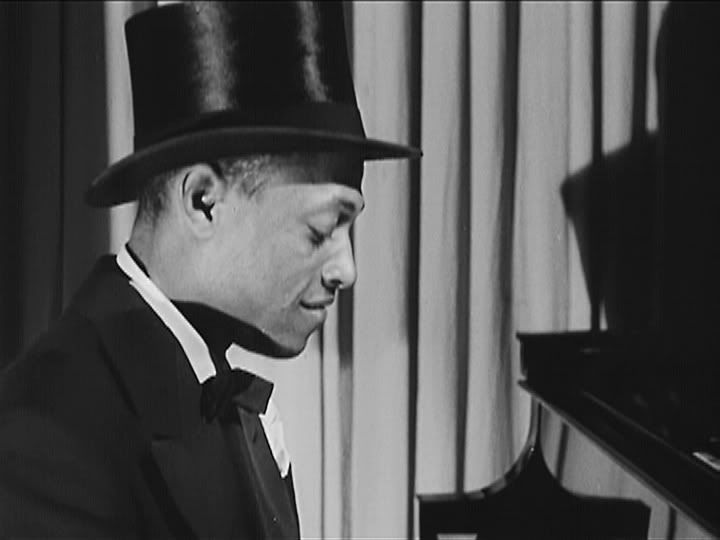
In memory of Wendell Marshall, first cousin of legendary Jimmy Blanton, and like him bassist of Duke Ellington Orchestra from September 1948 to January 1955.

.

Friday, July 30, 2010

Bunky's Body & Soul

Eddie Haywood In Dark Corner

Eddie Haywood in a shot from Henry Hathaway's classic film noir, The Dark Corner (1946), starring Lucille Ball. He and his orchestra, which are not showed in the nightclub sequence, play Heywood's blues. At the time of making the film, The Eddie Heywood Sextet was very popular, playing melodic and tightly arranged versions of swing standards. His version of Begin the Beguine became a hit, and three years of strong success followed. During 1947-50, Heywood was stricken with a partial paralysis of his hands and could not play at all. He made a gradual comeback in the 1950s, mostly performing commercial music in addition to composing the standard "Canadian Sunset." Despite a second attack of paralysis in the late '60s, Eddie Heywood continued performing into the 1980s.
Also in another scene from this film, The Mooche is playing in the radio, when William Bendix is trying to find a hideout in Mark Stevens's apartment.
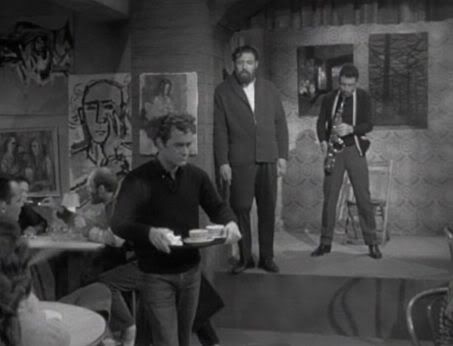

And finally A Bucket Of Blood (1959), Roger Corman's ultra-low-budget, and mini-masterpiece, about creating masterpieces, with a Fred Katz score and an appearance of Paul Horn in the opening sequence. He's playing a beatnik saxophonist in a typical west coast junky-intellectual joint. Music is bad, but what is good about this film is the way Corman shows us that anything bad could be so good in telling us a part - a big part - of the truth.

Wednesday, July 28, 2010

Classics 668: Jelly Roll Morton 1939-40
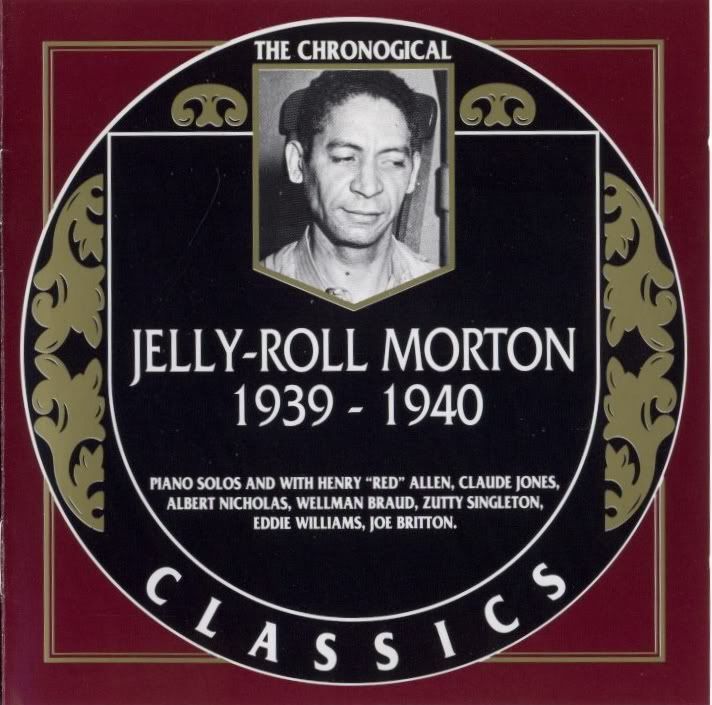

Classics 668
Jelly Roll Morton 1939-1940
Release Date
: 1996
Rating: B

Other notable musicians in this CD: Henry "Red" Allen, Albert Nicholas, Zutty Singleton
Label(s): General, Commodore
Number of sessions: 6
Unissued materials: none
Track Highlights: The Crave, Big Lip Blues.
Other issue or reissues: Last Sessions: Complete General Recordings (Commodore CMD 14032)

About the period:
Jelly Roll's health was poor. His pockets empty. His belly loaded with whiskey. He was dyin'.
"Ashes to ashes and dust to dust,
If the women don't get you, the whiskey must!"

The Album:
Jelly Roll's last recordings for General label. "I have a subject of mutual benefit to discuss with you," wrote Jelly to Charles Smith. General Records had asked Jelly for an album of the old New Orleans favorites. "Jelly was extremely ill," writes Mr. Smith, "and we used as many as four waxes on certain sides." The stand-out side, of course, was Mamies Blues, which, everyone agreed, was not "commercial." Nevertheless it has kept the album in print ever since, and has been called the most beautiful of all jazz piano records. When General went on to make some "commercials" with a swing band composed of Henry Allen trumpet, Joe Britten trombone, Albert Nicholas clarinet, Eddie Williams alto sax, Welman Braud bass, Zutie Singleton drams, and Jelly Roll piano, the records died fast.

The set starts with The Crave, one of those melancholic moments of Jelly Roll, a great combination of poetry and piano. Then comes The Naked Dance , a stride/ragtime kind of fast tempo solo on keyboards, executed perfectly by Morton.There is Buddy Bolden's Blues, an homage to trumpet master of New Orleans and we can add it to the small catalog of jazz tributes to Bolden like Hey, Buddy Bolden in Ellington's The Drum is a Woman LP, and also a reinterpretation of Ellington piece by Nina Simone. Again, Jelly Roll's Thought I Heard Buddy Bolden Say and Sidney Buddy Bolden Stomp and Buddy Bolden Story.

After you listened to superb trumpet solo of "Red" Allen on Big Lip Blues, then dig Mamie's Blues. "This is the first blues I ever heard in my life," that's Jelly's own introduction to the tune.

As Spring of 1941 came to Los Angeles, Jerry Roll's death came along and closed and locked the keyboard. He was in the middle of planning his next recording session of New Orleans music, but that was the end.

--Ehsan Khoshbakht

Listen to The Crave, 1939:


Details:


Jelly Roll Morton
Solo
New York. December 14, 1939

R-2562 The Crave
R-2563 The Naked Dance
R-2564 Mister Joe
R-2565 King Porter Stomp
R-2566 Winin' Boy Blues

Jelly Roll Morton
Solo
New York. December 16, 1939

R-2570 Buddy Bolden's Blues
R-2571 The Naked Dance
R-2572 Don't You Leave Me Here
R-2573 Mamie's Blues

Jelly Roll Morton
Solo
New York. December 18, 1939

R-2579 Michigan Water Blues

Jelly-Roll Morton's Seven
Jelly-Roll Morton (p,voc)/Henry "Red" Allen(t)/Joe Britton(tb)/Albert Nicholas(cl)/Eddie Williams(altosax)/Wellman Braud(b)/Zuny Singleton(d).
New York, January 4, 1940

R-2582 Sweet Substitute
R-2583 Panama
R-2584 Good Old New York
R-2585 Big Lip Blues


Jelly-Roll Morton Six
Jelly-Roll Morton (p,voc)/Henry "Red" Allen(t)/Albert Nicholas(cl)/Eddie Williams(altosax)/Wellman Braud(b)/Zuny Singleton(d).
New York, January 23, 1940

R-2621 Why?
R-2622 Get me Bucket
R-2623 If I Knew
R-2624 Shake It

The Morton Seven
Jelly-Roll Morton (p,voc)/Henry "Red" Allen(t)/Claude Jones(tb)/Albert Nicholas(cl)/Eddie Williams(altosax)/Wellman Braud(b)/Zuny Singleton(d).
New York, January 30, 1940

R-2632 Dirty, Dirty, Dirty
R-2633 Swinging The Elks
R-2634 Mama's Cot A Baby
R-2635 My Home is in a Southern Town


Total Time: 62 mins. (approximately)

Sunday, July 25, 2010

William Gottlieb's Jazz Photos, Part 6: Ray McKinley
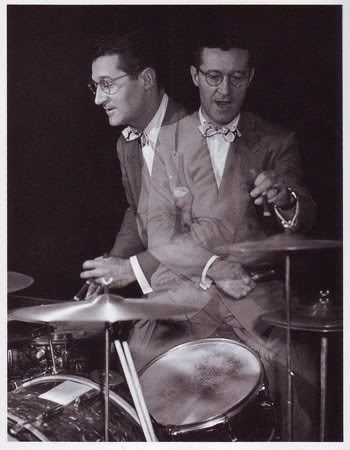

Ray McKinley (1910–95) got his start working with local bands in the Dallas–Fort Worth area, before joining Smith Ballew in 1929, when he met Glenn Miller. The two formed a friendship which lasted from 1929 until Miller's death in 1944. McKinley and Miller joined the Dorsey Brothers in 1934. Miller left for Ray Noble in December 1934, while McKinley remained. The Dorsey Brothers band became Jimmy's after Tommy left and formed his own band in 1935.McKinley remained with Jimmy until 1939, when he joined Will Bradley, becoming co-leader. McKinley and Bradley split in 1942 and McKinley formed his own band, which recorded for Capitol Records. The McKinley band was short-lived. When McKinley broke up the band, he joined Glenn Miller's Army Air Force band, which he co-led with arranger Jerry Gray after Miller's disappearance in December 1944. Upon being discharged at the end of the following year, McKinley formed an excellent, remarkably modern big band that featured a book of original material by legendary arranger Eddie Sauter. But with the business in decline, by 1950 that band was history and McKinley began evolving into a part-time leader and sometime radio and TV personality. In 1956, capitalizing on the popularity of the Glenn Miller Story movie with James Stewart, McKinley was chosen to be the leader of the revived Glenn Miller band, which he led until 1966. He co-hosted (with former Air Force band vocalist Johnny Desmond) a 13-week CBS-TV summer series with the band on CBS-TV in 1961. (from Wikipedia)

Friday, July 23, 2010

Till The Butcher Cut Him Down
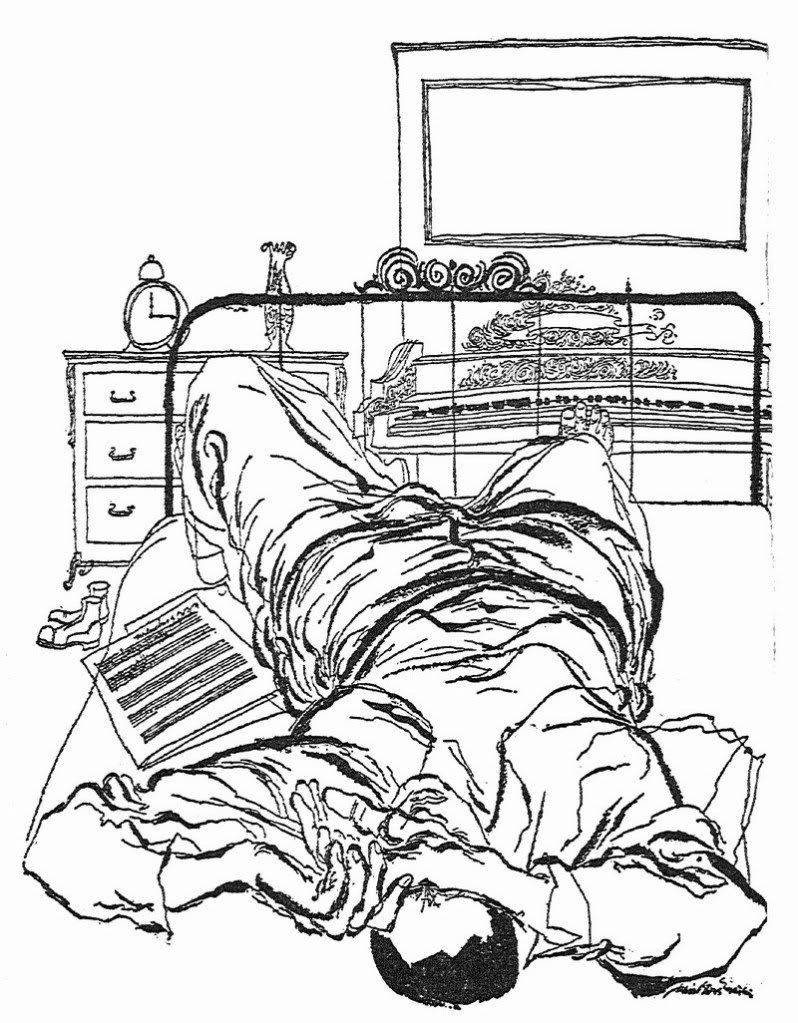

Today's one of those long, melancholic days. I'm listening to Jelly Roll Morton's last recordings and going through Alan Lomax'es notes, while the poet/pianist is singing:

"He rambled.
He rambled,
He rambled till the butcher cut him down, .. ."


DOWNBEAT LOS ANGELES
AUGUST 1, 1941
BURY JELLY ROLL MORTON ON COAST

Los Angeles A solemn, high requiem mass, performed at St. Patrick's Church with the full dignity of the Roman Catholic ritual, followed by burial at Calvary Cemetery was the world's parting gesture to Ferdinand "Jelly Roll" Morton, who died here at Los Angeles hospital July 10 of heart trouble and asthma.

One white man was among the approximately one hundred and fifty people who attended the church service and accompanied the funeral procession to the cemetery - Dave Stuart of the Jazz Man Record Shop.

THE CONSPICUOUSLY ABSENT

Notably absent from the funeral of the man who did so much to bring jazz out of the honkey tonks and dives of New Orleans were two o the most successful black bandleaders of the days Duke Ellington and Jimmie Lunceford. Ellington is appearing at the Mayan Theatre here in a stage revue and Lunceford is at the Casa Manana.

Among those present were the members of what was probably the first black jazz band to make phonograph recordings - pioneers of jazz saying goodbye to one of their valiant gang musicians who played from the heart because they never learned any other way to play.

Reb Spikes, Jelly's old song-writing partner, didn't have a car and almost didn't get to the cemetery. Dave Stuart saw that Reb was about to get left behind and took him out in his car,"Sure appreciated that," said Reb. "Wanted to go as far as I could with Jelly."

Thursday, July 22, 2010

Portrait of the Artist (Bob Brookmeyer, 1959)


Nat Hentoff Liner Notes for Bob Brookmeyer's Portrait of the Artist

Robert Brookmeyer is tall, lean, sardonic, epigrammatic, and utterly serious about music, if not always about himself. He has become recognized as one of the most expressive trombonists in jazz history. It is his not only that he plays the valve trombone with remarkable facility, but rather it is his imagination, intensity and cutting wit that make him an authentic jazz individualist. Although he is very much his own man, Brookmeyer reminds me of the harmonic taste and venturesomeness of the late Brad Gowans, the shaggy dog narrative humor of Vic Dickenson, and the urgency of Jimmy Harrison. I do not mean that he has necessarily been directly influenced by these men, but I do mean that he has a largeness of spirit and musicianship that these three shared.

This album, however, finally underlines another aspect of Brookmeyer – his writing and arranging. The only man in jazz who is more self-deprecatory than Brookmeyer is Pee Wee Russell, who is introvertedly similar to Bob in other areas of temperament. Characteristically, therefore, Brookmeyer terms himself an arranger rather than a composer and mutters that he does not consider himself in the same league as the more acknowledged jazz “composers.”

Let us hear. First there is the Blues Suite, which takes all the first side of the album. The work was written in February and March of 1959 and is Brookmeyer’s first large-scale jazz composition. “The piece,” he points out, “is very simple. There are no complicated transitions from one movement to the other. It is as long as it is only because that was the space I needed to develop what I had to say.” The work reflects Brookmeyer’s long-term involvement in the blues as well as his lack of rigidity, as both a composer and player, in addition to what he terms his occasional predilection for whimsy. I have been surprised when critics keen about the relative lack of humor in modern jazz and then overlook Brookmeyer. He is, in a way, the Krazy Kat of our time and like the mouse in the Herriman cartoons who kept conking the canine police official with a brick, Brookmeyer’s humor is of the loving kind.

The brief introduction is anchored on four help notes and presents in fragmentary form some of what is to come. The first movement is essentially constructed in elongated a-b-a song form. Note the melodic inevitability of the theme. Brookmeyer is one of the relatively few jazz writers who are actually melodists. There are touches of Ellington in the way the melody falls and in the voicings, particularly the reeds. The influences on the Brookmeyer piano, which is heard extensively and pungently in the work, are several. That includes Thelonious Monk, Jelly Roll Morton, Count Basie, certainly Duke Ellington, Fats Waller, and most recently, Bill Evans.

In this first movement, his piano is both rhythmically incisive and thematically, a connective protagonist. The atmosphere is remarkably relaxed, with the development unfolding with organic, sensuous ease.

The second movement, with its train-like, Monkish introduction is episodic. I cannot resist noting that the “jazz” Henry Mancini thinks he is writing for Peter Gunn is unwittingly a parody of the form and spirit Brookmeyer delineates here. The trumpet solo is by Ernie Royal. The movement continues with a thrusting urgency that has overtones of ominousness.

The third movement is whimsical. “Just a jump tune,” says Brookmeyer. The bursting tenor is Al Cohn, a musician of such consistency that he has for too long been taken for granted by a jazz audience ceaselessly hunting the “new.” Brookmeyer’s piano solo following Cohn has elements of Duke in its spare, propulsive economy. The fourth movement, like the first, is basically in a a-b-a song form. I am much struck by the rocking melody, which has a folk quality not unlike the themes Aaron Copland used in Appalachian Spring. Brookmeyer’s solo and the brass guar he has chosen for himself are rugged and yet lyrical and underline Brookmeyer’s key skill – a feeling for drama, or, as he puts it later, “mellow drama.”

Brookmeyer’s treatment of Duke Ellington’s It Don’t Mean A Thing (If It Ain’t Got That Swing) begins like the founding of Rome, and then Brookmeyer plungers into the marrow of the message. If there is indeed a vocalized essence of jazz instrumental playing – and I believe there is – it is pungently projected in Brookmeyer’s solo. The first trumpet solo is by the crisp, underestimated Nick Travis. The second burst is by Ernie Royal. The driving alto saxophonist is Gene Quill, currently an enlivening member of the Gerry Mulligan big band.

Mellow Drama is a long ballad composition. The mood is dark and the message would not have been unfamiliar to Edgar Allan Poe. The incisively fresh interpretation Out of Nowhere is brisker and is introduced by Brookmeyer. Gene Quill explodes on alto, and the blaring trumpet solo is by Ray Copeland. The concluding Darn That Dream is broodingly lyrical. The urgent, muted trumpet solo is by Ray Copeland and the open-hearted sequel is by Irving “Marky” Markowitz.

This album, I hope, will aid considerably in the re-evaluation of the Ambrose Bierce of the trombonists. Brookmeyer has the capacity to be one of the most ecbt of all jazz writers. The Blues Suite, for instance, is stripped clean of frills. It is a thoroughly unpretentious, but deeply felt piece. Similarly, the other arrangements are vigorously personal, often sharply edged in their humor, and always logically developed.

After a term of commercial writing in New York, Brookmeyer is now a key member of the Gerry Mulligan band. He has become one of that unit’s most enthusiastic writers and one of its most invaluable soloists. As this album indicates, Brookmeyer has a good deal to say as a writer, and he says it with trenchant economy and directness. This is indeed a Portrait Of The Artist as sketched by himself.
-- Nat Hentoff

Tuesday, July 20, 2010

Shades of Redd (Freddie Redd, 1960)


Nat Hentoff Liner Notes for Freddie Redd’s Shades of Redd (1960)


Since his emergence as com­poser of the score for Jack Gelber's harrowingly exact play, The Connection (Blue Note 4027), Freddie Redd has finally been gaining some of the recognition that has eluded him for much of his playing career. Freddie also plays the taciturn pianist in the play with convincing effect. Although he hopes to work again in the theatre, Freddie remains essen­tially a jazz player-writer, and this album underlines his growth as a composer of vigorously expressive jazz originals.
Freddie has been writing since he started playing. In both disciplines, he is largely self-taught. Born in New York, May 29, 1928, Freddie came of a moderately musical family. His mother sang in church, and still does; and his father, who died when Freddie was not yet a year old, had played piano.

Unlike most professional jazzmen, Freddie didn't take up an instrument until quite late in his teens. Around 1946, when he was in the Army, Freddie began to pick up the piano on his own. After being discharged, he studied for a month at the Greenwich House Music School in New York, but he became so proficient through his own investigations that he left school to take his first professional job, a jazz gig in Syracuse. With him, by the way, was tenor saxophon­ist Tina Brooks. After Syracuse, he free­lanced in Harlem, especially in a sit-in room called Club Harlem where pay was small but the chance to learn before an audi­ence and other musicians was extensive. Meanwhile, he was absorbing a number of influ­ences. The first jazz record he recalls having had a sharp impact on him was the Charlie Parker-Dizzy Gillespie Shaw 'Nuff to which he was exposed in the Army. Later, Freddie heard Bud Powell. "Bud really got me started. I'd never heard a pianist play quite like that — the remarkably fluent single lines and the pretty chords. In time, Thelonious Monk got to me, too. Actually, however, I've been influenced by many things I've heard on a lot of instru­ments. What I do is try to piece together what stimulates me into my own way of feeling things musically."

By 1953, Freddie had joined Cootie Williams and spent an exacerbating year traveling mostly through the South. Back in New York, Freddie started working with vibist Joe Roland and began to be heard quite often at Birdland’s informal Monday night sessions. In 1954, Freddie was with Art Blakey, and then for a time, he seemed to have disappeared. He turned up in Sweden on a tour with Rolf Ericson, joined Charlie Mingus's Jazz Workshop in 1956, and when Mingus went to the coast, Freddie left the band there. He was based in San Francisco for six months, and returned to New York where he did some recording, but was inactive on the club scene.

After several years of scuffling, the chance came to write the music for and appear in The Connection. Freddie has been at the Living Theatre on Sixth Avenue ever since. He doesn't find the long run dull since "something different happens every night,” but he would like to form his own group and go back into the clubs. He was particularly anxious to work out some of his ideas on how jazz writing and playing can be productively inter-related in this album, and the result, he feels, has given him more confidence than any experience since his scoring of The Connection. Freddie's long association with the play had led to his being dubbed "The Thespian" by Joe Termini, the owner of The Jazz Gallery and The Five Spot in New York, and Freddie chose the nickname for the title of the opening tune. On tenor is another thespian, Tina Brooks (whose own album, True Blue, is on Blue Note 4041). Brooks is Jackie McLean's understudy in The Connection. Born in Fayetteville, North Carolina, he's been based in New York since he was thirteen. After apprenticeships in rhythm and blues bands, he worked with Lionel Hampton, Benny Harris, and several combos. Freddie notes that Tina "creates his lines not only with a lot of lyricism but with real depth." The third thespian, Jackie Mclean, indicated in The Connection that he could successfully explore an acting career were he not so committed to jazz. In any case, we have here a unique front line of actor-musicians. This sketch of a "Thespian” begins with a broodingly lyrical line which has a Monkish touch. It suddenly quickens in tempo and intensity. Mclean breaks out in a brisk gallop, followed by Tina. Like Jackie, Tina plays with that unmistakable "cry" that is the emotional insignia of the echt jazzman. Freddie Redd's style is energetic and assertive, and communicates an urgent authority. "Blues-Blues-Blues" is obviously titled because of its undiluted blues spirit. Tina’s tone, incidentally, is particularly penetrating and accordingly, it strikes with concentrated force. McLean is again a compelling soloist. His tone too demands attention because of the strength of emotion it contains. The line of "Blues-Blues-Blues" has an unforced traditional feeling although it ends, like much in contemporary life, in mid-air.

"Shadows” has a provocatively twilite mood which accounts for its title. The tune emphasizes Freddie’s predilection for tenderly introspective ballads. Both reedmen are aptly lyrical with Brooks building considerable tension throughout a solo that is well organized and quite deeply felt. Freddie manages to play with his usual force and yet convey the soft loneliness of the tune. Similarly, Paul Chambers has a beautifully shaded statement before the final ensemble and the slowly unwinding theme. "Melanie" is named after the newborn baby of a friend of the composer. “It sounded happy to me,” says Freddie, “and that’s why I thought it fitted a child." Moreover, it has the kind of bouncing beat and line that children, as I can attest from watching mine, like to move freely to in what they regard as dancing. Paul has a warm, rhythmically supple solo and the hornmen speak with unstrained ardor.
Freddie first thought of "Swift" in two, and when he changed it into four, he realized how really swift it was. At the session, when he beat off the tempo, the hornmen looked at him quizzically, but as it turned out, they met the non-stop challenge, and there is an air of triumph in the final ensemble strut. "Just a Ballad for My Baby” is an unabashedly romantic tribute to a young lady. All hands seem to understand the caressing ode. "Ole" is a composition with a tangy Spanish tinge. Note the steadily tasteful, resourceful drumming of Louis Hayes – formerly with Horace Silver and now with Cannonball Adderley – both here and throughout the album.

Shades of Redd, in summary, is part of the continuing self portrait Freddie Redd is developing as a jazz performer-writer. The colors are all of the jazz language, and the mixer has made them reflect his own unique view of life on and off the stand.


-- Nat Hentoff

Saturday, July 3, 2010

Benny Carter: Doozy!
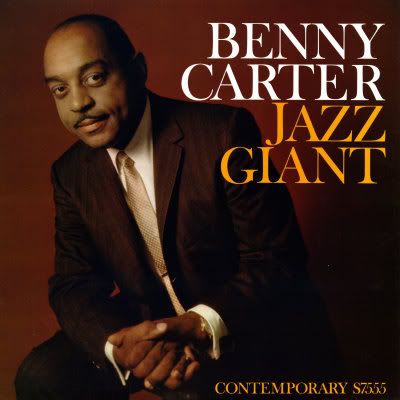


Notes from my jazzy uncle, Ali-Reza Poodat:


Speaking of Benny Carter, Norman Granz mentioned once that his all-time friend Frog [Ben Webster] gave the nickname to the king. As far as musicianship and composing and arranging is concerned, the king is a real monarch. As far as humanity is concerned I suffice to remind the words of Jimmy Rowles another lifetime pal of Benny: “he is the gentleman par excellence. A perfect friend. A man of all seasons and for all seasons.” I have never heard or read of so much modesty and humbleness by a musician of his caliber. In 1987 in an interview with the artistic director of the “American jazz orchestra”, Gary Giddins, he gave a typical answer to a question that was concerned with his influence in the field of the development of the alto sax:

Q: You are not conscious of a Benny Carter style?
A: No. I am not. I’ve always felt that was one reason for the failure of my orchestra... I don’t know... if I have made a contribution I would be very happy to know that. No, I don’t know and I’m not being modest, I really don’t know. Contribution to what- to my livelihood?

Q: Were you aware of the fact that you and Hodges seemed to be emerging as the major voices in jazz alto at the same time?
A: no, I didn’t think about it.

Q: Does that evaluation, which is standard jazz history, seem accurate to you in retrospect?
A: well, I don’t know. You see, there were many saxophone players that I heard in those days that I never hear about now, and nobody else hears about, and you wouldn’t know their names if they were mentioned, because they didn’t record and they were not heard by enough people.

So this is the way masters like him respond. When you come to think of it this is the same musician who’s been active as far back as 1929 and with the most fabulous orchestras of all times and has helped to bring along name musicians like Miles, Max Roach, Bud Powell, Monk and God knows how many other respectful cats of the same caliber. A man being respected by masters like Duke, Henderson, Redman, Basie, Hamp, and many alike. Julian Adderley who himself was very much influenced by carter’s style did observe: “Benny Carter could, and can, play as many notes as anyone, but he makes it look so easy.” Charlie Parker said the same thing to that effect. I can’t recall where I read or heard it, but it must have been a recorded documentary that I had on tape.
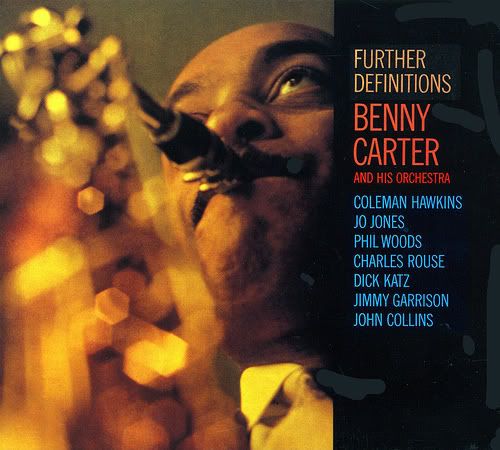
I still remember the day that I acquired a sole record of master from a friend in Iran. It was an impulse label. I guess it was the album by the title Further Definitions, of the year 1961. There was one of his masterpieces by the name of Doozy that I liked most. It became my national anthem for a long time, till tune Easy Money of the same penmanship, took its place.
Now that I’m writing these notes , it’s the time for a number like “ I still love him so” from the blessed year of 1955, a year little jazz [Roy Eldridge] and The King got together to record for Norman Granz [it is The King, 1976]. What a marvelous piano, vibes, and guitar performance by masters Flanagan, Jackson, and Pass. It’s a delight to listen to soft and easy going rhythm of these gents. Jake‘s is the most sensitive drumming in this session and so is the superb Williams’ bass. It is all reaffirmation of Cannonball’s remark: Benny makes everything so easy.